EU AI Act for Startups: What You Must Do and When

The EU AI Act applies to your startup if you place an AI system on the EU market or let people in the EU use it, wherever your company is incorporated. What you owe depends on your system’s risk category. For most startups the work is to classify the product, keep evidence that backs the classification, and prepare documentation before the first EU customer signs.
This guide is for founders, including US teams selling into Europe, who need a working picture of the rules. It covers scope, classification, obligations, dates, support for small companies and the records worth building now.
TL;DR
- The Act reaches non-EU companies that place AI systems or general-purpose AI models on the EU market, or whose systems are used in the EU.
- Classification comes first. Your obligations depend on whether your system is prohibited, high-risk, subject to transparency duties, or none of these.
- General-purpose AI obligations have applied since 2 August 2025. High-risk obligations for Annex III systems now apply from 2 December 2027, and for AI embedded in regulated products from 2 August 2028.
- Startups get priority sandbox access and simplified technical documentation, but there is no blanket exemption for small companies.
- Documentation, logs and a quality management system are the proof buyers and regulators will ask for. Start them before you need them.
Table of Contents
- What the EU AI Act is and why founders should care
- Does the Act apply to a startup outside the EU?
- How to classify your AI system
- Obligations by category
- Key dates for your roadmap
- Fines and what the Act does for small companies
- Documentation and records to prepare
- A 90-day preparation plan
- Our perspective
- Take the evidence-first route to market
- FAQ
- Sources
What the EU AI Act is and why founders should care
The Act is the first comprehensive regulation of artificial intelligence. It sets harmonized rules for developing, placing on the market and using AI systems, to protect health, safety and fundamental rights while supporting innovation, according to the European Commission’s guide to the AI Act.
For a startup it matters in three ways:
- It defines your legal responsibilities as a provider (you build or brand the system) or a deployer (you use someone else’s system in your product or operations).
- It shapes product design, because safety, transparency and oversight requirements have to be built in, not added afterward.
- It shows up in sales. Enterprise buyers in Europe increasingly ask suppliers to show how they meet the rules. We cover that angle in our piece on why traceable evidence wins startup deals under the EU AI Act.
The Commission describes the Act as innovation-friendly, with light governance structures and support measures meant to reduce the burden on SMEs and startups without lowering safety standards (European Commission).
Does the Act apply to a startup outside the EU?
Yes, if you reach the EU market. The Act applies to actors inside and outside the EU that place an AI system or general-purpose AI model on the EU market, or put an AI system into service or use it in the EU (European Commission).
Two carve-outs matter to founders:
- Research, development and prototyping before a system is released on the market are exempt.
- Systems used exclusively for military, defense or national security purposes are exempt.
So a US company with a prototype in a lab is outside the rules. The same company with a European paying customer, or an API that EU users call, is likely inside them. If you are weighing a European launch, our guide on how to expand from the US into Europe covers the market side.
How to classify your AI system
Classification is the gate every other obligation sits behind. The Act sorts systems into tiers, and you work out yours from the system’s intended purpose, not from the technology under the hood.
| Tier | What it means | Startup example |
|---|---|---|
| Prohibited | Practices banned outright under Article 5 | Manipulative systems that exploit vulnerabilities |
| High-risk | Allowed, with heavy obligations | Résumé screening, credit scoring, biometric identification |
| Transparency-triggering | Users must be told they interact with AI or see AI-generated content | Chatbots, synthetic media tools |
| General-purpose AI models | Separate obligations for model providers | Foundation model developers |
| Minimal risk | No specific obligations | Spam filters, most internal productivity tools |
Step 1: Check the prohibited practices
Prohibited practices are banned, with no compliance route (European Commission). Read Article 5 against your feature list first. A banned feature is not fixed by paperwork, only by removing it.
Step 2: Test for high-risk status
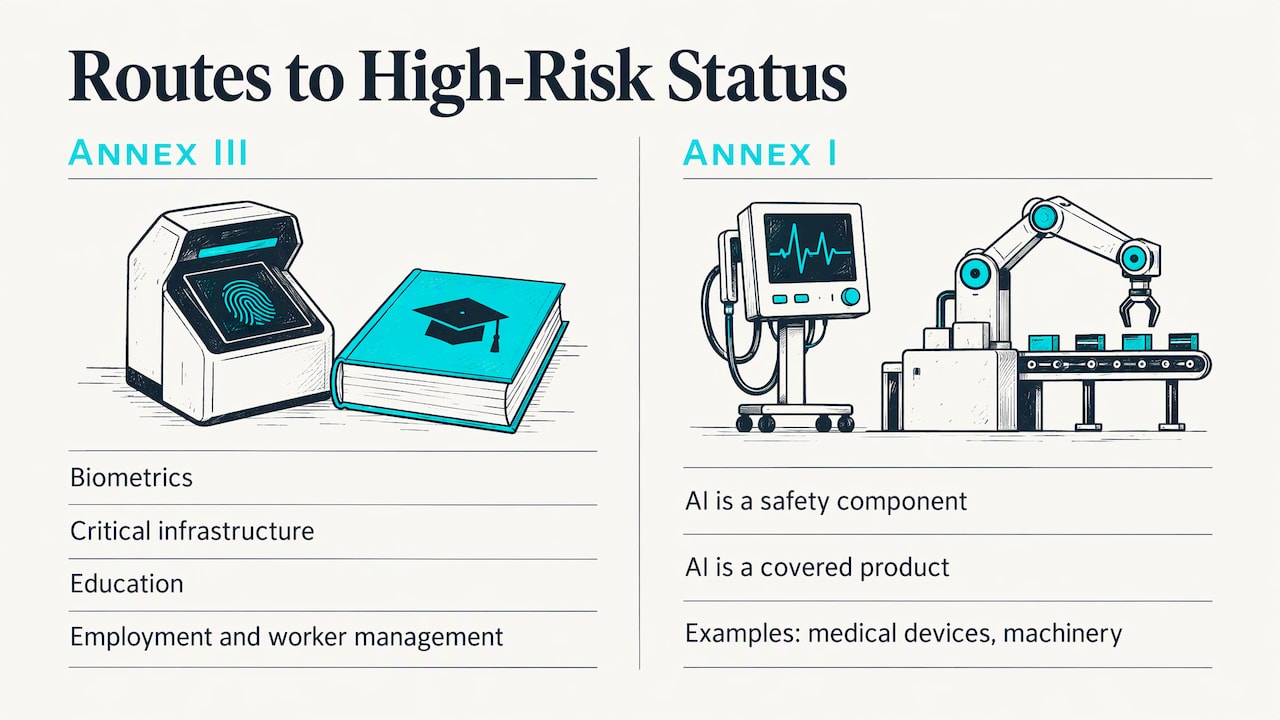
There are two routes into the high-risk tier. The first is a use case in one of the eight areas of Annex III: biometrics, critical infrastructure, education, employment and worker management, essential private and public services (including credit and insurance), law enforcement, migration and border control, and justice and democratic processes, as summarized in this classification guide. The second is AI that is a safety component of, or is itself, a product covered by the Annex I harmonization legislation, such as medical devices or machinery.
If your product sits in an Annex III area, ask whether the Article 6(3) derogation applies. It can take a system out of the high-risk tier when it does not pose a significant risk. If you rely on it, document your reasoning in writing. A one-page memo that states the intended purpose, the area considered and why the exception holds is far better than a verbal assurance.
Step 3: Check transparency duties
Certain interactive or generative systems carry transparency duties (European Commission). Article 50 rules apply from 2 August 2026, and systems placed on the market before that date have until 2 December 2026 to meet the marking and detection obligations for AI-generated content (European Commission). If your product generates text, images, audio or video, treat this as live work.
Step 4: Decide whether you are a model provider
If you train and release a general-purpose AI model, you are in a separate regime. If you build on someone else’s model, you are usually a downstream provider or deployer of an AI system, and the model provider carries the GPAI duties.
To speed this up, the Commission points startups to the AI Act Service Desk’s Compliance Checker, which indicates whether you have obligations and what to do next. Treat its output as a starting point and save the answers you gave.
Obligations by category
Prohibited and transparency-triggering systems
Prohibited practices are off the table. For transparency-triggering systems, the duty is mainly disclosure: users should know they are dealing with AI, and synthetic content should be marked in a detectable way.
High-risk systems: providers
Providers of high-risk AI systems must establish a quality management system, maintain technical documentation, perform conformity assessments and affix the CE marking, under Articles 16 and 11. The Act borrows the conformity assessment and CE marking logic from the EU’s existing product-safety framework (Commission implementation guidance).
Other provider duties include data quality, logging, human oversight, robustness and cybersecurity (European Commission). Risk management is not a one-time exercise: Article 9(2) requires a continuous, iterative process across the system’s entire lifecycle (Commission implementation guidance).
High-risk systems: deployers
If you use a high-risk system rather than build it, you still have duties. Under Article 26, deployers must:
- monitor the system;
- ensure input data is relevant and sufficiently representative where they control it;
- keep logs under their control for at least six months unless other law says otherwise;
- report serious incidents to the provider and to the relevant market surveillance authorities.
That last duty is where many startups are caught out. Reporting an incident requires logs you can trust and reconstruct from. This is the same discipline we describe in our guide to forensic readiness for cyber startups.
General-purpose AI models
Providers of GPAI models must maintain technical documentation, implement a copyright policy and publish a summary of training content. Open-source models are exempt from some documentation duties unless they present systemic risk (European Commission GPAI guidelines). You can show compliance by following an adequate code of practice or by other adequate means (same source). Models with systemic risk face additional risk-management duties.
Key dates for your roadmap
| Milestone | Date | Who is affected |
|---|---|---|
| Governance rules and GPAI obligations | Applicable since 2 August 2025 | Model providers |
| Article 50 transparency rules | Apply from 2 August 2026; marking and detection grace period to 2 December 2026 for systems already on the market | Chatbots, generative tools |
| Annex III high-risk systems | 2 December 2027 | Employment, credit, education and similar uses |
| High-risk AI in Annex I products | 2 August 2028 | AI embedded in regulated physical products |
The high-risk dates reflect adjustments made by the “AI Omnibus” (European Commission). Because the timetable has already moved once, check the Commission’s AI Act page for the current schedule before you fix a launch plan.
Fines and what the Act does for small companies
Fines are set as a percentage of global annual turnover or a fixed amount, whichever is higher, and the rules provide proportional adjustments for SMEs and startups (EUR-Lex summary). Proportional does not mean exempt. There is no size-based exemption from classification or from the Article 5 prohibitions.
The Act also gives startups practical help. According to the Commission’s implementation guidance, these include:
- priority access to regulatory sandboxes;
- dedicated information activities;
- simplified technical documentation forms.
Under Article 11, SMEs and startups may provide elements of technical documentation in a simplified manner using a form provided by the Commission. A sandbox lets you test an innovative system in a controlled environment with regulator contact, which is useful if your classification is uncertain.
Documentation and records to prepare
What do you actually put in the folder? For a high-risk provider, the list is concrete:
- Intended-purpose statement. One page, versioned, signed off by the founder and technical lead.
- Classification memo. The tests in the section above, with the answer and the reasoning for each.
- Technical documentation. Use the simplified Commission form if you qualify under Article 11.
- Risk management file. A living document updated at each release, since the process must run through the lifecycle.
- Data governance notes. Sources, quality checks and representativeness of training and input data.
- Logs. Automatic event logging with retention and integrity controls.
- Quality management system. Procedures for design, testing, change control and incident handling.
- Conformity assessment and CE marking records, completed before market release.
Log integrity is the part most teams underbuild. A log that can be edited, or that has gaps, will not help you in an incident report or a customer audit. Our guide to forensic readiness explains how to make evidence trustworthy.
The Act does not stand alone. If your product handles personal data of people in the EU, GDPR obligations for SaaS startups run in parallel. A US team can also reuse the risk work it did under the NIST AI Risk Management Framework as raw material for the Act’s risk management file, though the Act’s requirements are legal, not voluntary. If your tool or model could be restricted abroad, read about AI export controls too.
A 90-day preparation plan
Days 1 to 30: map and classify. List every AI feature, its intended purpose and its EU exposure. Run the Compliance Checker, write the classification memo and remove anything that touches a prohibited practice.
Days 31 to 60: build the evidence layer. Set up versioned documentation, logging with integrity protection, and an incident-reporting procedure. Assign an owner for each artifact.
Days 61 to 90: test against a buyer’s view. Ask a colleague to play a procurement reviewer and request your evidence. Where you cannot produce it within a day, fix the process. Then decide whether a sandbox or a European partner would shorten your route to market.
Our perspective
Most founders treat the AI Act as a legal reading assignment. We see it as a credibility test. A buyer in Frankfurt or Lisbon does not want to read your policy. They want to see that your claims survive scrutiny: logs that cannot be quietly changed, documents tied to the version of the product they are buying, and an incident story you can reconstruct.
That is why we built Cybertech Acceleration around digital forensics. Judicial-grade evidence turns compliance from a cost into a sales asset, and we help founders translate that technical strength into a business narrative that buyers and investors understand.
If you are a US company heading to Europe, or a European company heading to the US, start by deciding what evidence you would want if a customer challenged your system tomorrow. Build that, and most of the regulation follows.
Thiago Vieira
Take the evidence-first route to market
Cybertech Acceleration is an accelerator dedicated exclusively to digital forensics for cybersecurity and AI startups. We help founders add forensic evidence capabilities to their products, turn technical depth into commercial pitches, and enter the US or international markets with introductions and local support. If you are preparing for Europe or planning a US launch, see what the program offers or look at our Texas Mission.
FAQ
Are startups exempt from the EU AI Act?
No. The Act provides support for startups, such as priority sandbox access and simplified documentation, and proportional fines. It does not exempt small companies from classification or the prohibitions. Pre-market research and prototyping is outside scope, but once you place a system on the EU market, the rules apply (European Commission).
Does a US startup need to comply?
Yes, if your AI system or general-purpose model is placed on the EU market or used in the EU. Incorporation outside Europe does not change that. The Act covers actors inside and outside the EU (European Commission).
When do the high-risk rules start?
Annex III high-risk systems must comply from 2 December 2027, and high-risk AI embedded in Annex I products from 2 August 2028, after the AI Omnibus adjustments (European Commission). General-purpose AI obligations have applied since 2 August 2025.
What documentation do I need first?
Start with an intended-purpose statement and a classification memo. If you are high-risk, add technical documentation, a quality management system and logs, as set out in Article 16. SMEs can use simplified documentation forms under Article 11.
Sources
- European Commission’s guide to the AI Act
- European Commission
- European Commission
- Articles 16 and 11
- Commission implementation guidance
- Article 26
- European Commission GPAI guidelines
- EUR-Lex summary
- Article 11