NIST AI RMF for Startups: A Practical Guide for 2026
The NIST AI Risk Management Framework (AI RMF) is a voluntary guide to managing AI risk, and a startup can use it without hiring a compliance team. You do not need to adopt every part of it. You need a short, honest record of what your AI does, who it can hurt, how you tested it and who is accountable. This guide shows how to scope that work, what to skip, and how to turn it into something enterprise buyers and investors will actually read.
TL;DR
- The AI RMF is voluntary, and it is built to scale to organizations of any size. Nobody can hand you a certificate for it.
- It runs on four functions: Govern, Map, Measure and Manage. A startup can start with one page per AI feature and one documented test per identified risk.
- It is a baseline, not a legal shield. If you sell into the EU, binding rules apply separately.
- The value for a startup is commercial: written, repeatable evidence that shortens security reviews and builds buyer trust.
- Treat it as a habit your team keeps up, not a document you file once.
Table of Contents
- What the NIST AI RMF is, and whether you have to use it
- The four functions in plain terms
- What “trustworthy AI” means in the framework
- A startup scoping plan that fits in a few weeks
- Is there a NIST AI RMF certification?
- The EU question for startups selling abroad
- Where startups get stuck
- Our perspective: evidence is the product
- Turning your AI RMF work into traction
- FAQ
- Sources
What the NIST AI RMF is, and whether you have to use it
NIST published AI RMF 1.0 on January 26, 2023. NIST describes it as a voluntary, non-sector-specific and use-case-agnostic resource for organizations of all sizes that design, develop, deploy or use AI. It exists to help manage AI risks and promote trustworthy and responsible AI.
On the obvious question, NIST’s own FAQ says private and public organizations are not required to use the framework. It is also meant to work for organizations in any sector, including those operating within or across national borders. That matters if your team is spread across countries.
NIST defines an AI system as an engineered or machine-based system that can generate predictions, recommendations or decisions influencing real or virtual environments. According to the framework itself, risks come from technical aspects and from societal factors: how the system is used, who operates it and the context where it is deployed. For a startup, this is the useful part. Your model might be sound and your product still risky because of who uses it and for what.
So “required” is the wrong frame. The better question is: will a customer, investor or regulator ask how you manage AI risk? Very often, yes. The framework gives you a recognized vocabulary for the answer.
The four functions in plain terms
The framework’s Core is operationalized through four functions: Govern, Map, Measure and Manage. Profiles then let you apply it to a specific setting, risk tolerance and resource level. The Georgetown Center for Security and Emerging Technology explains the functions this way, and here is what each looks like at seed stage:
| Function | What it means | What a small team does |
|---|---|---|
| Govern | Policies, procedures, norms, accountability and resources | Name one owner for AI risk. Write a half-page policy on which AI uses are allowed and who approves new ones. |
| Map | Context for the system | Describe each AI feature: purpose, users, data flows, likely harms. |
| Measure | Analyze, assess, benchmark and monitor risk | Run and record at least one test for each risk you listed. |
| Manage | Prioritize and treat risk | Decide what you fix now, what you accept, what you monitor, and write it down. |
One point from the same CSET analysis saves startups from a common mistake: the functions are not confined to one lifecycle stage. Activities such as impact assessments and diverse-team decision-making can recur during design, training, deployment and operation. Govern is not a phase you finish before you write code. It runs through everything.
Govern first, but keep it small
Governance at a ten-person company is mostly a matter of clarity. Who decides whether a new model goes into production? Who hears about a customer complaint involving an AI output? Who can pause a feature? If the honest answer is “the CTO, informally,” write that down and add a backup. That already beats most early-stage practice.
Map before you measure
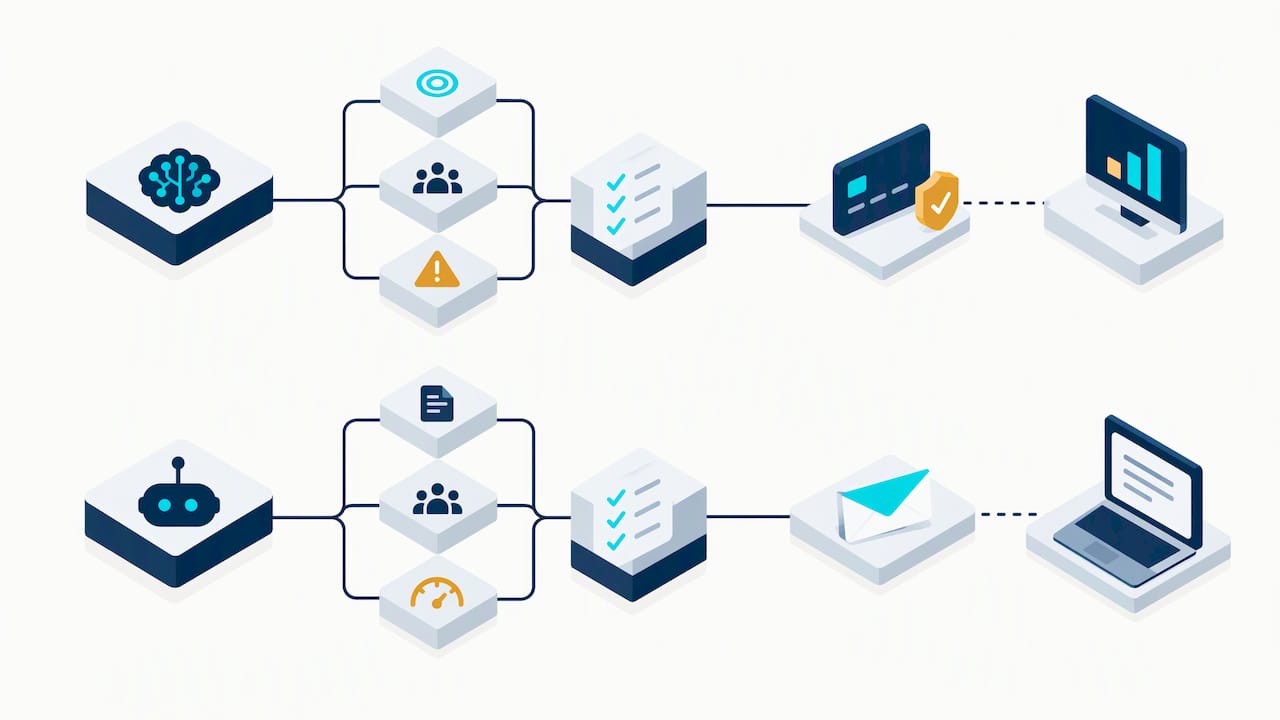
Mapping is where startups skip ahead and regret it. You cannot pick sensible tests until you know what the feature is for, who relies on its output and what happens when it is wrong. A fraud-scoring model that flags transactions for review carries different risks from a chatbot that drafts emails, even if they share the same underlying model.
What “trustworthy AI” means in the framework
The AI RMF does not treat trust as a single score. NIST lists these characteristics of trustworthy AI:
- Validity and reliability
- Safety
- Security and resilience
- Accountability and transparency
- Explainability and interpretability
- Privacy enhancement
- Fairness, with harmful bias managed
The warning that follows is the one founders should remember. NIST says that addressing these characteristics one at a time does not guarantee trustworthiness. Tradeoffs are common, and which characteristics matter most varies by context and stakeholder. Its framing is that trustworthy AI means balancing interacting characteristics rather than optimizing one metric such as accuracy, security or transparency.
In practice that means your documentation should record the tradeoffs you made, not just the numbers you hit. If you chose a more explainable model at some cost in accuracy because your buyers are auditors, say so. That sentence tells a reviewer you understand your own product.
Security teams will recognize overlap with security by design practices for early-stage startups. The AI RMF adds the questions that classic security reviews tend to leave out: bias, explainability, misuse and downstream harm.
A startup scoping plan that fits in a few weeks
NIST’s Playbook is deliberately modular. It offers voluntary suggestions aligned to AI RMF subcategories, and it states it is not a checklist: organizations may use as many or as few suggestions as fit their use case. That permission is the most important thing a startup can read in the whole framework.
Here is a sequence that respects it. The first two steps follow a practical approach proposed by one small-team guide, which is not NIST guidance: a one-page record per AI feature, then one documented quantitative test per identified risk. The rest is how we would extend it.
- List every AI feature, including vendor-embedded ones. Include third-party models and any AI inside tools your team uses on customer data. Incomplete inventories are a recurring SMB problem, especially when AI is shadow or vendor-embedded.
- Write a one-page record for each feature. Cover purpose, users, data flows and likely harms. Keep it to a page so people actually update it.
- Pick one test per risk. If the risk is biased output for a user group, test for it and record the method, the date and the result. If it is prompt manipulation, test that. One documented test beats five intended ones.
- Assign roles. CSET’s profile template recommends defining risk-management roles, assigning actions to them and recording when each role matters across the system lifecycle. At a startup one person may hold several roles. Write the names down anyway.
- Decide and log. For each risk, record whether you will mitigate, accept or monitor it, and who agreed.
- Set a review trigger. Re-run the record when the model, the use case or the known-risk picture changes, not on a fixed calendar alone.
CSET also describes profiles as the bridge between a high-level framework and actionable lifecycle guidance, especially when roles and actions are explicit. Your set of one-page records, plus the role table, is a lightweight profile. You can call it that in a sales call.
Extra care for generative AI features
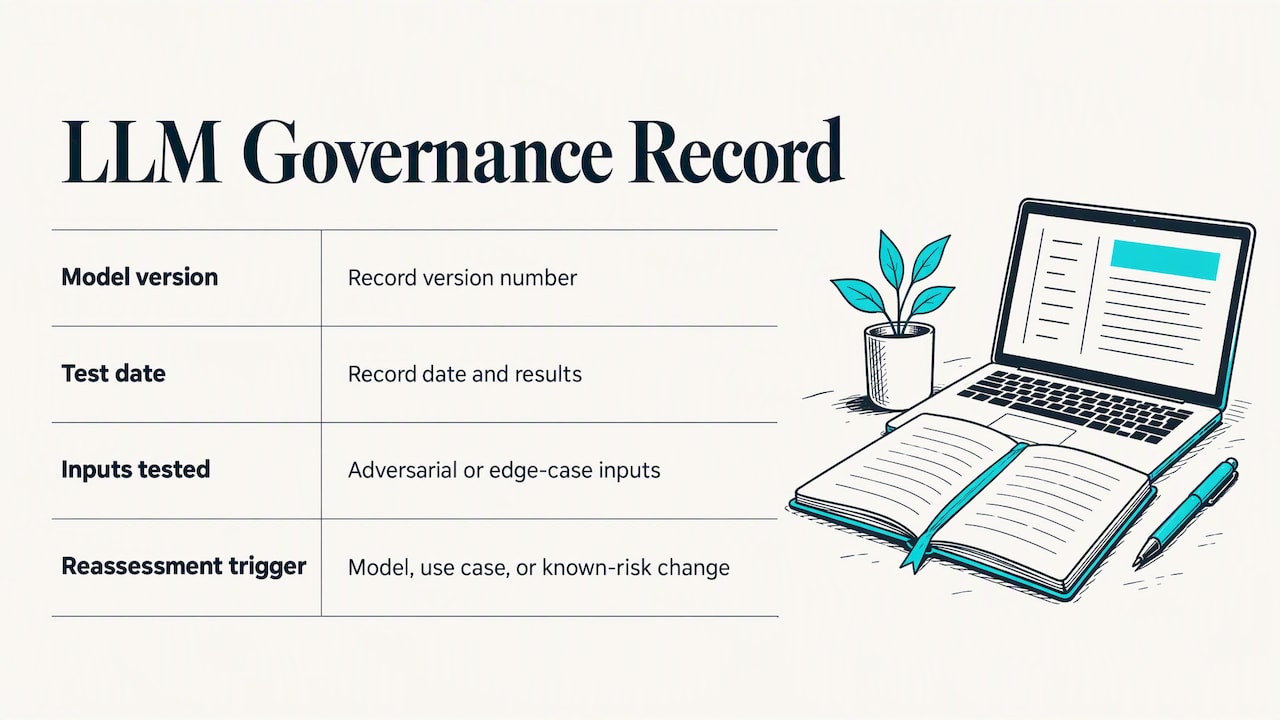
If a feature is built on a large language model, the same small-team guide suggests recording the model version, test date and results, testing adversarial or edge-case inputs, and reassessing when the model, the use case or the known-risk landscape changes. Model providers update versions often, so a test record without a version number loses most of its value a few months later.
Is there a NIST AI RMF certification?
No. One 2026 governance comparison states plainly that the AI RMF has no formal certification and is voluntary. Any vendor offering a “NIST AI RMF certified” badge is selling its own assessment, not an official credential. Be careful about claiming that status yourself. Say “aligned with” or “mapped to” the AI RMF, and be ready to show the mapping.
The nearest thing to a certificate is a different standard. One comparison notes that ISO/IEC 42001 is an international management-system standard that can be independently certified, while the AI RMF is a voluntary U.S. government framework. Some startups start with the AI RMF to build habits, then pursue ISO/IEC 42001 later if enterprise customers ask for an auditable certificate. That is a reasonable order, since the habits carry over.
The EU question for startups selling abroad
The AI RMF is voluntary. The EU AI Act is not. One analysis separates the two voluntary approaches from the EU AI Act as binding law, and says which applies depends on where you operate and what you build. The Cloud Security Alliance’s 2026 report describes the Act as a binding framework that can affect organizations placing AI systems on the EU market, including requirements for risk management, documentation, logging and human oversight in applicable high-risk contexts. Its advice to international teams: NIST can provide a useful baseline, but you must separately track binding regimes, their deadlines and their scope.
For a US startup planning a European launch, or a European one coming to the US, that means two tracks. Use the AI RMF to build the internal habit, then check with counsel whether the EU Act applies to your product and when. Our piece on EU AI Act compliance and traceable evidence covers why documentation you can trace wins deals, and our US compliance checklist for foreign cybersecurity startups covers the other direction.
Where startups get stuck
Two small-business guides list similar constraints. One names limited in-house expertise, too little time and money, framework complexity and fast-moving AI technology, and recommends phasing the work: inventory, governance, policy, monitoring, incident response, continuous review. Another points to limited capacity for bias and robustness testing, missing incident procedures, third-party gaps and weak cross-functional coordination.
The fixes are mostly about scope:
- Too much, too soon. Start with your highest-risk feature, not the whole product.
- No incident path. Write down who gets called when an AI output causes harm, and what you tell the customer.
- Third-party blind spots. If you build on someone else’s model, record what you know about it and what you cannot verify.
- Documents nobody owns. Put an owner and a review trigger on every record.
The deeper point comes from NIST itself. A 2024 NIST paper describes the framework as intended to foster a risk-aware organizational culture rather than act as a simple checklist. Adoption is a change in how people work. A folder of policies that engineers have never opened does not count.
Our perspective: evidence is the product
We work with cybersecurity and AI founders, and the pattern we see is consistent. Startups that treat AI governance as paperwork lose time. Startups that treat it as evidence close deals faster.
Buyers in security do not want to hear that your model is safe. They want to see what you tested, when, with what result, and who signed off. That is a forensic mindset: a record that someone else can inspect and reproduce. It is why Cybertech Acceleration is built around digital forensics, and why we push founders to produce judicial-grade evidence of how their products behave, not only claims about them. The AI RMF gives you the structure. Forensic discipline gives the structure credibility.
Our advice is narrow and practical. Pick one product feature. Write its one-page record. Run one real test and keep the raw output. Log the decision. Repeat for the next feature. Then learn to tell that story in business terms, because a technically excellent risk file that a procurement lead cannot follow does little for you. For more on the evidence side, see our notes on NIST digital forensics, its evidence limits, CFTT and NSRL.
— Thiago Vieira
Turning your AI RMF work into traction
Cybertech Acceleration is the first US accelerator dedicated exclusively to digital forensics for cybersecurity and AI startups. We help founders add forensic-grade evidence capabilities to their products, translate technical strengths into business narratives that investors and customers understand, and enter new markets with structured support, warm introductions and local setup.
If you are a founder outside the US, our Soft Landing program covers compliance and local setup for entering the American market. If you are weighing a first US trip, look at the Cybertech Texas Mission. For the wider picture, our US market entry playbook for cyber startups walks through the steps.
FAQ
Is the NIST AI RMF mandatory for startups?
No. NIST states that private and public organizations are not required to use it. It can still matter commercially, because customers and partners may ask how you manage AI risk, and the framework gives you a recognized way to answer.
Is there a NIST AI RMF certification?
There is no formal certification for the framework. If you need a certificate an auditor can issue, ISO/IEC 42001 is the standard that can be independently certified. Describe your work as aligned with the AI RMF rather than certified.
How much of the framework should a small team implement?
NIST’s Playbook says it is not a checklist, and teams may use as many or as few suggestions as suit their use case. Start with a one-page record per AI feature and one documented test per identified risk, then expand where customers or risk demand it.
Does following the AI RMF satisfy the EU AI Act?
Not on its own. The AI RMF is voluntary, while the EU AI Act is binding law for AI systems placed on the EU market in applicable contexts. Use the framework as a baseline, then ask legal counsel which EU obligations and deadlines apply to your product.
Sources
- NIST describes it
- NIST’s own FAQ
- According to the framework itself
- operationalized through four functions
- explains the functions
- Its framing
- it states it is not a checklist
- proposed by one small-team guide
- especially when AI is shadow or vendor-embedded
- ISO/IEC 42001 is an international management-system standard
- the two voluntary approaches from the EU AI Act as binding law
- a binding framework
- limited in-house expertise, too little time and money, framework complexity and fast-moving AI technology
- foster a risk-aware organizational culture