eDiscovery vs. Digital Forensics: What Cyber Founders Need to Know
eDiscovery finds, collects and produces electronic documents for a legal matter. Digital forensics examines the devices and data themselves to establish what happened, who did it and when, in a way that survives challenge. For a cybersecurity founder selling into the US, the practical point is simple: your product’s output may end up in either workflow, and buyers and counsel will ask whether it holds up in both.
This guide explains each discipline in plain terms, shows where they differ and overlap, and ends with what the distinction means if you are building a product, pricing it and entering the US market.
TL;DR
- eDiscovery is a legal process: identify, preserve, collect, process, review and produce electronically stored information (ESI) for litigation or an investigation.
- Digital forensics is a technical discipline: a structured examination of storage media and data, with a documented chain of evidence, so findings stand up in proceedings.
- They overlap at collection, validation and complex data sources, but they are not interchangeable. Choosing between them is a proportionality decision, not a tool decision.
- If your product creates, stores or analyzes data that could become evidence, building forensic-grade integrity into it is a differentiator with US buyers.
Table of Contents
- The short answer: how they differ at a glance
- What eDiscovery means
- What digital forensics means
- How the workflows differ
- Where the two overlap
- Can forensics recover deleted data?
- Chain of custody: the shared test
- Which one does a matter need?
- What this means if you build a cyber product for the US
- Our perspective
- Build evidence-grade proof into your product
- FAQ
- Sources
The short answer: how they differ at a glance
| eDiscovery | Digital forensics | |
|---|---|---|
| Main question | What relevant documents and communications exist, and what must be produced? | What happened on this device or system, who did it, and when? |
| Who works with the output | Attorneys and legal review teams | Forensic examiners, then lawyers, courts, regulators or management |
| Typical data | Email, chat, files, documents collected for review | Disk images, deleted files, metadata, system artifacts, logs |
| Typical method | Collection, processing, keyword search, review, production | Forensic imaging, recovery, timeline reconstruction, expert reporting |
| Typical output | A production set for the other side or a regulator | Findings, analysis and an expert report |
| Depth and cost | Scaled to volume and proportionality | Usually deeper, slower and more resource-intensive |
The split in this table follows how ILTA’s Peer to Peer publication (Fall 2023) describes the two: eDiscovery generally runs inside standard civil processes and focuses on authenticity and admissibility of ESI, while digital forensics demands stricter adherence to forensic protocols and chain of custody. It also notes that forensic analysis is more extensive and typically more time-consuming than eDiscovery.
What eDiscovery means
Discovery is the stage of a legal dispute where each side has to disclose relevant information to the other. eDiscovery is the same thing for electronic information. The international standard ISO/IEC 27050-1:2019 defines electronic discovery as discovering pertinent ESI or data by one or more parties involved in an investigation, litigation or a similar proceeding. It describes the activities as identification, preservation, collection, processing, review, analysis and production.
Notice what the process is built around: the case. The goal is to find the documents and communications that matter to a legal question, narrow down large volumes, let attorneys review them and hand over what is required. Speed and proportionality matter because the volumes are large and the review is expensive.
In practice, an eDiscovery team collects email, messages and files from the people and systems involved, processes them into a reviewable form, and lets lawyers decide what is relevant and what is privileged. Methods such as keyword searches and data sampling are standard here, as the ILTA material notes.
What digital forensics means
Digital forensics goes below the surface of the documents. The EU anti-fraud office’s guidelines on digital forensic procedures define it as applying digital investigation and analysis techniques to perform a structured examination of a digital storage medium while maintaining a documented chain of evidence, so that findings are admissible in administrative, disciplinary and judicial procedures.
A UK government publication quotes a widely used research-community definition: the use of scientifically derived and proven methods to preserve, collect, validate, identify, analyze, interpret, document and present digital evidence.
The key words are structured, documented and validated. A forensic examiner is not just finding a file. They are showing how they found it, that the original was not altered, and that someone else could repeat the work and reach the same result.
Forensics is not the same as security operations
Digital forensics is also different from prevention and incident response. Security teams contain and fix. Forensics reconstructs and documents so that the findings can be relied on later, whether in court, before a regulator or inside a company. That distinction is why “we detected it” and “we can prove it” are two different product claims.
How the workflows differ
Purpose and scope
eDiscovery starts from a legal obligation to disclose. Forensics starts from a question about events. The eDiscovery Certification Council, a US professional body, states that the two overlap but are not interchangeable. Its guidance says the method should be chosen by weighing purpose, data type, volume, metadata, recoverability, legal requirements, privacy, cost, speed, repeatability, validation and team skills.
How data is collected
In a typical eDiscovery collection, data is gathered from accounts and systems the way a user would reach it, then processed for review. In forensics, the examiner works with specialized tools to acquire a forensic image: a bit-for-bit copy of the storage medium that includes space a normal user never sees. The original stays untouched, and the analysis happens on the copy.
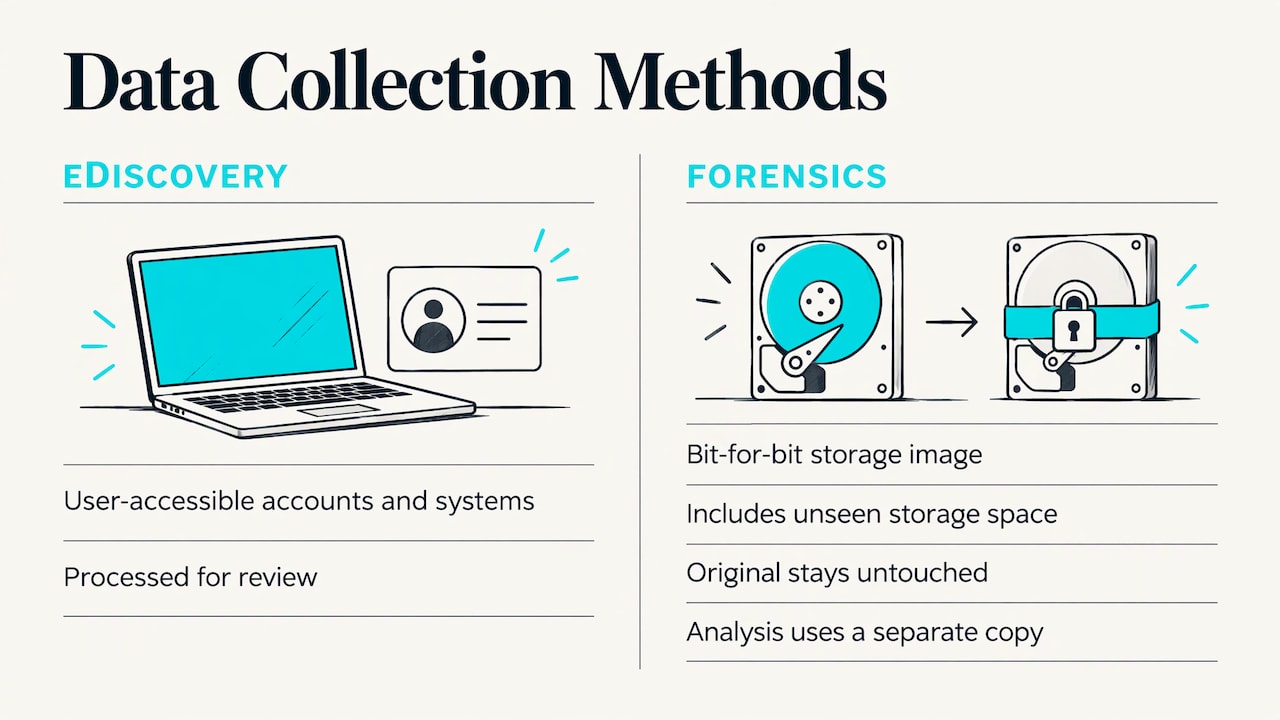
The OLAF guidelines show how strict this gets. After a forensic operation, the specialist creates two sealed backup copies of the image, one in-house and one off-site, works from a separate forensic work file, and records any transfer of data out of the lab to protect the chain of evidence. Searching is iterative, covering traces of deleted data in unallocated space, keyword searches and timeline searches.
What the analysis looks for
eDiscovery analysis asks which documents are relevant. Forensic analysis asks how, who, what, when and where. It examines metadata, system artifacts and deleted material to rebuild a timeline. That is why a dispute over who edited a file, or whether a USB drive was connected the night before an employee resigned, lands with a forensic examiner rather than a review team.
Who does the work and what they deliver
eDiscovery output is a reviewed, produced data set. Forensic output is findings, analysis and a report written so that it can be presented as expert evidence. The first is judged on completeness and defensible process. The second is judged on technical validity and documentation.
Where the two overlap
The overlap is real, and it is where most confusion comes from. The eDiscovery Certification Council notes that the disciplines frequently meet during collection, evidence validation, investigations and the analysis of complex data sources. A matter involving deleted files, mobile devices or disputed user activity may need forensic depth, while the wider case still needs processing, review and production.
A typical combined matter looks like this:
- A company faces a lawsuit, and a legal hold tells employees to preserve relevant data.
- Most custodians’ email and documents go through standard eDiscovery collection and review.
- One departing executive’s laptop is suspected of data exfiltration, so it gets a forensic image and a forensic examination.
- The examiner’s findings feed the legal team’s strategy, and relevant material from the image joins the production.
The common thread is defensibility. Whichever route data takes, someone may later ask whether the original content and metadata were preserved and whether the handling can be shown. A UK industry introduction puts it this way: digital evidence is dynamic and transient, and preserving original content and metadata is what protects against claims of tampering.
Can forensics recover deleted data?
Often, yes, and this is one of the clearest dividing lines between the two. Litigation material from the US law firm Katten, citing a 2006 federal decision, explains that deleted data stays on a hard drive in whole or in part until it is overwritten by ongoing use or wiped with specialized software. Even after wiping, directory entries, pointers or other metadata may remain. Forensic experts can recover such data from the drive or, preferably, from a mirror image that copies all allocated and unallocated space bit for bit.
Two limits follow from that explanation. Recovery depends on whether the data has been overwritten, and it works best on an image taken early. That is one reason timing of preservation matters so much in any matter where user activity is disputed.
Chain of custody: the shared test
Chain of custody is the record of who held evidence, when, and what they did with it. It is central to forensics and relevant to any evidence that might be challenged. Practitioners record dates, times, handlers, locations and integrity checks, supported by acquisition logs, hashing records and tool validation notes. A hash is a fixed-length fingerprint of a file or image: if one bit changes, the fingerprint changes, which lets you show that the copy matches the original.
For a technical walkthrough, see our guide to chain of custody for digital evidence. For the end-to-end sequence an examiner follows, our digital forensics investigation process guide covers each stage.
Which one does a matter need?
The most useful framing from the professional literature is proportionality. The eDiscovery Certification Council’s guidance says teams should define the intended output before choosing a workflow: what problem are we solving, what level of evidential detail is required, and what limitations would matter if the process were challenged. Having a tool available is not a reason to use it.
A simple way to apply that:
- Choose eDiscovery when the task is to find, review and produce relevant documents and communications at volume.
- Choose digital forensics when the question is about activity: deleted content, user actions, device history, intrusion timelines, or authenticity of a file.
- Plan for both when a case has a large document set and a small number of devices or systems where the facts are disputed.
ILTA’s publication adds a point that matters for security teams: the differences in goals, legal standards, depth, timing and cost determine which approach to use and how to protect client data in cybersecurity-related matters.
What this means if you build a cyber product for the US
Most explanations of this topic are written for lawyers and legal IT staff. If you are a founder, the question is different: what does your product leave behind, and could it be used as evidence?
Think through three situations your customers will face:
- A breach investigation. Your logs, alerts and reports may be requested by the customer’s counsel or a regulator. Can the customer export them with timestamps, integrity checks and a record of access?
- A dispute with a vendor or employee. If your tool shows that a user accessed or changed something, will that output be trusted without a forensic examiner re-deriving it?
- A litigation hold. If your customer is sued, your product’s data may fall inside the scope of preservation. Can data be preserved without being altered, and can it be exported in a form reviewers can use?
Products that answer yes to these questions are easier for US security and legal teams to approve. This is what we mean by evidence-grade proof: output designed so that its integrity can be demonstrated, not merely asserted. It is also a sharper story than a feature list. Founders who can explain, in a buyer’s own terms, why their output stands up in a proceeding give procurement and counsel something concrete to repeat internally.
The founders who benefit most are often those building alone or in very small teams, where the decisions about architecture, pricing and US entry all land on one person. Evidence handling is easy to postpone and expensive to retrofit.
Related reading on our site: the Idaho student murders digital forensics analysis shows how digital evidence is read in a real case.
Our perspective
We run a cybersecurity-only accelerator, and the eDiscovery versus forensics question comes up for a reason that has nothing to do with litigation software. It comes up because founders ask why one cyber product gets trusted by a US buyer and another does not.
Our view is that the difference is often evidence. A tool that detects something is useful. A tool whose output can be explained, verified and defended is one a CISO, a general counsel and an insurer can all say yes to. Forensic thinking is what turns the first into the second.
That is why our program includes a court-appointed digital forensics expert alongside exited founders, CISOs and MSSPs. Founders decide on co-founder, first hires, pricing and US market entry with people who have faced those decisions, and they build evidence-grade proof into their products so it holds up with US buyers and in court. The program runs November to March and closes with an in-person Texas Mission during SXSW.
We work with founders outside the usual hubs, in Brazil, Portugal and across Europe, building for the US. Many carry the big decisions alone, or have a co-founder and still feel alone. Understanding where eDiscovery ends and forensics begins is a small piece of a larger job: making your product something a US buyer can rely on from day one.
Thiago Vieira
Build evidence-grade proof into your product
If you are a solo or early-team cyber founder aiming at the US, our accelerator is built around exactly this gap. You work with exited founders, CISOs, MSSPs and a court-appointed digital forensics expert, and you get introductions inside a network of portfolio companies, alumni and 350+ cyber founders. Our founders have generated €600K+ in investment and new revenue since 2025. Start at the Cybertech Acceleration page to see how the program works.
The program closes with the Cybertech Texas Mission, an in-person week in Texas during SXSW. If you are an international startup preparing for US entry, the same page set includes country-specific routes for Portuguese, UK, German and Israeli cyber startups.
FAQ
Are eDiscovery and digital forensics the same thing?
No. eDiscovery is a legal process for identifying, collecting, reviewing and producing ESI in a proceeding. Digital forensics is a technical examination of devices and data that keeps a documented chain of evidence. They overlap at collection and validation, but a professional body states they are not interchangeable.
Is eDiscovery part of digital forensics?
Not exactly. Forensic methods can support eDiscovery, for example when a collection must preserve metadata or a device holds disputed activity. But eDiscovery also includes review and production work that forensics does not cover. Think of them as two disciplines that meet at certain steps.
Can forensics recover deleted files?
Often. Deleted data usually remains on a drive until it is overwritten or wiped, and traces such as directory entries or metadata can remain even after wiping. Recovery works best from a forensic image taken early, which is why prompt preservation matters.
Are cyber forensics and digital forensics the same?
In everyday use the terms are close, and many people use them interchangeably. Digital forensics is the broader name for examining any digital evidence, including computers, phones, networks and cloud data. Cyber forensics usually points to cyber incidents and intrusions, which sit inside that wider field.
Which should a startup care about first?
If you build security products, start with forensic soundness: integrity, timestamps, access records and exportable logs. Those properties serve both workflows. eDiscovery-specific export formats can be added once you know which customers need them.
Sources
- ILTA’s Peer to Peer publication (Fall 2023)
- ISO/IEC 27050-1:2019
- guidelines on digital forensic procedures
- scientifically derived and proven methods
- overlap but are not interchangeable
- frequently meet
- UK industry introduction
- explains