Forensic Readiness: A Practical Guide for Cyber Startups
Forensic readiness is an organization’s ability to collect, preserve and analyze digital evidence before an incident forces the question, so the evidence holds up in a legal matter, a disciplinary hearing or a court. You build it in advance: you decide which evidence matters, where it lives, who may touch it and how it is stored. Then, when something goes wrong, you spend your time investigating instead of scrambling. This guide covers what readiness means, what a policy, plan and checklist should contain, and how a startup with a small team can get there.
TL;DR
- Forensic readiness means having the capability to gather legally admissible digital evidence quickly, at minimal cost and with minimal disruption, before an incident happens.
- A workable program starts with business scenarios, maps evidence sources, secures collection and storage, trains people and ends with legal review.
- Startups do not need a large team: start from your most likely threats, fix logging and retention first, and automate collection.
- If you sell a security or AI product, readiness also applies to the product itself: logs and evidence your customers can rely on are a credibility signal.
- Treat it as a cycle. Every incident and every drill should improve the next one.
Table of Contents
- What forensic readiness means
- Why it matters to a young company
- Policy, plan and checklist: how they fit together
- Building the plan, step by step
- A forensic readiness checklist you can use
- Forensic readiness when you sell a security or AI product
- Building it on a startup budget
- Our perspective
- Turning readiness into a market advantage
- FAQ
- Sources
What forensic readiness means
The term has several formal definitions, and they agree on the core. NIST Special Publication 800-201, released in July 2024, describes forensic readiness as the ability to collect digital forensic evidence quickly and effectively, at minimal investigation cost, by addressing in advance the challenges that could get in the way of data collection.
An older, widely cited framing comes from the CESG Good Practice Guide No. 18, as quoted in an ISACA Journal article. It describes the achievement of an appropriate level of capability to collect, preserve, protect and analyze digital evidence so that it can be used effectively in legal matters, disciplinary hearings or courts of law.
Two ideas sit inside both definitions:
- Speed and cost. Evidence is gathered with minimal delay and expense.
- Legal usefulness. Evidence is collected in a way that survives scrutiny, not just in a way that satisfies curiosity.
Forensic readiness is not incident response, and it is not a forensic investigation. It is the groundwork that makes both faster and more reliable. For a closer look at how it connects to response work, see our guide to incident response forensic readiness from a legal and technical angle.
Why it matters to a young company
Without preparation, evidence gathering starts after the incident, under pressure. Researchers at the University of York point out that this time pressure can lead to data being deleted or lost, and that proactive readiness reduces disruption to business operations during an investigation. The same source links readiness to limiting investigation costs and to demonstrating due diligence and building customer and supplier trust.
The ISACA article lists the situations where readiness pays off: disputed transactions, allegations of employee misconduct, regulatory compliance and insurance claims. For a startup, add a few more that are common in practice:
- A large prospect asks, during security review, how you would preserve evidence after a breach.
- A customer disputes what your product did or did not detect.
- A departing employee or contractor is suspected of taking code or data.
- An investor’s due diligence asks what happens after an incident.
There is also a tension every responder faces. A digital investigation trades off evidence preservation against the need to keep the business running. A classic paper from Utica University notes that forensic readiness lets an organization minimize the impact of those competing priorities. Decide the trade-offs on a calm day, not at 2 a.m. while the system is down.
Policy, plan and checklist: how they fit together
Readers often search for a forensic readiness policy, plan and checklist as if they were three names for one thing. In practice, they do different jobs. The distinctions below are how we use the terms with the founders we work with, not a formal standard, so adapt them to your own governance documents.
| Document | Question it answers | Typical owner | Changes |
|---|---|---|---|
| Policy | What are we committed to, and who is accountable? | Leadership (CEO, CTO or CISO) | Rarely |
| Plan | How will we do it, with which tools and people? | Security or engineering lead | After incidents, tool changes, reviews |
| Checklist | Did we do each step, in order, this time? | Whoever responds | Every use |
What a policy should define
Keep it to one or two pages. A useful policy states the purpose (why you preserve evidence), the scope (systems, data and people covered), who is authorized to order and perform collection, which business scenarios trigger it, and the requirement for legal review. Naming accountability matters most. UK government guidance on digital continuity, for example, is aimed at the person responsible for forensic readiness, generally a senior risk owner or a delegate, which shows how formal bodies treat ownership as a named role.
What a plan should contain
The plan turns the policy into operations. Rowlingson’s ten-step process, published by Utica University, is the clearest skeleton. It begins by defining the business scenarios that require digital evidence and ends with legal review to support an appropriate incident response. In between, it covers identifying evidence sources, deciding how to collect and store them securely, setting up monitoring and escalation, training staff and documenting cases.
Building the plan, step by step
Here is how we would translate those stages for a company of five to fifty people.
1. Define the scenarios
Write down the three to five situations in which you would realistically need evidence. Tie them to your risk assessment. The Utica paper stresses that readiness should align with existing defensive measures and risk assessments so it targets the threats most likely to affect the business. A SaaS startup might choose account takeover, insider data theft and a customer dispute over product behavior.
2. Map your evidence sources
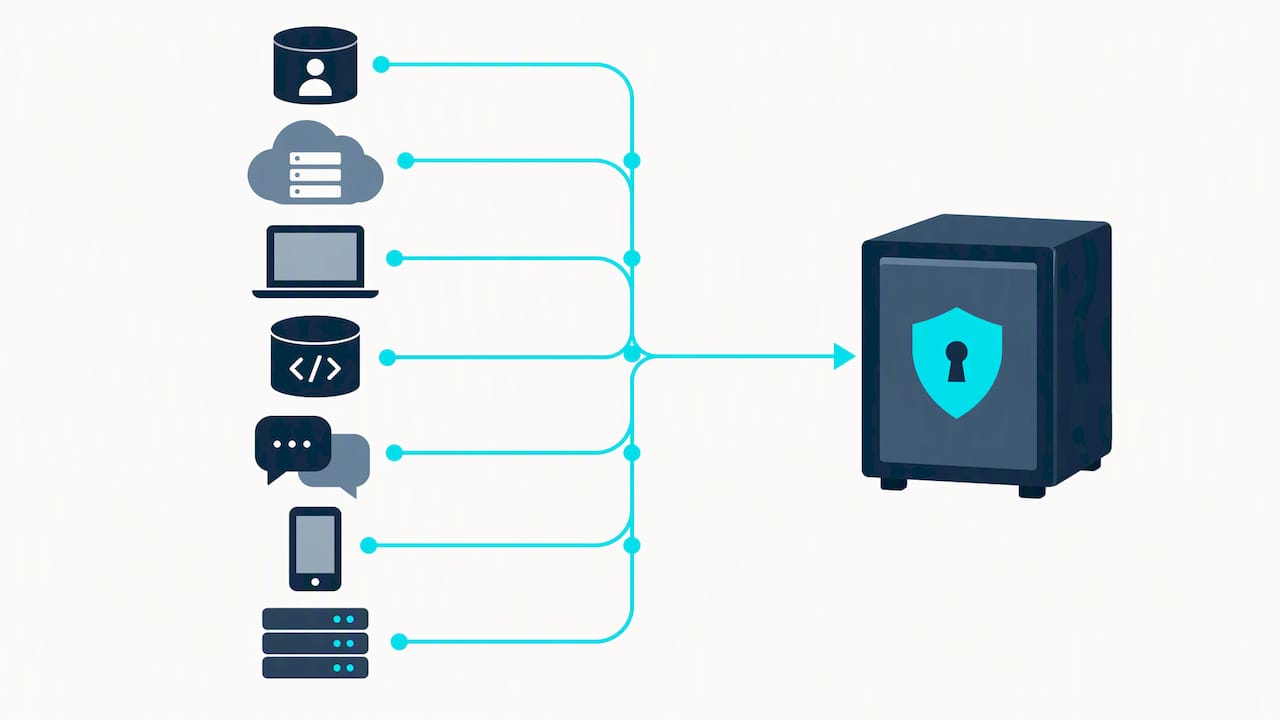
For each scenario, list where the proof would live: identity provider logs, cloud audit trails, endpoint telemetry, source control history, email, chat, mobile devices and your own product logs. Note who administers each and how long data stays.
3. Fix logging and time first
The NCSC guidance on digital forensics and protective monitoring gives concrete advice that applies far beyond network vendors. Import logs into a security information and event management (SIEM) tool. Use ISO 8601 timestamps in UTC so timelines line up across devices. Make sure there is enough local storage before logs roll over, because a log that has already been overwritten cannot be recovered.
4. Protect integrity and chain of custody
Evidence is only as good as your ability to show it was not altered. Jason Sachowski’s work on digital forensic readiness recommends cryptographic algorithms to preserve the authenticity and integrity of digital data throughout its life cycle. In practice: hash what you collect, record who handled it and when, restrict access to the storage location and keep originals separate from working copies.
5. Automate collection
AWS prescriptive guidance on forensics in security incident response notes that automating the forensic process, including log collection and pre-built search queries, speeds response and lightens the load on incident response stakeholders. For a small team, this is the best return on effort: a script that snapshots the relevant logs and hashes them beats a forty-page procedure nobody reads at midnight.
6. Train people and rehearse
Everyone who might be first on the scene, usually engineers and IT, should know the first three rules: do not wipe or reimage, do not investigate on the original system, and call the named owner. Run a short tabletop once or twice a year.
7. Get legal review
Admissibility turns on law and procedure, not just technology. Have counsel review your plan, particularly retention periods, employee monitoring notices and cross-border data handling. Our overview of digital evidence admissibility and cyber law standards explains what courts tend to look for, and the US courts guide for 2026 covers the American picture.
8. Review after every incident
AWS guidance emphasizes that readiness should be cyclical, with post-incident reviews used to improve future detection and response. Add what you learned to the plan the same week, while the gaps are fresh.
A forensic readiness checklist you can use
Use this as a starting point and adjust it to your systems. It follows the stages in the Utica ten-step process.
Authorization and scope
- [ ] A named owner for forensic readiness, with a backup
- [ ] Written authority to collect evidence from company systems
- [ ] Business scenarios listed and tied to your risk assessment
Evidence sources
- [ ] Inventory of log and data sources, with administrators
- [ ] Retention period set for each source, with a reason
- [ ] Logs centralized in a SIEM or equivalent
- [ ] All timestamps in UTC, ISO 8601 format
- [ ] Storage capacity checked against log rollover
Collection and preservation
- [ ] Documented method to collect without altering originals
- [ ] Hashing of every collected item
- [ ] Chain-of-custody form or ticket template
- [ ] Access-controlled, separate evidence storage
People and process
- [ ] Escalation path with phone numbers that work off-hours
- [ ] First-responder rules taught to engineering and IT
- [ ] Outside forensic and legal contacts identified in advance
- [ ] Case documentation template
Review
- [ ] Legal review completed and dated
- [ ] Tabletop exercise scheduled
- [ ] Post-incident review step added to your response process
If you need the investigative side after collection, our standard guide to the digital forensics investigation process walks through what happens next.
Forensic readiness when you sell a security or AI product
Most guidance addresses an organization protecting itself. If your startup builds security or AI software, there is a second layer: your product. Researchers in software engineering argue for a design-centric approach, where systems are forensic-ready by construction. They describe such systems as producing sufficient, relevant, trustworthy and non-repudiable digital evidence that is handled in a forensically sound way and conforms to legal obligations.
Government security agencies are pushing the same way. The NCSC encourages device manufacturers to ship standard logging and forensic features that are robust and secure by default, such as recording authentication methods, technical support events and service and application-level logging. Its 2026 commentary adds that responders should not have to rely on workarounds or zero-day vulnerabilities, and that vendors should provide supported ways to gather evidence. It also argues that radical transparency, such as software bills of materials, lets defenders investigate with greater confidence and speed.
For a founder, the implication is practical. When a buyer’s security team asks what evidence your product leaves behind, a clear answer is a sales asset. Ask yourself:
- Does the product log who did what, when, in a tamper-evident way?
- Can a customer export those logs in a standard format with reliable timestamps?
- Could the output be explained to a judge or a regulator by a non-engineer?
We cover this design approach on our evidence by design page, and the expert side in our piece on expert witnesses in cybercrime litigation.
Building it on a startup budget
You will not staff a forensic lab. You can, however, get most of the value with a short list of decisions:
- Start from the threats you actually face. Skip generic frameworks and pick the scenarios from step one.
- Spend on logging and retention before tools. Evidence that was never recorded cannot be bought later.
- Use what your cloud already offers. Audit trails and snapshot features are often switched off by default, so check.
- Automate collection so a junior engineer can run it correctly.
- Pre-arrange outside help. Know which forensic firm and which counsel you would call before you need them.
- Document as you go. A one-page plan that exists beats a thorough one that does not.
If you operate across borders, add one more item: find out where your logs are stored and which country’s rules govern access, retention and transfer. Those rules differ by country, so have counsel in each market confirm them rather than assuming one standard applies everywhere.
Our perspective
We are an accelerator built around digital forensics, and we see the same pattern in security and AI startups. Teams invest heavily in detection and prevention, then discover in a customer review or a dispute that they cannot prove what happened. The product may be excellent, but credibility in this market depends on evidence that stands up outside the engineering team.
So we push founders to treat forensic readiness as both a defensive practice and a commercial one. Internally, it limits damage and cost. Externally, it lets you tell a buyer or investor a precise story: here is what our product records, here is how it is preserved, and here is how it would be presented if it mattered. Translating that technical reality into a business narrative is where many strong engineering teams stall, and it is where we spend much of our time with founders.
Our advice is to begin small and begin now: one owner, one-page policy, logging fixed, collection scripted. Then improve after every incident and exercise.
— Thiago Vieira
Turning readiness into a market advantage
If you are a cybersecurity or AI founder who wants forensic-grade credibility built into your product and your pitch, that is what Cybertech Acceleration does. We are the first US accelerator dedicated exclusively to digital forensics, and we help startups add judicial-grade evidence capabilities, explain them in terms buyers and investors understand, and enter new markets with introductions and hands-on support.
If you are an international company aiming at the US, or a US company heading to Europe, our Soft Landing program covers structured market entry, compliance and local setup. Founders interested in the American market can also look at the Cybertech Texas Mission.
FAQ
What is the difference between forensic readiness and incident response?
Incident response is what you do during and after an incident to contain and recover. Forensic readiness is the preparation that makes sure evidence is available, trustworthy and usable when that happens. Good readiness shortens response because the logs, access and procedures already exist.
Does a small startup really need a forensic readiness policy?
If you handle customer data, sell to enterprises or build security software, yes. A short policy naming an owner, the scenarios and the legal review requirement takes a day to write. It is also something security questionnaires and investors increasingly ask about.
What should I do first if I have nothing in place?
Fix logging and time synchronization, then set retention periods for your key systems. After that, name an owner and write down your top few scenarios. Those three steps give you evidence to work with, even before the rest of the plan is finished.
How often should the plan be reviewed?
Review it after every real incident and after major changes to your infrastructure, and rehearse it at least once a year. AWS guidance treats readiness as a cycle in which post-incident reviews feed improvements.
Is forensic readiness required by law?
It depends on your country, sector and contracts. Some rules require logging, retention or breach reporting, which overlap with readiness, but there is no single universal mandate. Ask counsel in each jurisdiction where you operate.
Sources
- released in July 2024
- an ISACA Journal article
- Researchers at the University of York
- A classic paper from Utica University
- is aimed at the person responsible for forensic readiness
- NCSC guidance on digital forensics and protective monitoring
- cryptographic algorithms to preserve the authenticity and integrity
- forensics in security incident response
- argue for a design-centric approach
- radical transparency, such as software bills of materials