Accelerator Equity Standard: What’s Typical and What to Check

The standard in startup accelerators is equity in exchange for a small check and a fixed-term program: most programs take roughly 5% to 10% of your company. For a cybersecurity founder, the useful question is not the headline percentage. It is what that stake costs you at the seed round, what the program changes for your US buyers, and whether you can get the same support without selling ownership. Our program, Cybertech Acceleration, charges a US$3,000 fee and takes no equity.
TL;DR
- Accelerators typically take about 3% to 10% of a company, most often 5% to 10%, in exchange for cash, mentorship and a short cohort program, according to Carta’s accelerator guide.
- The percentage is not the whole cost. Convertible instruments such as SAFEs, top-up clauses and follow-on rights can add dilution later.
- Terms differ by program and by country, so one program’s numbers should never be quoted at another program’s cohort.
- Cyber founders who care most about US buyer trust, introductions and court-grade evidence in their product can choose a fixed-fee, no-equity route.
- Before signing anything, add up everything that converts, read the top-up clause, and check follow-on and information rights.
Table of Contents
- What the accelerator equity standard looks like
- Why the headline percentage understates (and sometimes overstates) the cost
- Deal structures differ more than the percentages
- The terms that matter more than the percentage
- How to judge whether the support is worth the stake
- Our approach: a fixed fee instead of a stake
- Where to start if you want to enter the US
- A short decision guide
- FAQ
- Sources
What the accelerator equity standard looks like
An accelerator is a fixed-length cohort program. Founders get mentorship, workshops, introductions and, often, a modest investment. The program usually ends in a demo day, where startups pitch investors. GVB World puts the usual take at 5% to 10% of equity for training and a relatively small amount of funding, over about three months. Carta gives a slightly wider band of about 3% to 10%.
The cash side varies more than the equity side. StartWise reports that most programs take 5% to 10% for a check between $100,000 and $500,000. It also reports that the best-known US program’s 2026 standard deal is $500,000 in two pieces: $125,000 for 7% on a post-money SAFE, plus $375,000 on an uncapped MFN SAFE. A second large US program’s deal is $220,000: $20,000 for 5% common stock, plus a $200,000 uncapped MFN SAFE.
Those terms are worth reading slowly, because three phrases carry most of the meaning:
- SAFE (Simple Agreement for Future Equity): an investor gives you money now and receives shares later, when a trigger event such as a priced funding round happens. The SEC’s investor bulletin describes it as a promise of a future equity stake if certain events occur.
- Uncapped MFN SAFE: it has no valuation cap of its own, and “most favored nation” means it can take on the best terms of SAFEs you sign later. Its final ownership is unknown until then.
- Post-money SAFE: the investor’s percentage is fixed against the company’s value after all SAFEs convert, so the number you see is the number they own, before the next round dilutes everyone.
A 5% to 10% range is therefore a starting point. Two programs both “taking 7%” can leave you in very different positions after the next round.
Why the headline percentage understates (and sometimes overstates) the cost
Dilution compounds. It does not add up in a straight line. According to Causo Hub’s 2026 dilution analysis, which draws on Carta’s 2025 data, a fixed 7% stake becomes 5.6% after a 20% seed round, because the seed investors dilute the accelerator’s stake at the same rate as yours. The same analysis cites a median founding team ownership of 56.2% after seed and 36.1% by Series A. Those figures already include angels, the option pool and priced rounds, so the accelerator is one part of a bigger picture.
Here is a simple illustration of the arithmetic, with round numbers of our own:
| Step | Equity-taking program (7%) | Fixed fee, no equity |
|---|---|---|
| Founders at start | 100% | 100% |
| After the accelerator | 93% | 100% |
| After a 20% seed round | 74.4% | 80% |
The gap of 5.6 percentage points at seed is real, but it is smaller than the 7 points the headline suggests. Whether that is a fair price depends on what the program delivers, which we come back to below.
The larger surprises come from instruments that convert later. Westaway’s founder guide works through a case where a company raises $1.5M on post-money SAFEs with a $15M cap. The uncapped MFN SAFE picks up that cap, so a $375,000 investment buys another 2.5%, and SAFE holders end up with 19.5% going into the priced round. With a $10M cap the same money would have cost 3.75%. Every later SAFE cap, in other words, also prices the accelerator’s money.
Deal structures differ more than the percentages
Programs deliver their economics in at least four ways:
- Fixed stake plus convertible money. The pattern above: a small piece of common stock or a post-money SAFE for a set percentage, plus a larger uncapped SAFE.
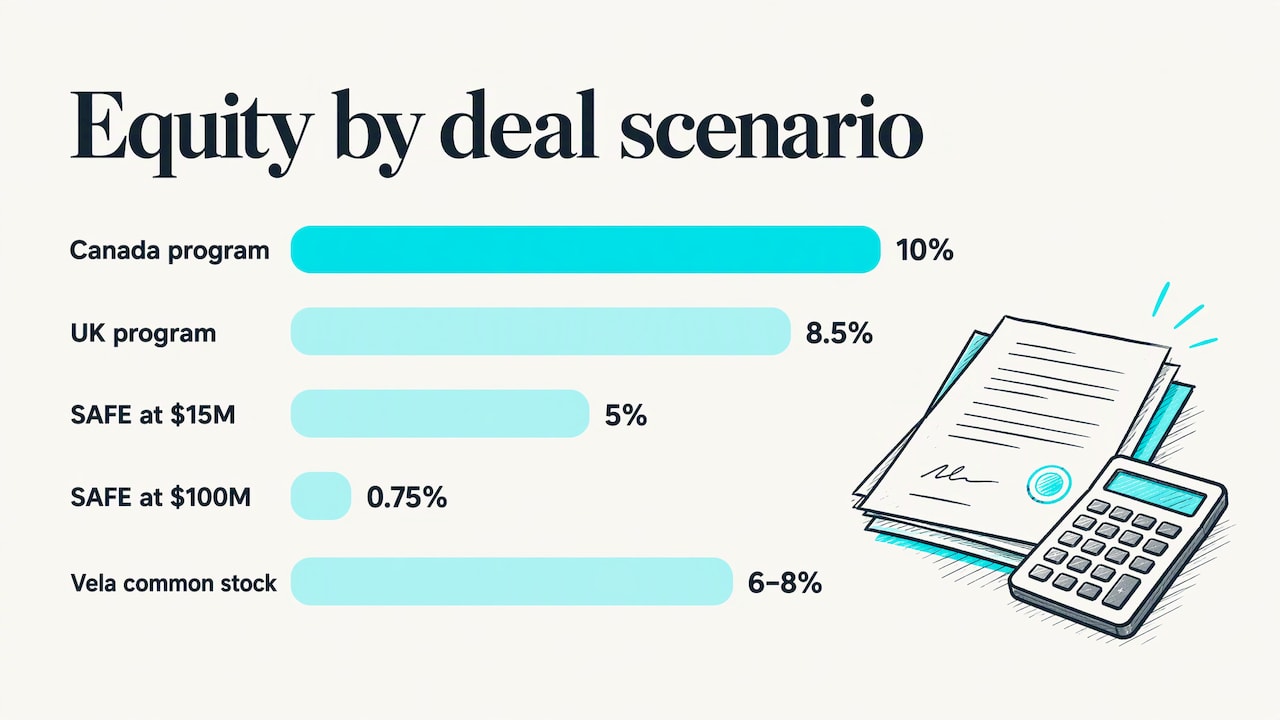
- Straight equity grants. A percentage of common stock for services, sometimes with cash. Vela Law notes that many programs take 6% to 8% of common stock for services plus cash, which suits very early companies but can create income recognition, reporting and stock option pricing issues for later-stage ones.
- Deferred-ownership models. One 2026 analysis of a low-dilution program shows how an uncapped $750,000 SAFE gives the investor 5% at a $15M valuation but only 0.75% at $100M, so dilution depends on how your company performs.
- No equity at all. University programs and some strategic programs often take little or none. JPMorgan’s guide puts typical equity at 0% to 10% for incubators and 5% to 10% for accelerators, and notes that corporate or hospital-run programs usually take less because their value comes from client relationships.
Geography matters as well. In the same Causo Hub comparison, one global program invests $150,000 for 10% fully diluted in Canada, but offers £125,000 for 8.5% plus a convertible note and a £40,000 service fee in the UK. If you are an international founder, make sure the numbers you read belong to your cohort and your country.
If you are weighing accelerators against other forms of support, our guide on accelerator vs incubator explains how to choose by more than stage. For a primer on the vocabulary investors use, this venture capital terms glossary covers the standard terms in plain language.
The terms that matter more than the percentage
Before signing, read the paperwork for four things. Sule’s guide to accelerator terms calls them the ones that carry more weight than the headline number: the equity-to-cash ratio, follow-on rights, information rights, and any unusual vetoes or consent rights. It also says to model warrants as deferred dilution in your cap table today.
A practical checklist:
- Add up everything that converts. List every SAFE, note and warrant, including the accelerator’s. An uncapped MFN SAFE takes the best terms of later SAFEs, so a generous cap you give a later investor reprices the accelerator’s money too.
- Read the top-up clause. Westaway explains that programs buying common stock may require you to issue free extra shares to restore their percentage. Narrow versions cover only founder issuances. Broad versions cover every issuance until a priced round above a minimum size.
- Check follow-on and information rights. Pro rata rights let the accelerator buy into later rounds. Information rights decide what you must report, and to whom.
- Look for vetoes and consent rights. Any right to block a financing, a hire or a sale should be rare and narrow.
- Match the terms to your jurisdiction. If you are forming a US company to sell to US buyers, our guide to US company formation covers the structure that most investors expect.
None of this is legal advice. Before you sign any equity or convertible agreement, have a startup attorney read it. They can model it against your actual cap table.
How to judge whether the support is worth the stake
Sule frames the decision as commercial rather than legal. A top-tier program’s network, credibility and follow-on capital can be worth far more than the equity it costs. A weaker program charging the same stake rarely is. The equity is gone permanently, while the program lasts a few months, so the network and follow-on access need to justify the price.
StartWise, citing startupik’s 2026 modeling, runs the numbers at a median $24M seed post-money valuation. The best-known US program’s deal converts to about 8.6% of the company, worth roughly $1,555,000 after subtracting the $500,000 cash. A second program lands near 5.8%, worth about $1,180,000 net. In both cases, StartWise concludes, founders are paying mostly for network and signal.
So ask what you are buying, and be specific:
- Who will actually pick up the phone? Named buyers, channel partners and investors in your target market beat a general alumni list.
- Does the program match your product category? General curricula teach generic go-to-market. Cyber products sell on trust, proof and compliance.
- Does it solve your hardest decision? Solo founders usually struggle most with co-founder choices, first hires, pricing and market entry.
- Can you afford the dilution at the next round? Model it with your own numbers, using the compounding math above.
For the founders we serve, buyer trust is the central issue. US security buyers want to know that evidence from your product stands up under scrutiny, and in some cases in court. A generic program rarely helps with that.
Our approach: a fixed fee instead of a stake
Cybertech Acceleration is a cybersecurity-only accelerator for solo and early-team cyber founders. The program runs from November to March. Exited founders, CISOs, MSSPs and a court-appointed digital forensics expert help founders decide on a co-founder, first hires, pricing and US market entry. They also help build evidence-grade proof into the product, so it holds up with US buyers and in court. The fee is US$3,000, with no equity.
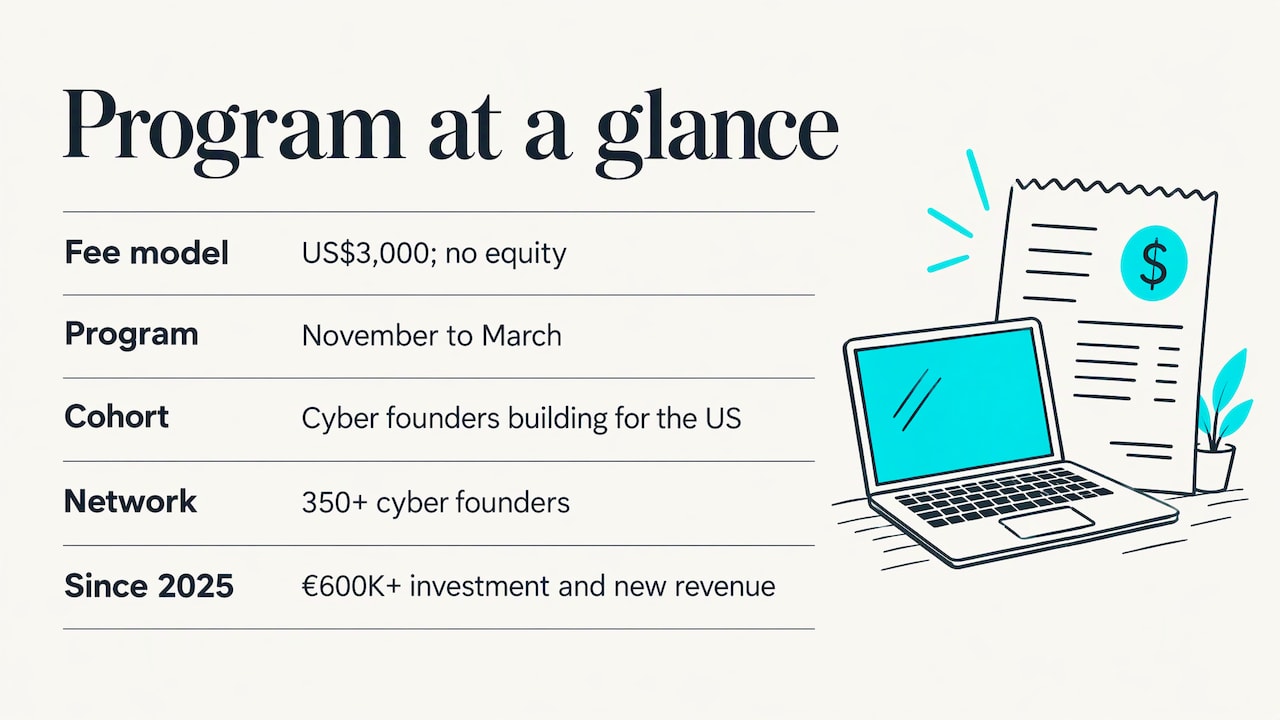
For your cap table, that means the arithmetic in the table above works in your favor from day one: you start your seed round with 100% of what you own today. The structure is also simple. There is no SAFE to model, no MFN clause that reprices with later caps and no top-up clause to negotiate. Since 2025, our founders have generated €600K+ in investment and new revenue.
The program also draws on a network of portfolio companies, alumni and 350+ cyber founders for introductions. Founders working outside the usual startup hubs, such as Brazil, Portugal and the rest of Europe and building for the US, are who we built the cohort for. Small cohorts keep the attention personal. If you are weighing capital separately, we also cover non-dilutive funding for cybersecurity startups, a route that fits well beside a fixed-fee program.
Our view on the equity standard
The 5% to 10% standard exists for a good reason: for a generic software company, a small check and a famous brand are worth trading ownership for. We have seen that the cyber founders we work with carry a different set of problems. They are often alone with the decisions. They sell to buyers who want proof, not a pitch.
That is why our program is built around the decisions and the evidence rather than around a check. A founder who works with exited founders, CISOs, MSSPs and a court-appointed digital forensics expert is learning from people who have bought, sold, defended and testified. That experience goes into pricing, the first hires and the product itself.
Charging a fixed US$3,000 and taking no equity keeps the incentives clean. You keep the cap table you built, and you spend the cohort on the work that earns US contracts. Our Texas Mission, held in person during SXSW, closes the program by putting founders in the room with the market they are building for.
Thiago Vieira
Where to start if you want to enter the US
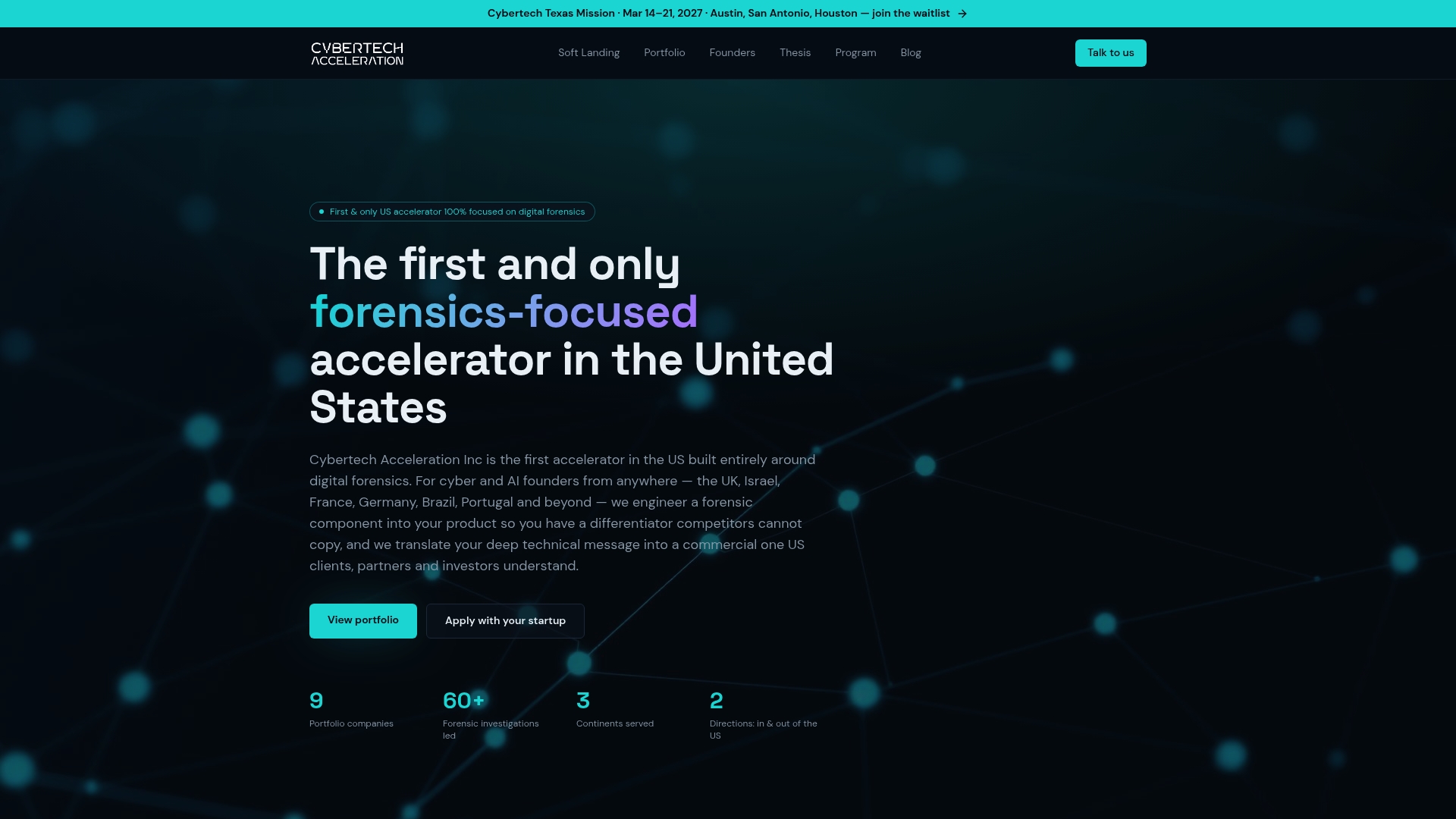
If your goal is the US market, the program is the first step, and the in-person Cybertech Texas Mission is where it comes together. For founders in specific countries, we also run soft-landing support for Portuguese, UK, German and Israeli cyber startups.
To see the whole program, from the November start through the March close, visit Cybertech Acceleration.
If you are a US company looking to enter Europe, the same network of founders, CISOs and MSSPs gives you a route to local introductions. Founders who want to build security into the product from the start can also read our security by design guide for early-stage startups.
A short decision guide
| If you need… | What to look for |
|---|---|
| A large check quickly | A program that offers cash, then model every SAFE and top-up clause against your cap table |
| Cyber-specific buyer trust and US entry | A cybersecurity-only cohort with practitioners and forensic evidence expertise |
| To keep your ownership intact | A fixed fee with no equity, such as ours at US$3,000 |
| Help with the first hires, co-founder and pricing | Mentors who have made those decisions and a small cohort |
| Introductions in the US | A network of portfolio companies, alumni and buyers, plus an in-person trip |
The most common mistake is to compare programs on the percentage alone. Compare what you give up, over the next two rounds, against what you will actually be able to do in six months.
FAQ
How much equity do accelerators take?
Most accelerators take about 5% to 10% of a company, and Carta cites a wider band of about 3% to 10%. The stake is usually paid for with a small amount of funding, a fixed program and introductions. The exact figure depends on the program, the country and whether part of the money arrives as a SAFE.
Is a 7% accelerator stake really 7% of my company?
At the moment you sign, yes. After a later round it shrinks along with everyone else’s stake. Causo Hub’s analysis shows 7% becoming 5.6% after a 20% seed round. A separate uncapped SAFE can add more ownership once its conversion terms are known.
What is the difference between an accelerator and an incubator on equity?
Incubators run flexible timelines for earlier ideas and typically take 0% to 10%. Accelerators run fixed cohorts for companies with a product or early traction and typically take 5% to 10%, per JPMorgan. Our accelerator vs incubator guide goes further.
Does Cybertech Acceleration take equity?
No. The fee is US$3,000 and we take no equity. The program runs from November to March and closes with the Texas Mission in person during SXSW.
Sources
- Carta’s accelerator guide
- GVB World
- SEC’s investor bulletin
- Causo Hub’s 2026 dilution analysis
- Westaway’s founder guide
- Vela Law
- One 2026 analysis
- JPMorgan’s guide
- Sule’s guide to accelerator terms