Encryption Export Compliance for Startups: A US Founder’s Guide
If your product uses encryption and you sell outside the United States, or sell into it from abroad, you need to know whether it is subject to US export controls and how it is classified. For most startups the answer is manageable: classify the product, check whether License Exception ENC applies, handle any reporting, and screen your customers. Founders get into trouble when they skip the classification and assume “we just use standard TLS” is an answer. This guide walks through the logic in the order you will meet it.
TL;DR
- US encryption controls sit in Category 5, Part 2 of the Commerce Control List and are enforced through the Export Administration Regulations (EAR). They cover exports, not domestic use.
- Classification comes first: an ECCN (or EAR99) decides which rules apply. Most commercial products then ship under License Exception ENC or as mass market items, with classification and reporting duties.
- Publicly available open source encryption is largely outside the EAR, and standard cryptography needs no notification.
- Penalties for violations are severe, and “we didn’t know” does not protect you from a misclassification.
- Export compliance is also a sales document: US enterprise buyers ask for it, so settle it before your first large deal.
Table of Contents
- What counts as an encryption export
- ECCN, EAR99 and the classification step
- License Exception ENC: how most startups ship
- Screening customers: the part people forget
- Open source and publicly available code
- What a violation costs
- US versus EU controls
- A worked example
- Where this fits in your US entry plan
- Perspective
- FAQ
- Sources
What counts as an encryption export
The EAR is the set of US rules, run by the Bureau of Industry and Security (BIS) at the Department of Commerce, that controls exports of goods, software and technology. Encryption items sit in Category 5, Part 2 of the Commerce Control List, which covers cryptographic information security, non-cryptographic information security, and items that defeat, weaken or bypass information security.
Two points surprise founders:
- The controls target export, not use. According to a professional summary of global crypto rules, US encryption controls cover export, but not import, domestic sale or use.
- “Export” is broader than shipping a box. Sending software to a customer abroad, re-exporting a US-origin product from one foreign country to another, and making it available to foreign nationals can all be treated as exports or transfers. A SaaS product, a downloadable agent and a hardware appliance can each raise different questions.
The same logic applies to your own team. If you are a non-US startup using US-origin encryption technology, your re-exports can fall under US law too, a point we cover in our guide to AI export controls for US and foreign startups.
ECCN, EAR99 and the classification step
An ECCN, or Export Control Classification Number, is a five-digit alphanumeric code that points to the control requirements for an item on the Commerce Control List, including control reasons and available license exceptions. EAR99 is the label for items subject to the EAR that fall under no specific ECCN.
For encryption, the codes you will meet most often are:
| Code | What it generally covers | Typical path |
|---|---|---|
| 5D002 | Encryption software that is not mass market | License Exception ENC, with classification and reporting duties |
| 5A002 | Encryption hardware that is not mass market | License Exception ENC |
| 5D992.c / 5A992.c | Mass market encryption software and hardware | Self-classification and a report to BIS |
| EAR99 | Items subject to the EAR with no specific ECCN | Generally no license, subject to end-user and end-use checks |
The table is a map, not a ruling. Which row your product falls into depends on its technical specifications: what the cryptography does, whether it is a core function or incidental, who the product is sold to, and how it is distributed. The BIS encryption page is the starting reference and the official place to check current requirements.
A practical sequence:
- Confirm the item is subject to the EAR. Items of US origin and items made abroad with certain US content or technology generally are.
- Inventory the cryptography. List algorithms, key lengths, protocols and what they protect. Distinguish encryption that secures data from encryption that is only used for authentication or digital signatures.
- Classify. Decide the ECCN, or whether the item qualifies as mass market.
- Choose the authorization. Usually License Exception ENC.
- File what the exception requires and keep records.
- Screen every deal against restricted-party lists and the destination.
Write down the reasoning at each step. A one-page classification memo, dated and tied to a product version, is the document a buyer’s procurement team or a regulator will ask for.
License Exception ENC: how most startups ship
License Exception ENC (15 CFR § 740.17) is the main authorization for exporting encryption products. It allows exports to most destinations without an individual license, provided you comply with the classification, reporting and registration requirements that apply to your item. Some destinations and end users are excluded or restricted, so the exception is not a blanket permission.
What this means in practice for a startup:
- Early on, self-classification may be enough for products that qualify, followed by the required report to BIS.
- Some products need a formal classification review before exports to non-government end users in most countries. A professional guide to EU and US differences describes this one-time BIS filing as something the EU has no direct equivalent for.
- Each product release matters. If you change the cryptographic functionality, revisit the classification.
The damaging mistake is treating classification as a checkbox owned by whoever last touched it. In a startup of five people, nobody owns it by default. Name an owner, and make “does this release change the crypto?” a line in your release checklist.
Screening customers: the part people forget
A correct ECCN does not clear a bad customer. Exporters are expected to screen parties against the US government’s Consolidated Screening List and to investigate red flags in a transaction. One compliance reference notes that ignoring red flags can turn a civil violation into a criminal one.
Red flags to train your sales team on:
- A buyer reluctant to say who the end user is or where the product will be used.
- An unusual shipping route, or a freight forwarder listed as the final destination.
- A request to remove or alter the product’s cryptographic features without a business reason.
- Payment from a third country unrelated to the buyer.
For a cybersecurity startup this is not abstract. Security tools are exactly the products that governments and sanctioned parties want, and your first reseller in a new region is often a company you have never met.
Open source and publicly available code
Many security startups publish an open source component or a free client. The rules here are friendlier than most founders expect.
Under 15 CFR § 742.15(b), publicly available encryption source code classified under ECCN 5D002 is not subject to the EAR, with notification requirements for non-standard cryptography. The Linux Foundation’s guidance explains that since 2021, an open source project using standard cryptography has no additional requirements or analysis, and email notifications are needed only for projects using non-standard cryptography, which it describes as fairly rare.
Three details to get right:
- Published means unrestricted further dissemination. The Electronic Frontier Foundation explains that published source code remains published even if it carries a licensing fee or royalty for commercial products built from it.
- Mass market object code can qualify too. BIS says that a free app meeting the mass market criteria and offered free of charge can be considered publicly available and not subject to the EAR, once properly classified.
- Your proprietary build is a separate item. Publishing a library does not automatically free the commercial product you build around it.
If your cryptography is custom or non-standard, take it to export counsel before publishing. That is a legal question, and a lawyer is the right person for it.
What a violation costs
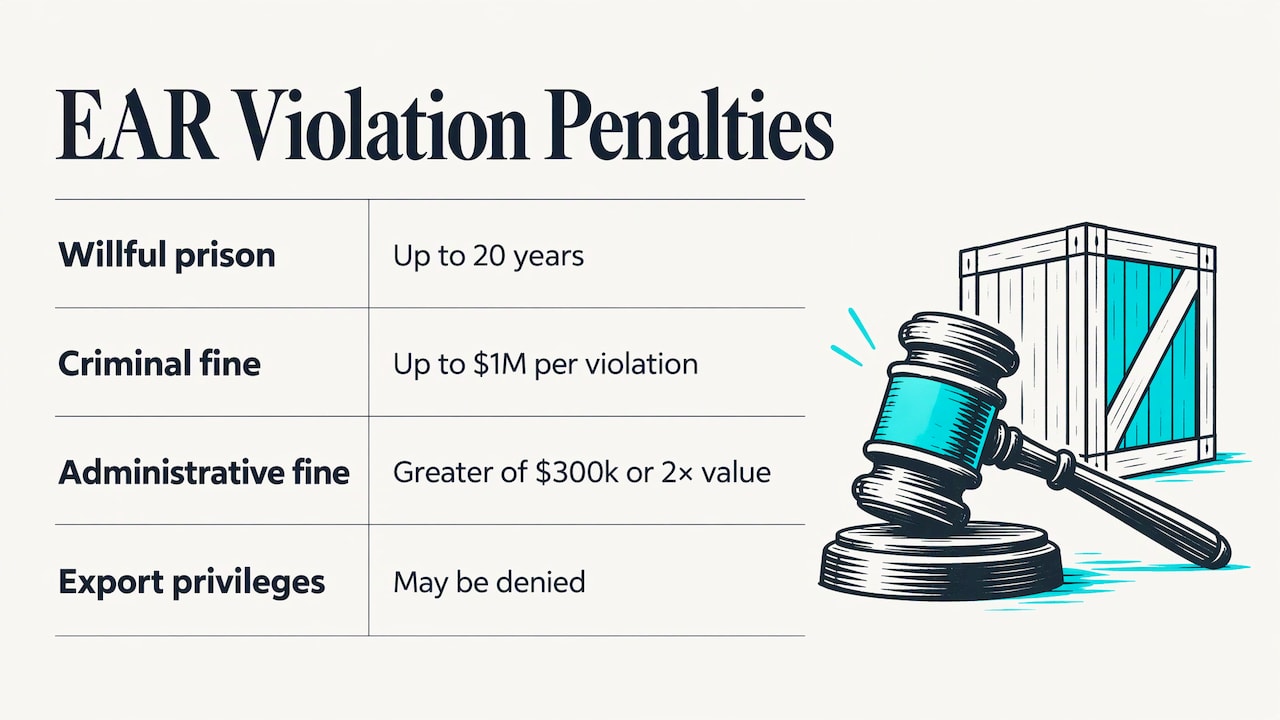
The stakes explain why this belongs on a founder’s agenda. According to a BIS training summary hosted by Harvard, under the Export Control Reform Act criminal penalties for willful EAR violations can reach 20 years in prison and $1 million per violation. Administrative penalties can reach $300,000 per violation or twice the value of the transaction, whichever is greater, and BIS can deny export privileges.
Enforcement does not require a villain. In a 2004 BIS order, a defense contractor was assessed a $6,600 civil penalty for exporting encryption test equipment to Malaysia without a required license and for misleading statements in export documents. The amount was small, but the order also threatened denial of export privileges for failure to pay on time, and that is the part a startup cannot afford. A compliance reference adds that a misclassification can trigger enforcement even without intent to violate.
US versus EU controls
If you are a US company entering Europe, or a European startup selling to US buyers, you operate under two systems. The EU’s regime rests on Regulation (EU) 2021/821, which has a common list of dual-use items and General Export Authorisations for simplified exports to specific destinations. The practical guide cited above describes the EU as jurisdiction-based rather than content-based, and as having no mandatory pre-export product review equal to the US classification filing. EU exporters must still classify items and comply with licensing and catch-all controls.
| Question | United States | European Union |
|---|---|---|
| Governing rules | EAR, Commerce Control List Category 5 Part 2 | Regulation (EU) 2021/821 and national authorities |
| Pre-export product review | One-time BIS review filing in certain cases | No directly equivalent filing |
| Simplified exports | License Exception ENC | EU General Export Authorisations |
| Core test | What the item is and does | Jurisdiction and the dual-use list |
A third layer is easy to miss: other countries restrict the import, use or sale of encryption. Steptoe’s 2025 overview notes that companies often face delays or an inability to sell because they were unfamiliar with local rules. Policy on encryption inside Europe is also moving: the debate over private messaging is covered in this analysis of EU Chat Control, which matters if your product is end-to-end encrypted.
For how this fits into a wider international plan, see our guide on cross-border data transfers, and our page for US companies that want to expand from the US into Europe and Brazil.
A worked example
Imagine a four-person startup in Lisbon that builds an endpoint agent with AES-256 for stored data and TLS for communication to a cloud console. It wants to sell to a US bank and a reseller in Singapore.
- Jurisdiction: the agent is developed abroad, so the team checks whether US-origin content or technology brings it under the EAR. Because it is hosted on US cloud infrastructure and incorporates US-origin components, they treat it as subject to the EAR for planning purposes and document why.
- Classification: encryption is a core function of a security product, so it is unlikely to be treated as incidental. They write down algorithms and key lengths and decide whether it qualifies as mass market or needs the non-mass-market path.
- Authorization: they confirm whether License Exception ENC fits and what filing it triggers.
- Screening: the Singapore reseller is checked against the Consolidated Screening List, and the sales lead asks who the end customers are.
- Record: a dated memo is stored with the release number.
The outcome is a folder the bank’s procurement team can read in ten minutes. That is worth more in a US sales cycle than most founders assume.
Where this fits in your US entry plan
Export classification is rarely the thing that sinks a deal, but a missing answer slows one. US buyers send security questionnaires, and legal and procurement review your compliance posture next to your SOC 2 and data handling answers. Doing the classification before your first pilot, not during contract redlines, keeps the timeline in your hands.
A realistic order for a foreign cyber startup:
- Classify the product and record it.
- Decide where your company and contracts will sit in the US.
- Prepare the compliance answers buyers ask for.
- Start conversations with buyers.
Our US market entry playbook lays out the wider sequence.
Perspective
Founders tend to treat export compliance as a legal chore that comes after product-market fit. We see it differently: it is part of the proof a US buyer needs before they trust a security product.
The cyber founders we work with are often alone with these decisions, or feel alone even with a co-founder. They choose a co-founder, a first hire and a price, and then an export question lands in a procurement email. The answer is not complicated, but it must exist in writing, tied to the product version, and owned by a named person.
That is why our program pairs founders with CISOs, MSSPs and a court-appointed digital forensics expert. A product that can show what it did, when and for whom, with evidence that survives scrutiny, makes classification, screening and buyer due diligence easier to answer with confidence. Compliance and credibility are the same asset when you sell security to the US market.
Thiago Vieira
FAQ
Do I need an export license to sell software with encryption abroad?
Usually not an individual license. License Exception ENC allows exports to most destinations without one, if you meet the classification, reporting and registration requirements that apply. Certain countries, end users and end uses are restricted, so screen each deal.
Is open source encryption software subject to export controls?
Publicly available encryption source code is largely not subject to the EAR. Since 2021, projects using standard cryptography have no extra requirements, and notification applies only to non-standard cryptography. Your proprietary commercial build is treated as a separate item.
What is the difference between an ECCN and EAR99?
An ECCN is a five-digit code that points to the specific controls for an item on the Commerce Control List. EAR99 covers items subject to the EAR that have no specific ECCN. Encryption products usually fall under Category 5, Part 2 codes rather than EAR99.
Does the EU have the same encryption export rules as the US?
No. The EU relies on Regulation (EU) 2021/821, a common dual-use list and General Export Authorisations. It has no directly equivalent mandatory product review filing, but exporters must still classify items and follow licensing and catch-all controls.
Who should sign off on my classification?
Name an internal owner for the technical inventory and the memo. For non-standard cryptography, a borderline classification or a sensitive destination, take the question to export counsel, since the answer is a legal one.
Sources
- Category 5, Part 2 of the Commerce Control List
- professional summary of global crypto rules
- points to the control requirements for an item on the Commerce Control List
- professional guide to EU and US differences
- compliance reference
- 15 CFR § 742.15(b)
- Linux Foundation’s guidance
- Electronic Frontier Foundation
- considered publicly available and not subject to the EAR
- BIS training summary hosted by Harvard
- 2004 BIS order
- Regulation (EU) 2021/821
- this analysis of EU Chat Control