AI Export Controls: What US and Foreign Startups Must Know
AI export controls are legal limits on sending advanced AI chips, certain software and technology, and in some cases model weights to particular countries, companies or end uses. The US framework has changed sharply since January 2025, and a startup that sells across borders needs to know which version of the rules applies to its product. The short answer: the broad 2025 “diffusion” framework is gone, the older Export Administration Regulations (EAR) still apply, and a new policy push now encourages exporting the American AI stack to trusted partners.
This guide is written for cybersecurity and AI founders. It covers what the rules target, what has changed, how to work out whether your own product is affected, and how to build a process that holds up in a deal or a diligence review.
TL;DR
- The US Commerce Department rescinded the AI Diffusion Rule on May 14, 2025, but the underlying EAR, end-user and end-use controls still apply to chips, software, technology and some access.
- Policy now leans toward promoting exports of the American AI technology stack to trusted countries, under Executive Order 14320, while keeping advanced technology from adversaries.
- Remote access and foreign-person access can count as exports, so cloud delivery and foreign hires are not a loophole.
- Classify your product, screen your customers and partners, control access, and write down every decision. That record is what buyers and investors ask for.
- Europe, Japan, the Netherlands and others run their own, unharmonized regimes, so a US-compliant product is not automatically cleared elsewhere.
Table of Contents
- What AI export controls are and why governments use them
- What the US rules cover
- What changed in 2025
- Which destinations, end users and end uses trigger a license
- Cloud, remote access and deemed exports
- How to tell whether your technology is controlled
- How the US approach differs from Europe and the rest of the world
- Where export controls meet a US market-entry plan
- Our perspective
- FAQ
- Sources
What AI export controls are and why governments use them
Export controls restrict who can receive certain goods, software and know-how. For AI, governments treat the technology as a security matter. RAND’s January 2025 assessment says frontier AI may enable advanced military capabilities, lower barriers to weapons of mass destruction, strengthen offensive cyber operations and facilitate mass-surveillance abuses. That is why controls reach both the compute needed to train models and, in some designs, nonpublic model weights.
The same analysis points to a second effect: export controls are increasingly used as system-governance tools, shaping who can build AI and under whose political rules. For a founder, this means the rules are not a technicality. They decide which markets you can enter, which cloud regions you can use and which partners you can take on.
What the US rules cover
The controls touch several layers of the AI supply chain:
| Layer | What can be controlled | Typical concern |
|---|---|---|
| Chips | Advanced computing integrated circuits | Training capacity in restricted destinations |
| Manufacturing equipment | Semiconductor tooling | Advanced chip production abroad |
| Software and technology | Controlled software, source code, technical data | Transfers to restricted parties |
| Model weights | Specified closed-weight models (under the 2025 framework) | Capability leakage |
| Access | Remote access, cloud services, deemed exports | Foreign persons using controlled items |
US controls combine list-based, end-user, end-use and services tools. CSIS notes that they can also apply extraterritorially through the Foreign Direct Product Rule to some foreign-made items built with US technology, software or equipment, an approach used for semiconductor manufacturing equipment and, in January 2025, AI model weights.
The BIS announcement of January 13, 2025 is the clearest statement of how far the model-weight idea went. It excluded models with widely available weights while applying controls to specified advanced closed-weight models. It also described a foreign-direct-product rule reaching certain weights produced abroad using advanced chips made with US technology or equipment. The initial weight threshold was models trained with 10^26 or more computational operations, and authorization was required for exports, reexports or in-country transfers to broad country groups, according to BIS.
If you read older articles on this topic, check which of these provisions they describe. Much of that framework did not survive.
What changed in 2025
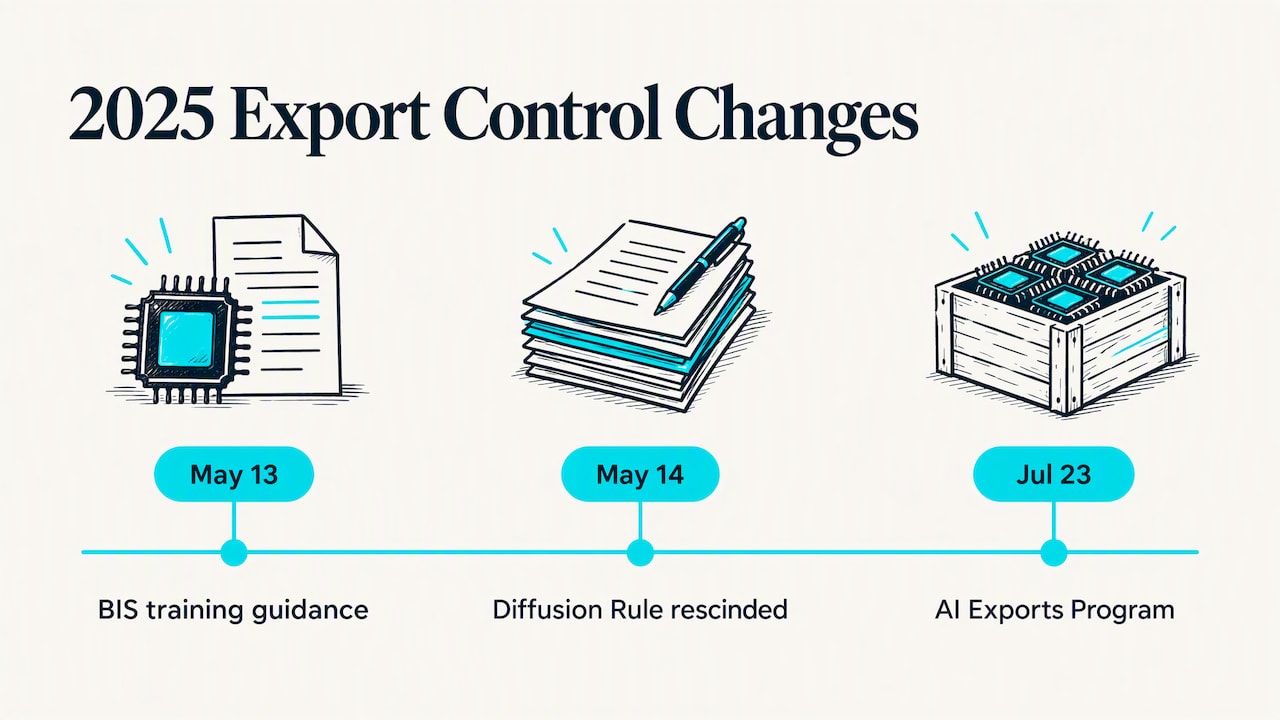
The Commerce Department formally rescinded the AI Diffusion Rule on May 14, 2025, saying it would stifle innovation and burden companies. The administration then said it would pursue a strategy to promote American AI technology with trusted foreign countries while keeping it from adversaries.
Two things followed that matter to founders.
Guidance on training. BIS issued a policy statement on May 13, 2025. It says a license may be required when advanced computing chips or other EAR-controlled items are exported, reexported or transferred with knowledge they will be used to train models for parties headquartered in D:5 countries or Macau for weapons-of-mass-destruction or military-intelligence end uses, as the BIS policy statement explains. Knowledge of the end use is the trigger, which is why documentation of what you asked and what you learned about a customer matters.
A promotion strategy. On July 23, 2025, the president issued Executive Order 14320, “Promoting the Export of the American AI Technology Stack.” It directs Commerce to set up an American AI Exports Program and call for proposals from industry-led consortia. Proposals must include full-stack AI packages, name target countries or regions and comply with US export control regimes, among other requirements. Selected packages can get priority access to federal financing and other tools.
The net picture: the government is simultaneously loosening some blanket restrictions and encouraging exports to vetted partners, while keeping the chokepoints around adversaries. Analysts disagree on whether that balance is right. One commentator argues that overbroad controls risk forfeiting the AI race and that the American AI stack should become the international standard, with chip sales to vetted partners and safeguards against misuse. Whatever your view, the practical rule for a company is the same: the law on the books, not the debate, governs your shipment.
Which destinations, end users and end uses trigger a license
Three questions decide most cases:
- Where is the item going? Country group matters, and so does where the buyer or its ultimate parent is headquartered.
- Who is the end user? Restricted-party lists can block a deal regardless of the product.
- What will it be used for? Certain military-intelligence and weapons end uses trigger license requirements even for otherwise low-risk items.
Even an item that needs no license for most destinations can need one for a listed party or a prohibited use. Treat destination, end user and end use as three separate checks, not one.
Cloud, remote access and deemed exports
Founders often assume that a SaaS product avoids export rules because nothing physically ships. Guidance from a US national laboratory’s export office says otherwise: reexports and transfers of controlled items, technology, software, data or access may be subject to US controls, remote access from abroad is treated as an export to the user’s country, and foreign-person access to controlled AI models inside the United States may constitute a deemed export.
That has direct consequences for how you run a startup:
- A contractor in another country with admin access to controlled technology is an export question.
- A foreign national engineer working in your US office can raise a deemed-export question for controlled technology.
- Hosting training runs in a foreign data center is a transfer decision, not just an infrastructure choice.
If your team is international, the hiring and access design deserves the same attention as the product design. Our guide on cross-border data transfers covers the data-protection side of the same problem.
How to tell whether your technology is controlled
The same federal guidance gives a workable method: assess the item’s function, performance, design, destination, end use and end user, screen collaborators against restricted-party lists, control access to systems and data, and document classification and access decisions. Here is how that becomes a routine for a startup.
Step 1: Classify what you sell
List every product component: model, weights, training pipeline, software, documentation, hardware. Match each to a classification under the Commerce Control List, or document why it is not listed. Security and encryption features often change the answer for cybersecurity products, so classify them deliberately instead of assuming.
Step 2: Map your flows
Draw where code, weights, data and credentials move: which countries, which vendors, which employees, which cloud regions. Include support access and incident response, where engineers often receive broad rights quickly.
Step 3: Screen every counterparty
Check customers, resellers, investors with technical access, contractors and universities against restricted-party lists before contracts are signed, and re-check on a schedule. Record the date, the list version and the result.
Step 4: Control access technically
Use role-based access, geographic restrictions where they are needed and logging. Policy documents that the systems do not enforce will not convince an auditor.
Step 5: Write it down
Keep a short classification memo per product, a screening log and a record of every access decision. When a customer asks whether your AI product is export compliant, you should be able to hand over a file within a day.
For unclear cases, bring in export counsel. A misclassification can carry penalties and, for a startup, the loss of a funding round.
How the US approach differs from Europe and the rest of the world
The US combines unilateral, plurilateral, country-specific and extraterritorial tools. CSIS observes that allies generally rely on multilateral regimes, though they can impose some unilateral semiconductor controls, and that China has expanded its own export-control and economic-security authorities.
SIPRI’s March 2026 analysis frames coverage globally as extending beyond hardware to transfers of AI algorithms, training data and models, noting that the Wassenaar Arrangement provides de facto international standards for military-item controls and that national implementation remains important.
In the European Union, hardware required to train or run frontier models, specifically high-performance GPU clusters, can fall under Category 4 dual-use controls. Dual-use rules in Europe also shape defence-adjacent work, and teams exploring that field can start with defence R&D partnerships in Europe.
The practical result is fragmentation. A US-origin product sold to a German customer can face US rules through reexport and EU dual-use rules at the same time. Two other pieces of our work cover the European side: EU AI Act compliance and NIS2 and US compliance for security vendors.
Where export controls meet a US market-entry plan
For a foreign startup entering the US, export controls work in two directions. Your product may carry US-origin technology that triggers reexport rules when you sell outside the US, and your US entity, staff and cloud choices may create deemed-export questions from day one. For a US company entering Europe, the EU dual-use rules and local compliance are the mirror image.
Build the export review into your entry plan instead of treating it as legal cleanup. Our US compliance checklist for foreign cybersecurity startups and US market entry checklist for cybersecurity startups show where it fits in the sequence.
Our perspective
We work with cybersecurity and AI founders on the hardest part of selling: being believed. In our experience, export compliance is one more place where credibility decides the deal. A buyer’s security or legal team rarely asks whether you are compliant in the abstract. They ask for evidence: a classification memo, a screening log, an access record.
That is why we focus on digital forensics. A company that can show traceable, defensible records of what its system did, who accessed it and when has an advantage in procurement, in diligence and in front of regulators. Export decisions are no different. Teams that treat documentation as part of the product move faster, because they answer a questionnaire in a day instead of a month.
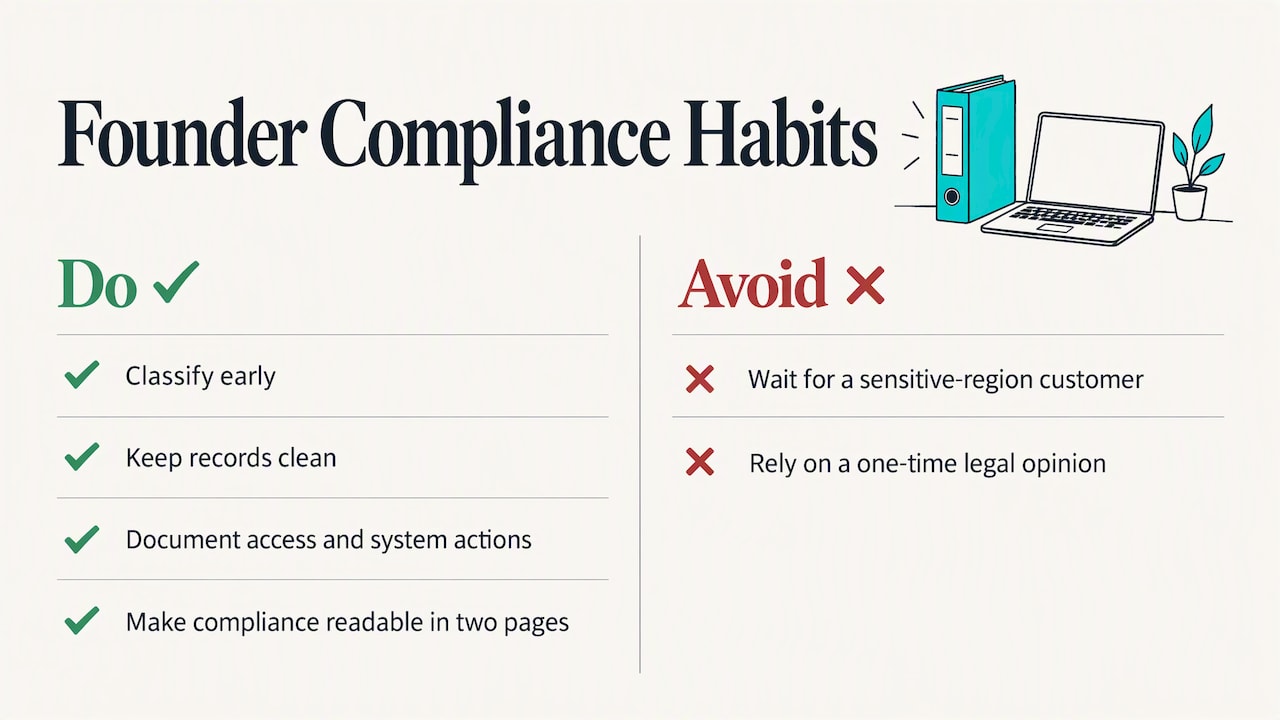
Our advice to founders is plain. Do not wait for a customer in a sensitive region to force the question. Classify early, keep your records clean and make your compliance story something an investor can read in two pages. The rules will keep moving, and a documented process adapts to change far better than a one-time legal opinion.
— Thiago Vieira
FAQ
Are AI export controls still in force after the AI Diffusion Rule was rescinded?
Yes. Rescinding the AI Diffusion Rule removed that specific framework, but the broader EAR, restricted-party lists and end-use controls remain. Chips, controlled software and technology can still need licenses depending on destination, end user and end use.
Do export controls apply to cloud services and remote access?
They can. Federal guidance treats remote access from abroad as an export to the user’s country, and foreign-person access to controlled AI models in the US can be a deemed export. Delivering software as a service does not remove the analysis.
Do open-weight models fall under the controls?
Under the January 2025 framework, models with widely available weights were excluded from the model-weight controls. That framework was later rescinded, so confirm the current position with export counsel before you rely on it for any release.
Do European companies face the same rules as US companies?
No. The EU has its own dual-use regime, and high-performance GPU clusters can fall under its Category 4. A product can face both European rules and US reexport rules at once.
What should a startup document first?
Start with a classification memo for each product, a log of restricted-party screening and a record of who has access to controlled systems. These three documents answer most customer and investor questions.
Sources
- facilitate mass-surveillance abuses
- used for semiconductor manufacturing equipment and, in January 2025, AI model weights
- according to BIS
- formally rescinded the AI Diffusion Rule on May 14, 2025
- as the BIS policy statement explains
- comply with US export control regimes
- overbroad controls risk forfeiting the AI race
- may constitute a deemed export
- national implementation remains important
- can fall under Category 4 dual-use controls
- defence R&D partnerships in Europe