GDPR for SaaS Startups: A Practical Compliance Plan

If your SaaS product handles personal data of people in the EU, the GDPR applies to you, wherever your company is incorporated and however small it is. The work is manageable when you do it in the right order: map your data, fix your contracts, build user rights into the product, and set up transfers and breach handling before an enterprise buyer asks for them. This guide walks through that order, written for founders rather than lawyers.
TL;DR
- GDPR applies to any startup that processes personal data of people in the EU, with no revenue or headcount threshold, including US companies with EU users or EU-based customers.
- Most B2B SaaS companies act as a processor for their customers, so a solid Data Processing Agreement (DPA) is the document that wins or stalls deals.
- Breaches must be reported to the authority within 72 hours of you becoming aware, so write the incident plan before you need it.
- If your product profiles users or makes automated decisions, plan a DPIA early, before processing starts.
Table of Contents
- Does GDPR apply to a US SaaS startup?
- Controller or processor: the question that shapes everything
- The compliance plan, step by step
- Your DPA is a sales document
- Moving data between the EU and the US
- Breach notification: the 72-hour clock
- Do you need a Data Protection Officer?
- AI features and the DPIA trap
- Treat privacy as a product feature
- A realistic timeline
- Where we see the real friction
- If you are crossing the Atlantic
- FAQ
- Sources
Does GDPR apply to a US SaaS startup?
Usually yes, and founders are often surprised by how. The regulation covers organizations outside the EU that offer services to people in the EU or monitor their behavior, as the EU’s own business guidance on GDPR explains. In practice, you are in scope if any of these is true:
- You market to EU customers, for example with localized pages, euro pricing or EU sales reps.
- You use analytics or tracking that follows EU visitors on your site or inside your app.
- Your business customers feed EU employees’ or customers’ data into your platform, even if you never targeted Europe.
- You hold EU or UK sales leads in your CRM. Kantis notes that leads, employees and users all count.
A common founder question is whether GDPR matters when all current customers are American. If nobody in the EU touches your data today, it may not. But the first prospect from Berlin or Amsterdam on your email list changes that, and retrofitting is slower than building it in.
The regulator also does not care about your stage. The securely.dev guide puts basic compliance for a SaaS startup at roughly four to six weeks of work, which is a useful planning figure for a small team, not a guarantee.
Controller or processor: the question that shapes everything
Before you write a single policy, decide which role you play for each data set. It determines which obligations are yours.
| Situation | Your role | What it means |
|---|---|---|
| Customer data uploaded into your platform by your business customers | Processor | You act on the customer’s instructions and sign a DPA with them |
| Your own marketing site, newsletter, CRM and product analytics | Controller | You need a legal basis, a privacy notice and a way to honor rights requests |
| Account data for your customers’ staff (logins, billing contacts) | Usually controller | Treat it like any other first-party data |
Most B2B SaaS companies are both at once. Write that down in a short data map: what you collect, why, where it is stored, who receives it and how long you keep it. Every other step builds on this document, and it is what a customer’s security questionnaire will ask about.
The compliance plan, step by step
- Map your data and vendors. List every system that touches personal data: your database, logging, support desk, email tool, analytics, payment provider and cloud host. Experts point out that each new SDK or marketing pixel adds a processing activity that must be mapped and disclosed, so this is a living document, not a one-time exercise.
- Pick a legal basis for each activity. Contract, legitimate interests and consent cover most SaaS cases. Do not default to consent for everything: consent can be withdrawn, which makes it fragile for core product functions.
- Publish a clear privacy notice. Say what you collect, why, who receives it, where it goes and how long you keep it. Match it to your data map, not to a template you have not read.
- Build user rights into the product. People can ask for access, correction, export and deletion. Decide now how a request reaches you, who handles it and how deletion propagates to backups and sub-processors. Export and deletion are the two requests you will see most.
- Sign DPAs and keep a sub-processor list. Details in the next section.
- Set up transfer mechanisms. Covered below.
- Write an incident response plan. Who decides, who notifies, and what evidence you keep.
- Decide whether you need a DPO or a DPIA. Both are covered later in this guide.
Your DPA is a sales document
For a B2B SaaS company, the DPA is where GDPR meets revenue. When you are a processor, Article 28 requires a contract with your customer that sets out, among other things, what you process and why, your security measures, and your use of sub-processors. The Kantis guide describes how US startups often treat GDPR as a box to tick for larger customers, then lose time or the deal when an enterprise legal team rejects a weak DPA template.
A practical DPA kit includes:
- A standard DPA you can sign the same day, with the Article 28 terms covered.
- A public sub-processor list and a process for notifying customers of changes.
- A short security overview (encryption, access control, logging, backup, incident response).
- A named contact for privacy questions.
Having these ready shortens procurement. If you sell to larger companies, security reviews tend to run alongside the privacy review, so our guide to security by design for early-stage startups pairs well with this one.
Moving data between the EU and the US
If you are a US company, data transfers are where your position differs from that of a European startup. The European Data Protection Board’s Guidelines 05/2021 treat the territorial-scope rule and the international-transfer rules as two separate tests. Being directly subject to GDPR does not remove the need for a valid transfer mechanism.
Your realistic options:
- EU-US Data Privacy Framework. The European Commission adopted an adequacy decision on 10 July 2023, and transfers to certified US organizations can proceed without extra instruments. Certification is voluntary self-certification, and the framework’s legal status has been challenged in court, so check its current standing before you rely on it as your only mechanism.
- Standard Contractual Clauses (SCCs). The fallback when you are not certified, and a sensible backup when you are. Many enterprise customers will ask for them regardless.
- Data residency. Hosting EU customer data in an EU region reduces transfer questions, though remote support access from the US can still count as a transfer.
Whichever route you choose, write it into your DPA and privacy notice so the answer is the same everywhere.
Breach notification: the 72-hour clock
Under the rules summarized by the European Commission, an organization must notify the supervisory authority without undue delay and at the latest within 72 hours of becoming aware of a breach, unless it is unlikely to put people’s rights and freedoms at risk. As a processor, you must tell your controller customers about every breach you experience, and they then run their own clock.
That means the plan needs to answer, in advance:
- Who can declare an incident, including on a weekend?
- Where are logs kept, and how do you tell what data was affected?
- Which customers do you notify, and through which channel?
- Who drafts the authority notification when you are the controller?
Run one tabletop exercise per year. An hour spent walking through a fake breach will expose gaps that no policy document does.
Do you need a Data Protection Officer?
Probably not yet. A DPO is mandatory only in limited cases, such as large-scale processing of sensitive data or large-scale, regular and systematic monitoring of individuals, as in behavioral advertising or profiling. Most early-stage B2B SaaS companies fall below that line, though some appoint one voluntarily to manage risk. Even without a DPO, name one person who owns privacy, so questionnaires and rights requests do not land in a shared inbox.
AI features and the DPIA trap
If your product uses machine learning to profile people, track behavior or make decisions that affect access or rights, treat it as high risk. A Data Protection Impact Assessment is a written analysis of risks to individuals and how you reduce them. Supervisory authorities publish lists of processing that requires one, such as the UK ICO’s list shared with the EDPB, which includes profiling and behavior tracking.
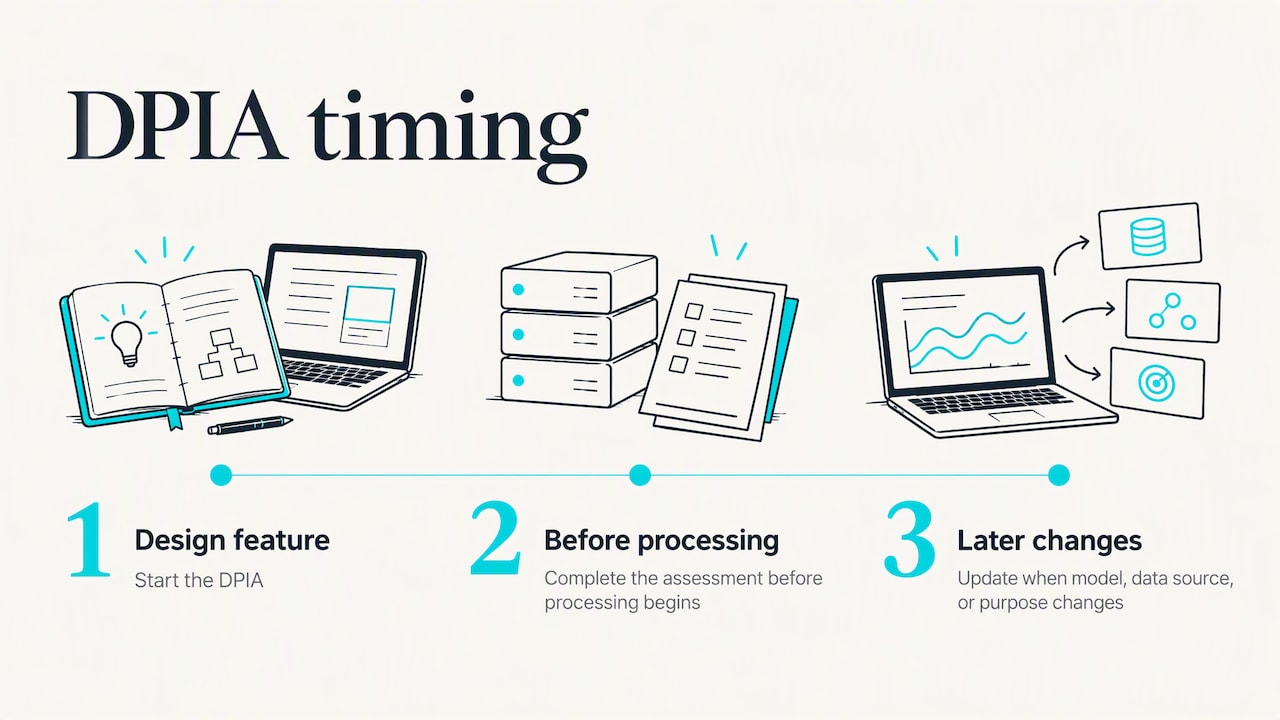
The timing is what catches founders out: the DPIA must happen before processing begins, not after launch. Start it when you design the feature, and update it when the model, the data source or the purpose changes. If you also sell into Europe with AI, read our piece on EU AI Act compliance and traceable evidence, because the two regimes ask for overlapping documentation.
Treat privacy as a product feature
Article 25 asks for data protection by design and by default. That is also what enterprise buyers want to see. LexVibe’s SaaS guide argues that privacy built into the product smooths procurement, because vendor risk teams can find the answers in your documentation instead of chasing you.
Concrete defaults that pay off:
- Collect the minimum: if a field does not serve a feature, drop it.
- Set retention periods and automate deletion.
- Separate tenant data and log who accessed what.
- Make analytics opt-in or anonymized where you can.
- Keep admin tools that can export or delete one user’s data without an engineer writing a query.
A realistic timeline
| Week | Focus | Output |
|---|---|---|
| 1 | Data map, roles, vendor list | One-page data inventory |
| 2 | Legal bases, privacy notice, cookie review | Published notice, updated consent flow |
| 3 | DPA template, sub-processor list, SCCs | Signable contract pack |
| 4 | Rights requests, retention, deletion | Working export and delete process |
| 5 | Incident plan, tabletop exercise | Written runbook, named owners |
| 6 | DPIA screening for AI features, final review | Decision log, gaps list |
Six weeks assumes a small team doing this alongside product work. Adjust to your size, and keep a dated log of decisions. A written record of why you chose a legal basis or skipped a DPO is itself evidence of compliance.
Where we see the real friction
Privacy work is easy to start and hard to prove. A policy page says what you intend; buyers want to see what actually happened to data, and regulators want the same.
At Cybertech Acceleration, we work with cybersecurity and AI founders on credibility, and we see one pattern again and again: the startups that close enterprise deals are the ones that can show evidence, not just assurances. For GDPR that means logs you can query, a deletion that you can demonstrate, and an incident timeline you can reconstruct within 72 hours. Our focus on digital forensics shapes how we look at this. If you cannot reconstruct what happened to a record, you cannot honestly tell a customer or a regulator. We encourage founders to build those traces into the product early and to describe them in plain business language, because the person signing the contract is rarely an engineer.
— Thiago Vieira
If you are crossing the Atlantic
GDPR is one half of a two-way move. European cybersecurity and AI startups entering the US face their own compliance questions, and US companies entering Europe face the ones above. Cybertech Acceleration is an accelerator dedicated to digital forensics for cybersecurity and AI startups, with structured market entry, compliance and local setup, and introductions to potential partners in both directions. If you are planning a US launch from Europe, see our soft landing program, or read the US compliance checklist for foreign cybersecurity startups. Founders weighing a specific country can start with our German or UK pages.
FAQ
Does GDPR apply if all my customers are in the US?
Not automatically. It applies when you offer services to people in the EU, monitor their behavior, or process EU residents’ data on behalf of a customer. If a US customer’s EU employees use your product, you are likely in scope as a processor. Check your analytics and lead lists too.
What is the minimum GDPR setup for a seed-stage SaaS company?
A data map, a privacy notice that matches it, a working process for access and deletion requests, a signable DPA with a sub-processor list, a transfer mechanism and an incident plan. One practitioner guide frames the core as a privacy policy plus user data rights, and says a DPO is not needed at that stage.
Do I need a DPO?
Only if your core activities involve large-scale sensitive data or large-scale systematic monitoring of individuals. Most early-stage B2B SaaS companies do not meet that test. You can still appoint someone voluntarily, and you should name an internal privacy owner either way.
When is a DPIA required for an AI product?
When processing is likely to create a high risk to people, which regulators’ lists associate with profiling, behavior tracking and automated decisions affecting access or rights. Do it before processing begins. If you are unsure, a short screening note documenting why you concluded one was not needed is better than nothing.
Is a US-based startup safe if it uses the Data Privacy Framework?
It helps for transfers from the EU to a certified US company, but it does not replace the rest of GDPR: you still need a legal basis, rights handling, a DPA and breach procedures. Because the framework has faced legal challenges, many companies keep SCCs as a backup. Ask your counsel for the current position.
Sources
- within 72 hours
- business guidance on GDPR
- Experts point out
- transfers to certified US organizations
- the UK ICO’s list shared with the EDPB