API Logging for Forensics: What to Record and How to Protect It

An API log is forensic-grade when it lets an investigator answer four questions after a breach: who called, what they touched, when it happened and whether the record itself can be trusted. Most startup logs answer the first three badly and the fourth not at all. If you sell security or AI software to US buyers, your own API audit logs are part of the product, because buyers and, in a dispute, courts will ask to see them.
This guide is for founders, not log-analysis specialists. It explains what to record, which fields make an entry useful, how to protect the records, and how to test whether your logs would survive a real incident.
TL;DR
- Operational logs, access logs and audit logs are different things. Forensics depends on audit-style records that name an actor, a target and an outcome.
- Record authentication, authorization, privilege changes, token lifecycle, sensitive-data access, exports and configuration changes, each with a UTC timestamp and a correlation ID.
- Protect logs from tampering and unauthorized reads, and keep secrets and unnecessary personal data out of them.
- Missing log entries do not prove nothing happened. Know which routes and services fall outside your collection.
- Forensic readiness is cheaper to build at the start than to retrofit when a US customer asks for evidence.
Table of Contents
- API logs, audit logs and why the difference matters
- Which API events to record
- Fields that make an entry usable
- Protecting logs so they hold up
- Blind spots and privacy risks
- What a gateway log cannot tell you
- A readiness test you can run this month
- Why US buyers care about this
- Perspective
- FAQ
- Sources
API logs, audit logs and why the difference matters
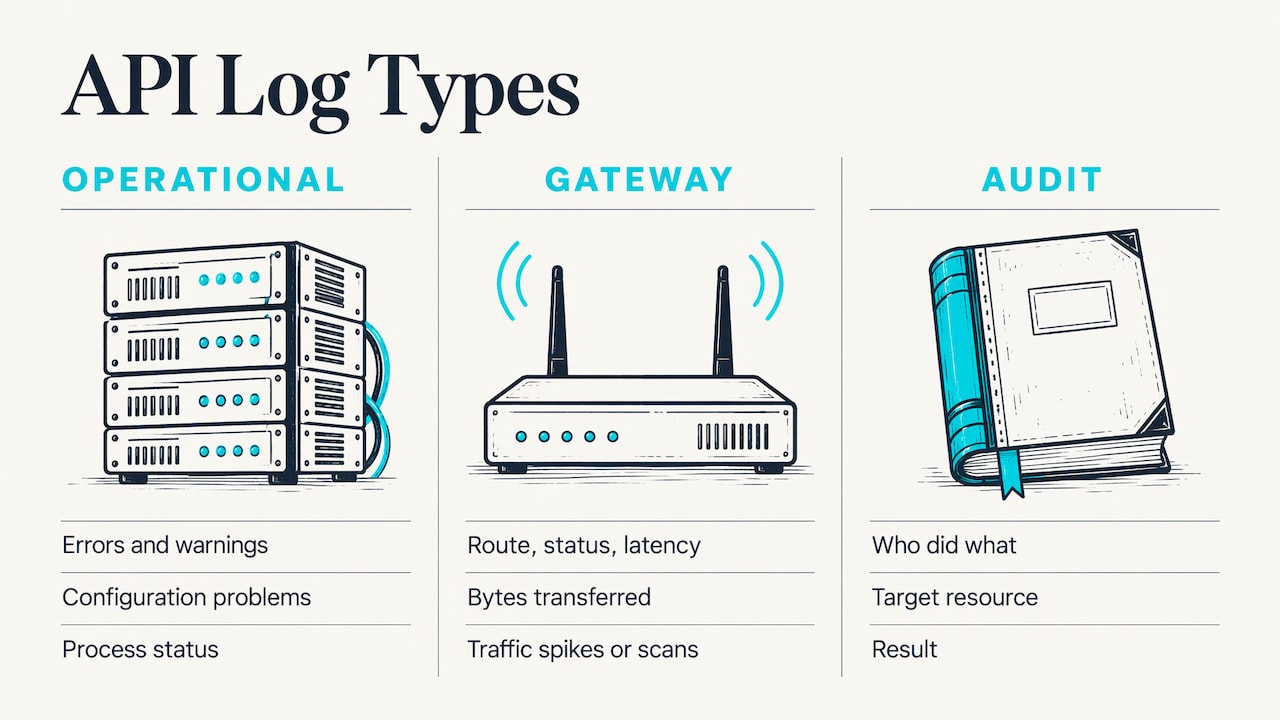
Three kinds of records get called “API logs”, and an investigation needs them for different reasons.
Operational (server) logs describe how a process is running: errors, warnings, configuration problems. HashiCorp’s Vault documentation draws this line clearly: its audit devices record API requests and responses, while server logs cover process errors and configuration warnings.
Gateway or access logs show how traffic moved: route, status code, latency, bytes. They are useful for spotting a spike or a scan. They rarely tell you who the verified person or service was, or what business object was touched.
Audit logs are the records of who did what to which resource, and with what result. They are the ones that matter in a forensic review.
OWASP’s Logging Cheat Sheet makes the practical point that application-level security event logging adds insight that network, operating-system, web-server and database logs alone often lack. It also notes that operational, audit and security logs serve different purposes and often should be kept separate. If everything goes into one stream, the one record you need in a dispute is buried among debug noise, and protecting it becomes harder.
Which API events to record
The goal is not to log everything. OWASP warns against logging too much as well as too little. The goal is to capture the events that change who can do what, and the events that move or expose data.
The OWASP DevSecOps Guideline lists the core set:
- Authentication and authorization events, including MFA and denials
- Privilege escalations
- Token issuance and revocation
- Input validation failures
- Administrative and configuration changes
- Access to sensitive data, and exports
- Output from security tools
- Session lifecycle events
- Deployments
The UK National Cyber Security Centre (NCSC), the British government’s cyber authority, gives matching advice in its guidance on securing HTTP-based APIs: log authentication and authorization events, permission changes, failed requests and errors, and sensitive operations such as password changes, account modifications and privilege escalations. The guidance is British, but the logic does not depend on the country.
GitLab publishes its internal Security Logging Standard, which is a useful model of what a mature company requires. It adds token and key lifecycle, data access and exports, security detections, API actions and automated system actions to the list.
A first-pass priority list for an early team
If you have a small team and a limited week, start here:
- Every login, failed login and token issuance or revocation.
- Every permission or role change, and who made it.
- Every read or export of customer data above a size or sensitivity threshold.
- Every administrative or configuration change through the API.
- Every deployment that changes API behavior.
These five cover most of what a buyer’s security questionnaire and most incident reviews will ask about.
Fields that make an entry usable
An event with no context is nearly worthless. GitLab’s standard requires, at minimum, the event and entity type, a UTC ISO-8601 timestamp, a unique event ID, an actor identifier and username, the source IP, the target resource identifier, type and details, and the outcome. The NCSC’s list is shorter but similar: timestamp, source IP, user identity and the accessed endpoint.
The OWASP DevSecOps Guideline adds two practices that pay off later:
- Correlation IDs. One identifier carried from the gateway through the application to the database, so an investigator can follow a single request across systems.
- UTC timestamps with millisecond precision. Mixed time zones and second-level precision make sequencing events during a fast attack guesswork.
Here is what the difference looks like in practice.
| Weak entry | Forensic-grade entry |
|---|---|
| “POST /export 200” | Event ID, UTC time to the millisecond, actor ID and username, tenant, source IP, resource exported, row count, outcome, correlation ID |
| “Login failed” | Actor attempted, source IP, method (password, SSO, MFA step), reason code, session ID, correlation ID |
| “Config updated” | Who changed it, which setting, previous and new value reference, approval or ticket reference, time |
The left column tells you something happened. The right column lets you say who did it, to what, and in what order.
For a deeper design discussion, see our guides on audit trail design and, for model-driven products, AI audit trails.
Protecting logs so they hold up
A log that someone could have edited is a weak exhibit. OWASP’s Logging Cheat Sheet is direct about the controls:
- Protect logs from tampering in transit, and from unauthorized access, modification or deletion once stored.
- Use tamper detection for stored logs.
- Copy logs to read-only media as soon as possible.
- Record and monitor who accesses the logs, and review read privileges periodically.
- Do not destroy logs before the required retention period, and do not keep them beyond it. Legal, regulatory and contractual obligations can all set those periods.
HashiCorp’s Vault shows what a strict design looks like: it sends each API request and response to its enabled audit devices and refuses the request if it cannot save the audit entry to at least one of them. The principle is worth borrowing for your most sensitive actions: if the action cannot be recorded, it does not happen.
For the mechanics of chaining entries, signing them and storing them so you can defend them later, read our guide to tamper-proof logging.
Retention is a decision, not a default
The length of time you keep logs should come from your contracts, your regulators and the kinds of incidents you need to investigate. Write the period down per log type, and write down who may delete and how. Whether a specific period applies to you is a question for your counsel; the technical point is that your retention setting should be a documented choice rather than whatever the cloud default happens to be.
Blind spots and privacy risks
Logging has two failure modes: gaps and leaks.
Gaps. The OWASP DevSecOps Guideline notes that siloed logs can hide multi-stage attacks, and that stopped log shipping can leave holes. Monitor ingestion itself. A quiet log stream should trigger a question, not comfort.
Leaks. Logs can expose secrets and personal information. The NCSC says passwords, API keys, access tokens and personally identifiable information should not be logged, and recommends redaction or masking along with encryption in transit and at rest. OWASP adds session identifiers, encryption keys and payment-card data to the do-not-log list. Its Logging Cheat Sheet also cautions that logs may themselves hold personal, sensitive or commercially valuable information, so access controls matter as much as integrity controls.
The practical rule: log that an action happened and which object it touched, not the secret or the full personal record inside the payload. Store identifiers, not contents.
What a gateway log cannot tell you
Many early teams rely on their API gateway as the one source of truth. A gateway sees transport: route, status, size. It does not know whether the caller was entitled to that customer’s record, or what the application did with the request. A forensic review therefore correlates several sources: the gateway, the application, the identity provider and the database or audit records, joined by a trace or transaction ID.
Two habits keep that correlation honest:
- Keep each source’s original timestamp, and note any known clock drift, instead of overwriting times with a normalized value.
- Describe the quality of each source: complete, sampled, delayed, redacted or unavailable.
The second habit matters most. If a route fell outside your collection, the absence of log entries for it does not show that nothing happened there. Say so in the report, rather than letting a reader assume silence means safety.
Our digital forensics investigation process guide walks through how investigators move from preservation to reporting.
A readiness test you can run this month
Forensic readiness means your logs are good enough before anyone asks. Run this check against one realistic scenario, for example “a customer says a former employee’s token exported their data last Tuesday.”
- Find the actor. Can you name the identity behind the token, and when it was issued and revoked?
- Find the action. Can you list every call that token made, in order, with outcomes?
- Find the data. Can you say which records or how many rows left the system?
- Prove the record. Can you show the logs were not changed, and who could read or edit them?
- State the limits. Can you list which services or routes fell outside collection?
If any answer is “we would have to guess”, that is your next sprint. Pair this with an attack-side view: this API security testing guide shows how testing exposes the endpoints where your log coverage matters most. For the legal and technical side of preparing for incidents, our forensic readiness guide goes further.
Why US buyers care about this
If you are building a security or AI product for the US market, your logs have two audiences. The first is your own team during an incident. The second is your customer’s security reviewer, who wants to know that your product leaves a trail they can rely on, and, if a matter turns contentious, a lawyer who will ask whether the record can be defended. Evidence you can show is a differentiator against competitors whose logs only say that a request happened.
Founders outside the usual startup hubs often meet this requirement late, when a first US enterprise deal stalls on a questionnaire. Designing the audit trail early removes that obstacle.
Perspective
Most founders treat logging as plumbing. We treat it as the first piece of evidence your product produces.
When a founder works alone, the logging design usually comes from whatever the framework generated. That is fine until a buyer asks who changed a permission, or a lawyer asks whether a record could have been altered. At that moment the founder needs an answer that holds up, not a promise.
That is why our program pairs founders with a court-appointed digital forensics expert alongside CISOs, MSSPs and exited founders. Evidence-grade proof is something you design into the product: the right events, the right fields, controls that protect the record. Done early, it also becomes a sales argument in the US, where buyers read a clear audit trail as maturity.
We built the program for founders who carry these decisions alone: what to log, what to price, whom to hire first, and how to enter the US. A small cohort, a network of more than 350 cyber founders and a Texas Mission are there so that none of those decisions has to be made in isolation.
Thiago Vieira
FAQ
What is the difference between API logs and API audit logs?
API logs is the broad term for any record of API activity, including errors, traffic and performance. API audit logs are the subset that records who did what to which resource and with what outcome. Audit logs are the ones an investigator relies on, so they should be structured, attributable and protected separately where practical.
How long should I keep API audit logs?
There is no single answer. OWASP advises neither deleting logs before the required retention period nor keeping them beyond it, and notes that legal, regulatory and contractual obligations can affect the length. Set a period per log type, document it, and confirm it with your counsel and your customer contracts.
Should I log request and response bodies?
Usually not in full. The NCSC and OWASP both advise keeping passwords, API keys, access tokens and personal data out of logs, and using masking or redaction where sensitive values appear. Log identifiers and metadata about the object touched, so you can reconstruct events without creating a second copy of sensitive data.
Does a missing log entry mean nothing happened?
No. If a route, service or time window fell outside your collection, silence proves nothing. Monitor that log shipping keeps running, and record which sources are complete, sampled, delayed or redacted, so any investigation states its limits honestly.
What is the quickest improvement for a small team?
Add a correlation ID to every request, standardize on UTC timestamps, and log authentication, permission changes, data exports and configuration changes with actor, target and outcome. Then send the records to storage that your application accounts cannot edit.
Sources
- audit devices record API requests and responses
- application-level security event logging adds insight
- OWASP DevSecOps Guideline
- guidance on securing HTTP-based APIs
- Security Logging Standard