FIPS 140-3 Overview: Requirements, Levels and Validation
FIPS 140-3 is the US government standard that decides whether the cryptography inside your product counts as protection at all. If you sell a product that encrypts, signs or stores keys to US federal agencies, or to buyers who copy federal rules, you will be asked whether your cryptographic module is validated under it. This guide explains what the standard covers, what the four levels mean, how validation works and what changed with FIPS 140-2, written for founders who need to make the call without becoming cryptography auditors.
TL;DR
- FIPS 140-3 is NIST’s standard for cryptographic modules protecting sensitive but unclassified information. It has four security levels and replaces FIPS 140-2 entirely.
- Validation is done by an accredited lab and then reviewed by the Cryptographic Module Validation Program (CMVP), run jointly by the US and Canada. Your own claim of “FIPS-compliant” counts for nothing without a CMVP listing.
- Validation covers a defined module and boundary, not your whole product. Draw that boundary early.
- FIPS 140-2 certificates are no longer usable for new systems after September 21, 2026. New buyers will ask for 140-3.
- Higher level does not mean better fit. Choose the level your buyer’s requirements call for.
Table of Contents
- What FIPS 140-3 is and why buyers ask for it
- The four security levels
- The 11 requirement areas
- How the validation process works
- FIPS 140-3 versus FIPS 140-2: what changed
- What a validation does and does not cover
- Post-quantum algorithms and the validation gap
- Where FIPS 140-3 sits among the other US credentials
- A practical sequence for a founder
- Promo: building US-buyer proof into your product
- Perspective
- FAQ
- Sources
What FIPS 140-3 is and why buyers ask for it
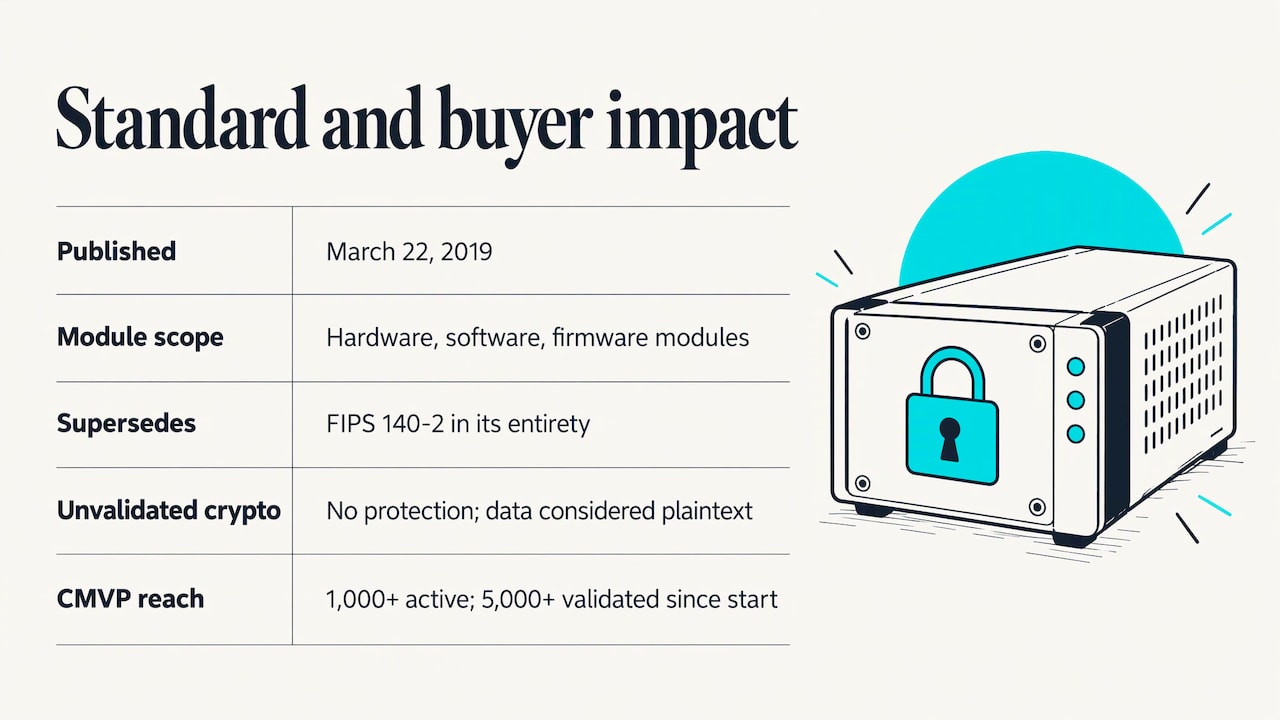
NIST published FIPS 140-3, Security Requirements for Cryptographic Modules, on March 22, 2019. It sets the requirements for hardware, software and firmware modules that protect sensitive information in federal systems, and it supersedes FIPS 140-2 in its entirety.
A cryptographic module is the bounded piece of hardware, software or firmware that performs encryption, hashing, signing or key management. The standard does not ask whether you picked a strong algorithm. It asks whether the whole module around the algorithm is built, protected and tested correctly: how keys are stored, how it fails, how it proves it has not been tampered with.
The reason this matters commercially is blunt. NIST’s CMVP page states that non-validated cryptography is treated as providing no protection, so data protected by it is considered plaintext. When a federal agency specifies cryptographic protection, FIPS 140-2 or 140-3 validation is required. Many regulated buyers, integrators and prime contractors write the same requirement into their procurement.
The program behind the standard is the Cryptographic Module Validation Program, a joint effort of NIST and Canada’s Canadian Centre for Cyber Security. According to NIST, it lists over 1,000 active validated modules and has validated more than 5,000 since it began. Validated modules are accepted by US and Canadian federal agencies.
If you are a founder outside the US, this is one of the first places a US buyer’s security questionnaire will separate you from a vendor they can approve quickly. If your product is sold to defense suppliers, the same pressure arrives through CMMC 2.0 contractor requirements, which push cryptography questions down the supply chain.
The four security levels
FIPS 140-3 provides four increasing qualitative levels, Level 1 through Level 4, intended to cover everything from low-value administrative data to life-protecting data, and from guarded facilities to unprotected locations. The levels build on each other. NIST’s summary table describes them like this:
| Level | What it adds | Typical fit |
|---|---|---|
| 1 | Production-grade components, correct algorithms and self-tests. No special physical protection. | Software libraries, such as a crypto provider inside an application |
| 2 | Tamper evidence, opaque enclosures, role-based or identity-based authentication | Appliances and devices in offices or data centers |
| 3 | Tamper detection and response, strong enclosures, identity-based authentication, non-invasive attack mitigation | Hardware security modules, smart cards, devices in less controlled places |
| 4 | Tamper-detection-and-response envelopes, fault-injection mitigation, multi-factor authentication | Modules in hostile or unprotected environments |
Non-invasive attack testing, which looks at leakage such as power or timing signals, applies at Levels 3 and 4 according to the same NIST table.
Pick the level your buyer needs, not the highest one
The standard itself says the level must be chosen to match the requirements of the application and environment. A software module running on a server has no use for tamper-response hardware. Pushing for Level 3 or 4 when your buyer asks for Level 1 or 2 adds cost and calendar time for no sales benefit.
One more nuance for your product marketing. The Canadian Centre for Cyber Security, as co-authority in the program, advises purchasers that the ratings in individual security areas can matter more than the overall level. A buyer’s architecture may care most about, say, key management or physical security. Ask your target customers which areas their requirements name, and plan the validation around those.
The 11 requirement areas
FIPS 140-3 assesses a module across 11 areas, each rated by level:
- Cryptographic module specification
- Cryptographic module interfaces
- Roles, services and authentication
- Software and firmware security
- Operating environment
- Physical security
- Non-invasive security
- Sensitive security parameter management (how keys and similar secrets are generated, stored and destroyed)
- Self-tests
- Life-cycle assurance (how the module is designed, built, delivered and maintained)
- Mitigation of other attacks
You do not get one pass-fail grade. The certificate shows an overall level and a rating per area, and some areas are marked not applicable. Two real examples show how this reads.
The OpenSSL FIPS Provider is a software module. Its published security policy shows an overall Level 1, Life-Cycle Assurance at Level 3, and physical and non-invasive security marked N/A, because software has no physical enclosure to rate.
NXP’s JCOP 4.5 on P71D600 is a smart card module. It is validated at overall Level 3, with Physical Security at Level 4 and Operational Environment marked N/A, since its physical protection removes the need for operating environment requirements.
Read a few of these policies for products like yours before you scope anything. They show exactly what a buyer’s reviewer will look at.
How the validation process works
The process is paperwork-heavy and lab-driven. It follows seven steps:
- Define the module and validation boundary. Decide exactly which hardware, firmware or software is the module. Everything inside the line gets tested.
- Engage an accredited laboratory. Testing is done by independent labs accredited through NVLAP, the US lab accreditation program. NIST’s program manual states that NVLAP makes the final accreditation decision, with a one-year accreditation period and on-site assessments after that.
- Prepare documentation. This includes a non-proprietary security policy, the public document that describes the module and how to run it in its approved mode.
- Complete lab testing. The lab tests against FIPS 140-3, the ISO/IEC standards it references and CMVP requirements. NIST’s Implementation Guidance clarifies the test requirements the labs apply, and the separate algorithm testing program (CAVP) covers the approved security functions.
- Submit to CMVP. The lab, not you, sends the results and supporting package.
- CMVP review and listing. If the requirements are met, CMVP issues the validation and lists the module.
- Deploy within the validated conditions. The validation holds only if production matches what was tested.
Where founders lose time
Three things slow first-time vendors down.
A fuzzy boundary. If you cannot say which code, firmware and hardware are in the module, the lab cannot scope it. Teams that wrap cryptography in one clean component, rather than scattering calls across the product, have a shorter path.
Documentation written last. The security policy and design evidence are produced from your engineering records. If those records do not exist, you create them under a lab’s clock.
The queue. NIST’s overview material notes that CMVP has experienced a significant backlog and encourages buyers to use modules already on the Active list while waiting. Plan the validation into your US sales timeline from the start, not after the first deal stalls. Review times move, so check the program’s current status before promising a buyer a date.
FIPS 140-3 versus FIPS 140-2: what changed
FIPS 140-3 keeps four levels, but it reorganizes the standard. It references ISO/IEC 19790:2012 for the module requirements and ISO/IEC 24759:2017 for testing, where FIPS 140-2 held the requirements inside the document itself. It also adds non-invasive attack testing at higher levels and updates software and firmware security requirements.
The timeline matters more to a seller than the technical differences:
- FIPS 140-3 was approved March 22, 2019, took effect September 22, 2019, and testing began September 22, 2020.
- Per NIST, new FIPS 140-2 validation submissions have stopped, with limited report submissions allowed after April 1, 2022.
- FIPS 140-2 modules could be used for new systems through September 21, 2026. After that date, those certificates move to the Historical list.
- FIPS 140-3 modules sit on the Active list for five years, or two years for Interim Validations, and can be used for new and existing systems.
What “Historical” means in practice: systems already deployed keep running, but a buyer purchasing something new generally needs a currently validated module. An industry explainer from July 2026 describes the historical status as a practical procurement blocker, not a technical one. If your product embeds a third-party module that holds only a 140-2 certificate, check its status now, because your buyer will.
Interim validations
For submissions received before January 1, 2024, vendors could elect a two-year interim validation with an “Interim Validation” caveat. NIST’s overview describes how it could be removed through a follow-up submission that extends the sunset to five years in total. If you rely on a component with this label, read its certificate dates.
What a validation does and does not cover
A validation applies to a defined module and its boundary. It does not automatically extend to every product, configuration or operating mode. Buyers are advised to review the CMVP validation record and the non-proprietary security policy and confirm that hardware, firmware, configuration and approved mode in production match the validated conditions.
Take that as a design rule. If your product ships with a validated module but the default configuration runs in a non-approved mode, a careful buyer’s reviewer will see the gap. Ship in approved mode by default and document it. NXP’s policy shows the pattern: its module and applets are configured to operate in Approved mode and end users cannot change the configuration.
For hardware vendors, NIST also documents equivalency testing tiers for several hardware categories, and under certain conditions a vendor can list multiple hardware modules under one certificate. That can save effort when a product family shares a design.
Post-quantum algorithms and the validation gap
If your roadmap includes post-quantum cryptography, note the state of play. A 2026 industry report found that as of the first quarter of 2026, no FIPS 140-3 validated module implemented ML-KEM, ML-DSA or SLH-DSA, the new NIST post-quantum algorithms. Validation status moves as modules are listed, so check the CMVP Active list for the current picture rather than relying on a dated report.
Where FIPS 140-3 sits among the other US credentials
Founders often mix up the US security credentials, so here is the split:
- FIPS 140-3 validates a cryptographic module.
- Common Criteria evaluates the security functions of a product against a defined profile. Our guide on Common Criteria certification for startups covers it.
- FedRAMP and CMMC cover cloud services sold to agencies and the contractors in the defense supply chain. See our primer on FedRAMP and CMMC basics for foreign vendors.
FIPS validation often shows up as a control inside these frameworks, which is why one validated module can support several buyer conversations.
For products that produce evidence, such as logs, forensic images or integrity records, validated cryptography is only part of the trust story. The evidence also has to survive scrutiny. Our articles on NIST digital forensics and evidence limits and data integrity verification explain how integrity claims get tested.
A practical sequence for a founder
- Ask three target buyers what they require. Get the level, the areas and whether a 140-3 listing is mandatory or a preference.
- Inventory your cryptography. List where keys are generated and stored, and which libraries or hardware do the work.
- Decide build, buy or embed. Using an already validated module for the cryptographic core can shorten the path; just confirm its certificate is on the Active list and that your use matches its approved mode.
- Draw the boundary and write it down before talking to a lab.
- Budget calendar time, not only money. Lab testing and CMVP review queues are the long parts.
- Keep production in line with the validated build. Any change to the module can raise a question about the validation.
Promo: building US-buyer proof into your product
FIPS validation is one proof point among several that a US buyer weighs. Cybertech Acceleration is a cybersecurity-only accelerator for solo and early-team cyber founders. In our November–March program, exited founders, CISOs, MSSPs and a court-appointed digital forensics expert help founders decide on pricing, first hires and US market entry, and build evidence-grade proof into their products that holds up with US buyers and in court.
The program closes with an in-person Texas Mission during SXSW. If you are building for US buyers from outside the usual hubs, you can start at Cybertech Acceleration.
Perspective
Most founders meet FIPS 140-3 as a line in a questionnaire, and they treat it as a certificate to collect. We see it as a design decision that belongs in your first US buyer conversations.
The founders we work with are mostly solo or in very small teams, building for US buyers from far away. They carry the scoping calls alone: which level, which boundary, which module to embed. Our program is built around those decisions. Exited founders and CISOs tell you what a US buyer will actually ask for, and our court-appointed digital forensics expert shows what evidence-grade proof looks like when it has to stand up outside a sales meeting.
Our advice: write down the boundary, ask three buyers what they need, and fit the level to that answer. Then build the proof around it in a way a buyer, and if it ever comes to it a court, can follow.
Thiago Vieira
FAQ
Is FIPS 140-3 the same as being “FIPS compliant”?
No. Using an approved algorithm, or following the standard’s ideas, is not validation. A module is validated when an accredited lab tests it and CMVP lists it. NIST states that cryptography without validation is treated as unprotected when an agency requires validated protection.
Which FIPS 140-3 level do I need?
The one your buyer’s requirements call for. NIST’s standard says the level should match the application and environment. Software modules commonly validate at Level 1, while hardware devices exposed to tampering risk move to Levels 2 and 3. Ask your target customers which levels and security areas they name.
Can I still use a FIPS 140-2 module?
Existing deployments can continue, but new systems can no longer rely on one. FIPS 140-2 modules were acceptable for new systems only through September 21, 2026, after which certificates move to the Historical list. For new products and new US deals, look for 140-3 modules.
Who performs the testing?
An independent, NVLAP-accredited laboratory tests your module and submits the results to CMVP, which reviews them and issues the validation. You prepare the documentation and the module. You do not certify yourself.
Does validation cover my whole product?
No. It covers the defined module and boundary, and only in the validated configuration and approved mode. Buyers are advised to compare the security policy against what you run in production, so keep the two aligned.
Sources
- cryptographic modules protecting sensitive but unclassified information
- non-validated cryptography is treated as providing no protection
- everything from low-value administrative data to life-protecting data, and from guarded facilities to unprotected locations
- Tamper evidence, opaque enclosures, role-based or identity-based authentication
- ratings in individual security areas can matter more than the overall level
- overall Level 1, Life-Cycle Assurance at Level 3, and physical and non-invasive security marked N/A
- overall Level 3, with Physical Security at Level 4 and Operational Environment marked N/A
- NVLAP makes the final accreditation decision
- clarifies the test requirements
- significant backlog
- references ISO/IEC 19790:2012 for the module requirements and ISO/IEC 24759:2017 for testing
- approved March 22, 2019, took effect September 22, 2019, and testing began September 22, 2020
- equivalency testing tiers for several hardware categories
- no FIPS 140-3 validated module implemented ML-KEM, ML-DSA or SLH-DSA