Evidence Lifecycle Management: Stages, Controls and Tools
Evidence lifecycle management is the discipline of tracking a piece of evidence from the moment it is collected until it is returned, destroyed or otherwise formally released, and proving at every step that it was not altered. For digital evidence, that means documented handling, cryptographic hashing, access controls, audit logs and an approved disposition. If you build or buy forensic, security or AI tooling, this is the standard your customers’ lawyers, auditors and judges will hold you to.
This guide walks through the stages, the controls that make evidence defensible, the standards worth knowing, and what founders should build into a product so its output survives scrutiny.
TL;DR
- Evidence lifecycle management covers five phases: collect, package and document; intake; store and preserve; transfer and release; disposition.
- Integrity is shown, not claimed: hash values, an unbroken chain of custody and logged access at every handoff.
- Standards such as ISO/IEC 27037 guide the process but never replace the admissibility rules of the jurisdiction you operate in.
- A digital evidence management system should connect intake, storage, sharing and retention in one logged workflow.
- For cybersecurity and AI startups, forensic-grade evidence handling is a commercial differentiator, not only a compliance task.
Table of Contents
- What evidence lifecycle management means for digital evidence
- The five phases of the evidence lifecycle
- Chain of custody: the thread through every phase
- Hashing and logging: how integrity is demonstrated
- Standards that shape the lifecycle
- What a digital evidence management system should do
- Designing the process around it
- Our perspective: forensic-grade evidence is a product feature
- Building evidence lifecycle capability into your startup
- Common mistakes in evidence lifecycle management
- FAQ
- Sources
What evidence lifecycle management means for digital evidence
Traditional evidence management grew up around physical items: a bag, a tag, a locker, a signature. Digital evidence follows the same logic but is far more fragile. The United Nations Office on Drugs and Crime describes digital evidence as volatile and fragile, which is why handling protocols have to prevent modification during access, collection, packaging, transfer and storage.
The Scientific Working Group on Digital Evidence (SWGDE) frames archive management as an active process of policies, procedures, people, tools and infrastructure that keeps information preserved, protected and usable from acquisition through final disposition. The word “active” matters. A folder of files on a shared drive is storage. A lifecycle is storage plus rules, records and accountability.
The topic is often searched as digital evidence management. The two phrases overlap heavily: the lifecycle is the timeline, and the management system is the set of tools and procedures that enforce it.
The five phases of the evidence lifecycle
The NIST and National Institute of Justice Evidence Management Steering Committee describes five phases: collect, package and document; intake; store and preserve; transfer and release; and disposition. The model was written with physical and digital items in mind, and it maps cleanly onto digital work.
| Phase | What happens | Digital example | Control that proves integrity |
|---|---|---|---|
| 1. Collect, package, document | Evidence is identified, acquired and recorded at the source | A forensic image of a laptop or a log export from a cloud tenant | Contemporaneous notes, hash of the image, who/when/where |
| 2. Intake | Evidence enters the custody system | Upload to a repository, assignment of a case or item ID | Hash re-verified on receipt, access role assigned |
| 3. Store and preserve | Evidence is held for the required time | Encrypted storage with redundancy | Authentication, access logging, separate hash storage |
| 4. Transfer and release | Evidence moves to analysts, counsel, courts or other parties | Time-limited sharing link or a copy to opposing counsel | Logged transfer with person, time and purpose |
| 5. Disposition | Evidence is returned or destroyed | Secure deletion after case closure | Documented approval by an authorized source |
Phase 1: Collect, package and document
The UNODC lists identification, collection, acquisition and preservation as the opening handling steps. Errors made here cannot be repaired later. INTERPOL’s guidelines for first responders advise that chain of custody documentation should be created at the time of collection, recording each person who had possession and the time and purpose of any transfer. The same guidelines suggest planning ahead: a checklist, and enough secure or brand-new storage media so that nothing gets contaminated.
Phase 2: Intake
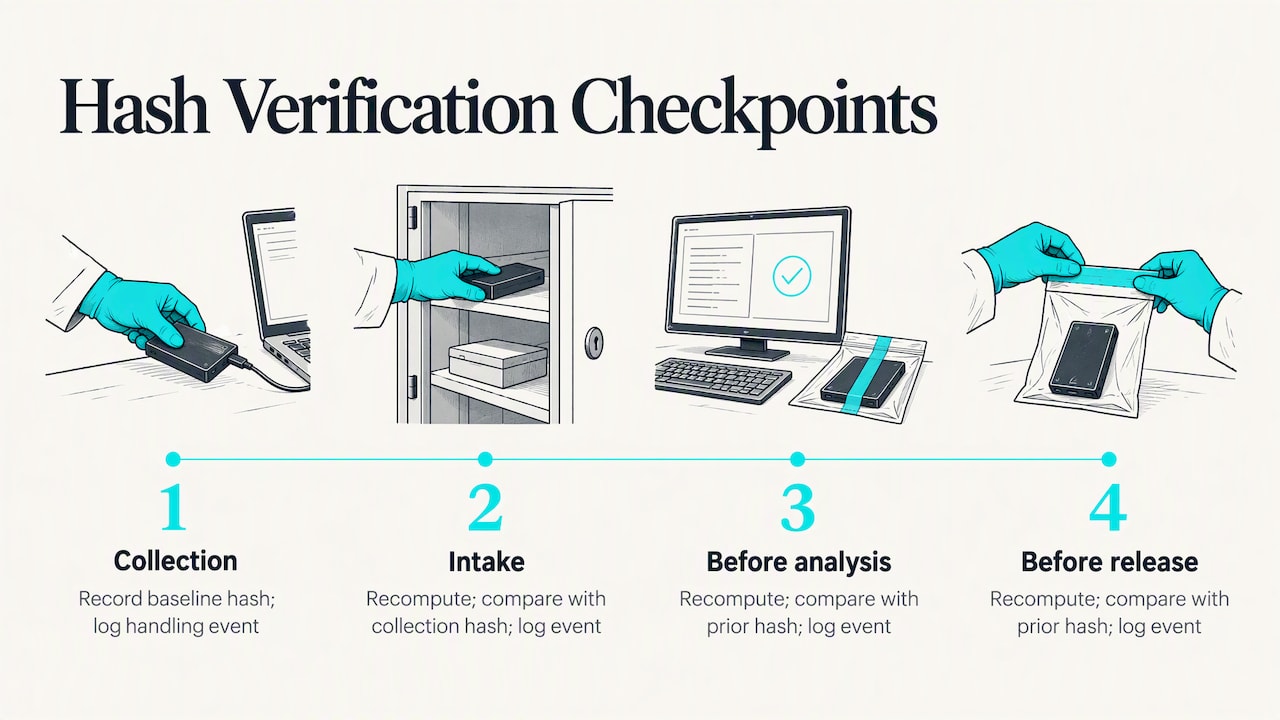
Intake is where many organizations quietly lose defensibility. Files arrive from different sources in different formats, and someone has to assign identifiers, confirm that what arrived matches what was sent, and set who may see it. A hash computed at collection and checked again at intake gives you a simple, verifiable handoff.
Phase 3: Store and preserve
Preservation is not a one-time archival step. UNODC’s position is that integrity has to be demonstrable through every handling phase, not asserted at the end. In practice that means the evidence sits in a system with authentication, access controls and logging. NIST’s report on digital evidence preservation (NIST IR 8387) says hashes of images and objects should be stored separately in a secure location, and that if hashing is not used, an early physical copy should be kept and transfers documented.
Phase 4: Transfer and release
Every time evidence moves, the record must show who sent it, who received it, when and why. The National Center for State Courts says secure sharing should support authenticated users, role-based permissions, controlled downloads or time-limited links, in-system viewing, and logged access, while still protecting confidential or sealed material. Emailing a zip file satisfies none of those.
Phase 5: Disposition
Disposition is the phase most teams forget to design. Evidence is not kept forever and not deleted on a whim. The Evidence Management Institute’s standards chapter says digital evidence should be retained for the required custody period, through case adjudication, and until disposition is approved and documented by an authorized source. The deletion itself becomes part of the record.
Chain of custody: the thread through every phase
The NIST/NIJ committee states that an unbroken chain of custody from collection to final return or disposal is integral to investigations, and that a break can compromise the item’s evidentiary value so it may no longer be relied on in court. For a digital file, which can be altered without leaving a visible trace, that risk is higher than for a physical object.
A workable chain-of-custody record answers five questions for each handoff:
- Who held the evidence, and who received it?
- When did the transfer happen?
- Where was the evidence before and after?
- How was it moved (method, media, system)?
- Why was it moved?
UNODC’s guidance lists the same elements: who collected or acquired the evidence, when, where, how and why it was transferred. The records must be created as events occur. Reconstructing them from memory months later invites exactly the challenge you are trying to avoid.
Hashing and logging: how integrity is demonstrated
NIST IR 8387 recommends hashing algorithms to uniquely identify and verify file integrity. A hash is a fixed-length fingerprint computed from file contents. Change a single bit and the fingerprint changes. Recording the hash at collection, then re-computing it at intake, before analysis and before release, produces a trail that anyone can check independently.
In US federal courts, hashing also has a procedural payoff. Amendments to the Federal Rules of Evidence effective December 1, 2017 added Rule 902(14), which allows data copied from an electronic device, storage medium or file to be authenticated through a process of digital identification such as hash values, shown by a certification of a qualified person. That can reduce the need for live testimony to establish that a copy matches the original. Whether and how a given court accepts it is a matter for counsel in that jurisdiction.
Logging is the second half. The NCSC says digital evidence storage should keep audit logs, version history, metadata, encryption, role-based access, monitoring, backups and retention and destruction rules aligned with court policy and applicable statutes. Think of the hash as proof of what the file is, and the log as proof of what happened to it.
Standards that shape the lifecycle
No single document governs everything. These are the references most often cited:
- ISO/IEC 27037:2012 gives international guidelines for identification, collection, acquisition and preservation of digital evidence to maintain integrity and admissibility. It also says that national laws and regulations must be followed and that the standard does not replace jurisdiction-specific rules on admissibility, evidential weighting or relevance.
- ISO/IEC 27042:2015 offers guidance on analysis and interpretation of digital evidence, addressing continuity, validity, reproducibility and repeatability. It also expects investigators to justify their chosen analytical methods and show that non-standard methods are fit for purpose. That matters for any AI-based analysis.
- ISO/IEC 27043:2015 sets out principles and processes for incident investigation, from pre-incident preparation to investigation closure.
- NIST IR 8387 and NIST SP 1500-33A give US-specific preservation and evidence management guidance.
- INTERPOL and Council of Europe guidance cover cross-border practice. INTERPOL notes that legal and procedural frameworks for digital evidence differ widely by jurisdiction, and the Council of Europe’s 2019 procedures cover retrieval, transport, handling, analysis and presentation of electronic evidence.
The common thread: standards describe good process, courts decide admissibility. If your customers operate in more than one country, design for the strictest process and verify local rules with local counsel.
What a digital evidence management system should do
A digital evidence management system (DEMS) is the software layer that enforces the lifecycle. Analyst reviews describe the category as SaaS or on-premises products that store, organize and share evidence, with hashing, chain-of-custody access logging, multi-format support, storage redundancy and access controls.
The IJIS Institute’s task force adds the policy side: a repository should provide security, privacy, continuity, chain-of-custody logging, case management, redaction, secure storage and sharing, plus retention, purging and expungement policies. The NCSC stresses lifecycle continuity: technology should connect submission, review, presentation, storage and sharing so each item stays linked to the right case without weakening confidentiality or custody.
A practical checklist when you evaluate any system, whether you are buying it or building it:
| Capability | Why it matters |
|---|---|
| Hash on ingest and on demand | Lets anyone re-verify integrity at any point |
| Immutable, time-stamped audit log | Proves who did what, and when |
| Role-based access and authentication | Limits exposure of sensitive or sealed material |
| Controlled sharing (expiring links, in-system viewing) | Avoids uncontrolled copies |
| Retention rules and documented disposition | Prevents both premature deletion and indefinite hoarding |
| Case linkage and metadata | Keeps evidence tied to the right matter |
| Export of a custody report | Gives counsel something to attach to a certification |
Designing the process around it
Tools do not fix a weak process. The NIST/NIJ committee suggests organizations ask four things: are personnel trained, are processes and standard operating procedures carefully written and documented, is the right equipment available, and are facilities suitable for processing and storing evidence? SWGDE’s draft collection practices add that data handling and documentation should stay consistent throughout the evidence lifecycle.
A short implementation sequence for a small team:
- Map the lifecycle you actually have. Draw each place evidence is collected, stored and sent, including the informal ones.
- Write one SOP per phase. Keep each to a page, with named roles.
- Choose a hash algorithm and a place to store hashes separately from the evidence.
- Define retention and disposition rules with counsel, per jurisdiction.
- Test the chain. Pick an item at random and ask someone outside the team to reconstruct its history from the records alone.
That last test is the one that exposes gaps fastest.
Our perspective: forensic-grade evidence is a product feature
We work with cybersecurity and AI founders every day, and the pattern is consistent. Teams build excellent detection, analytics or automation, then discover that a buyer’s legal team, insurer or regulator asks a different question: can we rely on this output if it is challenged? A dashboard alert is not evidence. A finding with a hashed source, a recorded chain of custody and a reproducible method is.
That gap is why Cybertech Acceleration exists as the first US accelerator dedicated exclusively to digital forensics. We help startups build judicial-grade evidence capabilities into their products, then translate the technical substance into a business narrative that clients and investors understand. The two halves go together. A forensic component nobody can explain does not close deals, and a pitch without verifiable evidence handling does not survive due diligence.
For AI companies the point is sharper. ISO/IEC 27042 expects investigators to justify their methods and show that new ones are fit for purpose. If your model flags, classifies or summarizes material that may end up in a dispute, you should be able to say how its output is preserved, versioned and reproduced. Founders who design for that early sell to more cautious buyers sooner.
The companies in our network have generated over $600K in two years through structured market entry, warm introductions and collaboration, which tells us buyers pay attention when credibility is built in.
— Thiago Vieira
Building evidence lifecycle capability into your startup
If you are a cybersecurity or AI founder, you do not need to become a records-management shop. You need to make four decisions early:
- Where does your product touch evidence? Ingestion, analysis, reporting and export each need their own controls.
- What will your customers’ counsel ask for? Usually a hash, a log and a custody report.
- Which jurisdictions do you sell into? Rules on admissibility, retention and privacy differ, and standards do not override them.
- How will you say all this in a sales conversation? Plain language beats acronyms.
Our program is built around those questions. It combines forensic integration, commercial translation, structured market entry, compliance and local setup, and introductions to partners. For international teams, our Soft Landing program covers US entry, and we run country-specific tracks, including for UK cyber startups, German cyber startups, Israeli cyber startups and Portuguese cyber startups. US companies looking at Europe can use the same two-way approach.

If you want to see the US market on the ground, the Cybertech Texas Mission brings founders into direct contact with buyers and partners. Pricing is not published, so the fastest route is to start from our main page and tell us what you build.
Common mistakes in evidence lifecycle management
- Treating hashing as optional. Without it, you are asking a court to trust your word.
- Documenting after the fact. Custody records written later carry less weight than those made at the time.
- Sharing by email or consumer file transfer. It breaks logging and creates uncontrolled copies.
- No disposition plan. Evidence kept indefinitely is a liability, and deletion without approval is a risk.
- Assuming one standard fits every country. ISO guidance helps, but admissibility is decided locally.
- Skipping malware screening on ingest. Evidence files can carry malicious content, so scan during ingestion and storage.
FAQ
What are the stages of the evidence lifecycle?
The NIST/NIJ committee describes five: collect, package and document; intake; store and preserve; transfer and release; and disposition. Each stage has its own records and controls, and the chain of custody links them together.
What is the difference between evidence lifecycle management and digital evidence management?
Lifecycle management is the end-to-end process and policy, from collection through disposition. Digital evidence management usually refers to the systems and practices that carry it out, such as a repository with hashing, logging and access controls. In practice the terms are used almost interchangeably.
How do you prove digital evidence has not been altered?
You compute a hash value when the evidence is collected, store it separately, and re-verify it at each handoff, as NIST IR 8387 recommends. Pair it with a contemporaneous chain-of-custody record and access logs. In US federal court, Rule 902(14) allows hash-based authentication through a qualified person’s certification, but counsel should confirm how it applies to your case.
Does ISO/IEC 27037 guarantee evidence will be admissible?
No. The standard guides identification, collection, acquisition and preservation, but it states that it does not replace jurisdiction-specific rules on admissibility, weighting or relevance. Follow it as good practice and check local requirements with a lawyer.
How long should digital evidence be kept?
For the required custody period, through case adjudication, and until disposition is approved and documented by an authorized source. The exact period depends on the court, agency or statute involved, so set it with counsel.
Sources
- describes digital evidence as volatile and fragile
- an active process of policies, procedures, people, tools and infrastructure
- five phases
- chain of custody documentation should be created at the time of collection
- hashes of images and objects should be stored separately in a secure location
- authenticated users, role-based permissions, controlled downloads or time-limited links, in-system viewing, and logged access
- retained for the required custody period, through case adjudication, and until disposition is approved and documented by an authorized source
- added Rule 902(14)
- identification, collection, acquisition and preservation of digital evidence
- guidance on analysis and interpretation of digital evidence
- principles and processes for incident investigation
- retrieval, transport, handling, analysis and presentation of electronic evidence
- SaaS or on-premises products that store, organize and share evidence
- security, privacy, continuity, chain-of-custody logging, case management, redaction, secure storage and sharing, plus retention, purging and expungement policies
- stay consistent throughout the evidence lifecycle