NIST Digital Forensics: Evidence Limits, CFTT, and NSRL
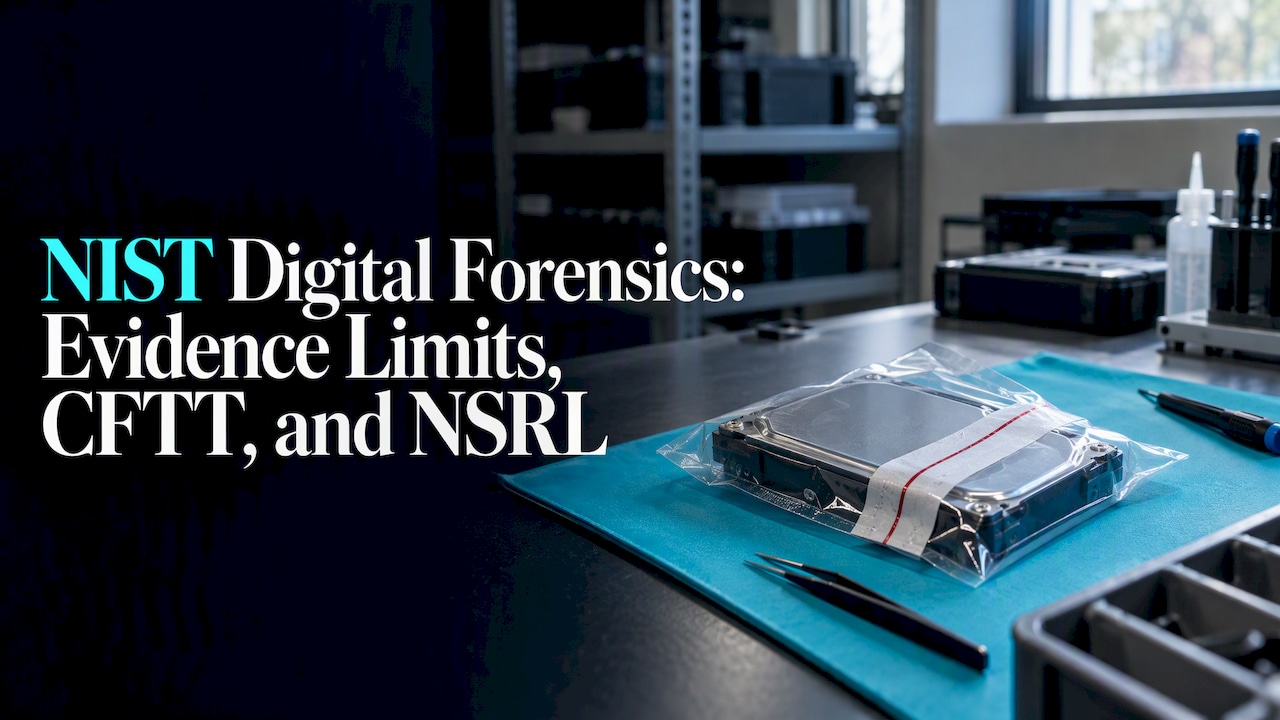
NIST describes digital forensics as the process of acquiring, preserving, analyzing, and reporting on evidence using scientific, demonstrably reliable, and repeatable methods suitable for judicial proceedings. NIST organizes the work into four steps: identify, acquire, and protect data; process it; analyze the extracted information; and report the results. NIST guidance is non-mandatory best practice, not automatic law.
TL;DR:
- Preserve volatile data before containment changes it, image evidence when possible, analyze only copies, and record timestamps, hashes, custody transfers, and tool versions.
- Treat CFTT reports as tests of specific functions and versions, not universal certifications; validate each tool against your lab’s actual needs.
- Consult counsel before collection because NIST guidance is nonmandatory, and jurisdictions, contracts, regulators, or agencies may impose separate requirements on your organization.
- Use NSRL reference sets to filter known files, and rehearse workflows with CFReDS datasets that provide known answers for tool testing.
- When using AI tools in examinations, keep an examiner involved and document configurations and versions so another examiner can reproduce each automated step.
Table of Contents
- What NIST covers under digital forensics and who the guides serve
- Which NIST publications and programs should investigators know?
- How do you apply NIST guidance inside incident response?
- What are the basic evidence handling steps?
- How do you read CFTT reports and federated testing results?
- What has changed in NIST digital forensics guidance recently?
- How do NIST forensic practices fit with AI tools?
- What makes NIST standards hard for startups, and how can they cope?
- Why does following NIST matter for credibility?
- How can Cybertech Acceleration help forensic startups reach the market?
- FAQ
- Sources
What NIST covers under digital forensics and who the guides serve
NIST treats digital forensics broadly. The glossary entry, which draws on SP 800-86, describes the discipline as applying computer science and investigative procedures to identify, collect, examine, and analyze data while maintaining chain of custody and validating results with mathematics and validated tools. In practice that reaches well past a single laptop.
In scope, according to NIST SP 800-86:
- Computers and their file systems, including deleted and hidden data
- Mobile devices and other embedded or IoT hardware
- Network traffic captured during or after an incident
- Operating system artifacts such as logs, registry entries, and metadata
- Application artifacts such as browser history, chat data, and databases
The intended readers are incident response teams, forensic analysts, and the people who manage evidence. The guide aims to help organizations build a forensic capability that supports incident response, not to turn every responder into a courtroom expert.
One caution matters more than the rest. NIST frames SP 800-86 as a starting point for building a forensic capability and states that it is not a substitute for legal advice. Combine that with the fact that NIST guidelines do not create legal obligations on their own, and the practical takeaway is clear: use the guidance to structure your methods, then confirm jurisdiction-specific requirements with counsel.
Which NIST publications and programs should investigators know?
NIST spreads its forensic material across several documents and programs. Each answers a different question, and knowing which to open saves hours.
- SP 800-86: The guide that formalizes the phases of collection, examination, analysis, and reporting. Start here to design a repeatable process.
- CFTT (Computer Forensics Tool Testing): NIST’s program for testing methodology, published test suites, and reports. The CFTT program page is the entry point.
- NSRL (National Software Reference Library): Publishes quarterly Reference Data Sets that help you filter known files out of seized devices, so you spend time on what is unfamiliar.
- CFReDS (Computer Forensic Reference Data Sets): Datasets built for investigator training and tool testing, useful when you need known-answer material to validate a workflow.
- NIST IR 8387: Digital Evidence Preservation: Considerations for Evidence Handlers covers chain of custody, hashing and digital signatures, and storage.
- Federated Testing: Extends CFTT with shared test suites and a live .iso so labs can run their own tests and share reports.
- Tool catalog: NIST’s Computer Forensics Tools & Techniques Catalog lists tools and techniques, and the CFTT technical pages point to test artifacts and sample datasets.
A sensible reading order: SP 800-86 for the process, IR 8387 for handling, CFTT for tool selection.
How do you apply NIST guidance inside incident response?
Forensics is not a separate project that begins after the incident ends. It runs alongside detection, containment, and recovery. The CSF 2.0 links incident analysis and record integrity to forensic activity: categories such as RS.AN call for preserving provenance and recording actions taken during an investigation. The Detect and Respond functions likewise include outcomes for evidence collection, preservation, and recording actions for later analysis or legal use.
A workable mapping:
- Detect: Flag the event, note the time and source, and start a log of every action from the first minute.
- Respond, containment: Decide what must be preserved before it is changed. Volatile data such as memory and active connections disappears first.
- Respond, acquisition: Collect data, imaging in the field when the system cannot be moved or powered down, and in the lab when you can transport it safely.
- Respond, analysis: Examine the copy, not the original, and record each finding with the method used.
- Report: Document results, limitations, and tool versions so another examiner could repeat your work.
NIST also recommends consulting legal counsel before beginning forensic activities, so that collection complies with applicable laws.
Pro Tip: Keep a running log from the first alert: labels, transfer records, hashes, and timestamps. Rebuilding that record later is nearly impossible.
For a deeper operational playbook, see our guide to incident response forensic readiness.
What are the basic evidence handling steps?
The core principle is simple: protect the original and work on a copy. SP 800-86 builds its collection and examination phases around that idea, and it is also standard practice across the field. Here is what that looks like at the bench:
- Image first. Acquire a forensic image of the media and run every analysis against the image, never the original.
- Hash at acquisition. Compute a hash when you acquire and store it separately from the evidence. IR 8387 covers hashing and digital signatures; prefer modern algorithms, though older ones may be acceptable when necessary.
- Log custody. Use timestamped logs, transfer receipts, and secure storage so every hand-off is traceable. Our chain of custody technical guide goes deeper.
- Mix automation with review. Automated tools scale, but manual checks catch what they miss. Recovered deleted files can include extraneous data, so confirm relevance before drawing conclusions.
- Version everything. Artifact meaning can shift as software updates, so record tool and operating system versions in every report.
NIST’s scientific foundation review finds that digital investigation techniques are reliable when used appropriately, but not all evidence is discoverable. That is the honest framing for any report: say what you found, and say what the method could not reach.
For the full sequence, our digital forensics investigation process guide walks through each phase.
How do you read CFTT reports and federated testing results?
CFTT works by testing tools against functional requirements, then publishing detailed reports that document capabilities and limitations. The technical pages list common test areas, including disk imaging, deleted file recovery, mobile devices, SQLite, string search, and write-blocking.
Reading a report well means:
- Check which functions were tested and which were not. A tool can pass imaging tests and say nothing about your mobile extraction needs.
- Treat limitations as requirements for your own validation, not as footnotes.
- Remember that NIST does not certify tools as universally validated. “NIST-tested” means a specific version passed specific tests, and you must judge fitness for your lab’s use case.
- Use federated testing to run your own checks. The project supplies suites for mobile acquisition, disk imaging, and forensic string search, plus a live Linux .iso and a process for sharing reports within the community. You can download the ISOs and published reports from the Federated Testing page.
What has changed in NIST digital forensics guidance recently?
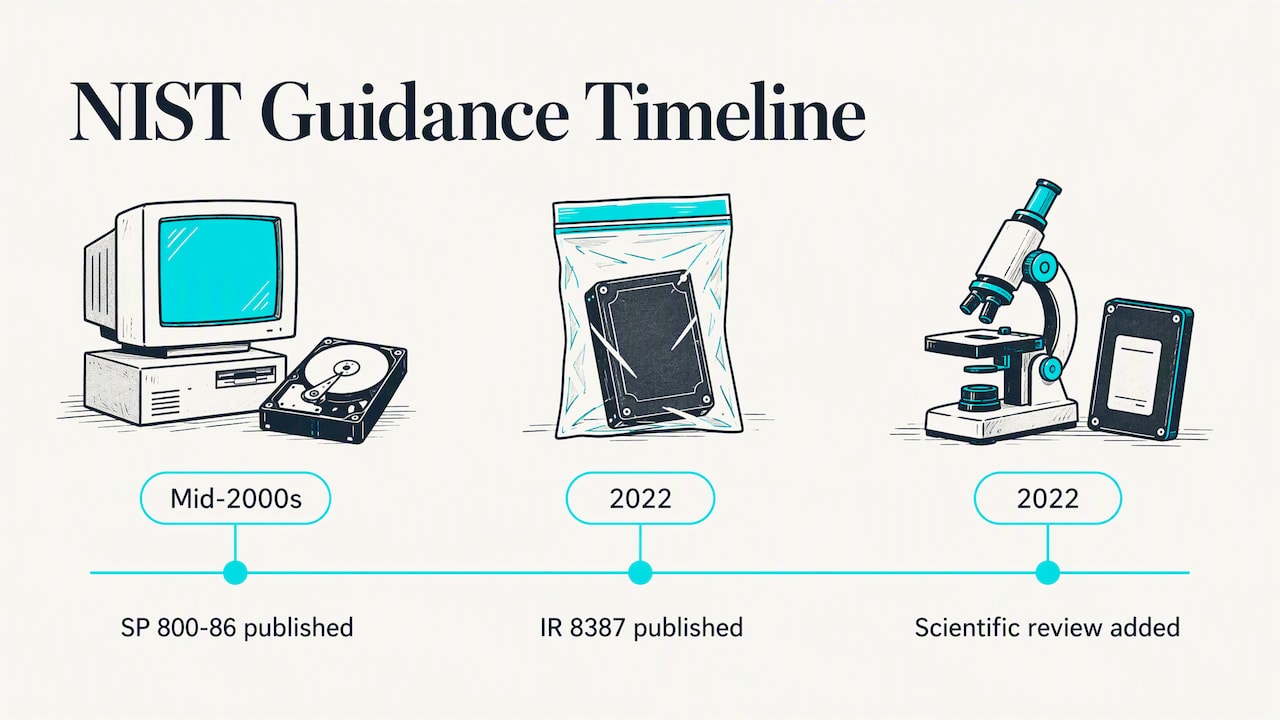
The foundational text is older than many of the technologies it now has to cover. SP 800-86 dates from the mid-2000s, and its core four phases have held up. The more recent NIST material fills the gaps around it rather than replacing it.
Two documents show the direction. IR 8387, published in 2022, updates the handling picture with modern guidance on preservation, hashing and digital signatures, and storage, including special handling for law-enforcement-generated evidence. The 2022 scientific foundation review adds an evidence-based look at where techniques are reliable and where they are not, including the warning that artifact interpretation can change as software evolves.
Alongside them, the Cybersecurity Framework 2.0 places forensic outcomes inside a broader risk management structure, and the Govern function it introduces improves the visibility of governance work such as meeting regulatory requirements.
The practical lesson: treat SP 800-86 as the process backbone and read the newer publications for preservation detail and scientific caveats. Check the NIST pages directly for current revision status, since a publication’s date does not always show whether newer guidance supersedes it. Our 2026 investigation process guide tracks how these pieces fit together in current practice.
How do NIST forensic practices fit with AI tools?
AI tools now sit in two places in a forensic workflow: as part of the investigation, helping triage large datasets, and as part of the evidence, when a product’s own logs or model outputs become something to preserve. NIST’s guidance does not rewrite itself for either case, but its principles transfer.
If you use an AI-assisted tool for examination, apply the same standard you apply to any other tool. Ask what it was tested against and what the test reports say about limitations. CFTT’s approach of functionality-based testing is a useful template: define what the tool must do, test that, and record the results. The scientific foundation review’s warning about changing artifact meaning applies with extra force here, because models and software update frequently. Version your tools and record them in reports.
If an AI system is the source of evidence, the preservation rules still apply. Hash what you collect, store it separately, and log custody, following IR 8387.
Two habits keep AI use defensible. First, never let an automated output stand in for examiner judgment; NIST pairs tools with human review. Second, document how any automated step was configured, so a second examiner can reproduce it. Repeatability is the heart of NIST’s definition, and an opaque tool undermines it.
What makes NIST standards hard for startups, and how can they cope?
Startups face a particular squeeze: limited staff, fast release cycles, and customers who expect proof. Applying a long, careful forensic process can feel out of reach.
Common friction points:
- No dedicated examiner. Engineers handle incidents alongside product work, so evidence handling is improvised.
- Cloud and SaaS sprawl. Evidence lives across services the team does not fully control.
- Documentation debt. Logs and records are thin because nobody had time to write them.
Practical fixes follow directly from NIST’s own advice. Build a small forensic capability on the SP 800-86 model rather than waiting for a full team: a written procedure, a trained responder, and a tested imaging toolkit. Use CFTT reports to pick tools instead of testing everything yourself, and use the reference datasets to rehearse before a real incident. Settle the legal question early, since NIST advises consulting counsel before forensic activity begins.
Because NIST guidance is non-mandatory, you can adopt it in stages. Start with custody logs and hashing, which cost little, then add tool validation as you grow.
Why does following NIST matter for credibility?
I’ve come to see NIST’s value less as a rulebook and more as a shared language. When your methods match a published standard, a skeptical reader, whether opposing counsel, a customer’s security team, or an investor, can see what you did and why. That repeatability is what turns a technical finding into something people will rely on. Better evidence handling also lowers the risk that good work is dismissed on a procedural technicality, and it feeds cleaner lessons-learned reviews after an incident.
— Thiago Vieira
How can Cybertech Acceleration help forensic startups reach the market?
We run a US accelerator dedicated to digital forensics for cybersecurity and AI startups. If you are building judicial-grade evidence capabilities into a product, we help you turn that work into market readiness, compliance readiness, and a story investors and buyers understand. Founders weighing US entry can start with our Soft Landing program or the Cybertech Texas Mission, then talk to us about which fits your stage.
FAQ
What are the 5 pillars of NIST?
The NIST Cybersecurity Framework is organized around core functions, and CSF 2.0 adds Govern to the earlier set. The older version lists Identify, Protect, Detect, Respond, and Recover. Forensic activity touches Detect and Respond most directly.
What are the top digital forensic tools?
NIST does not rank tools. Instead, CFTT publishes test reports on specific tools and versions, and the tool catalog lists options. Pick tools by the capabilities your cases need and what the reports say about their limitations.
Is NIST a legal requirement?
Generally no. NIST guidelines are non-mandatory, risk-based frameworks that do not create legal obligations on their own, though contracts, regulators, or agencies may reference them. Confirm what applies to you with counsel.
What are the essential principles of digital forensics?
NIST’s definition points to the core ones: use scientific, demonstrably reliable, and repeatable methods, preserve the original, maintain chain of custody, and report results transparently. Different texts phrase these principles differently.
Sources
- NIST Guide Details Forensic Practices for Data Analysis | NIST
- Computer Forensics Tool Testing Program (CFTT) | NIST
- NIST SP 800-86, Guide to Integrating Forensic Techniques into Incident Response
- Digital Evidence Preservation: Considerations for Evidence Handlers
- Federated Testing Project | NIST