Metadata Forensics: What It Reveals and How to Build It Right
Metadata forensics is the examination of data about data: timestamps, authorship fields, message headers, device logs and application artifacts, used to establish what happened, when, and who was involved. It often answers questions the visible content of a file cannot. A document can say anything, but its metadata can show when it was created, on which account, and whether someone changed it afterward. This guide covers what examiners look at, where the method breaks down, and what a product team must get right if it wants its output to survive a courtroom or an insurer’s review.
TL;DR
- Forensic metadata analysis rests on four families of artifacts: file system timestamps, application artifacts, message headers and system logs. Each tells a different part of the story.
- Metadata is only as good as the way it was collected. Copying a file can overwrite the very access times you needed, so write-blocking, hashing and a documented chain of custody are the minimum.
- The strongest findings come from correlating artifacts across sources, not from reading one timestamp in isolation.
- AI can flag and sort metadata at scale, but its output needs a confidence level and human validation before anyone treats it as evidence.
- For cybersecurity and AI startups, judicial-grade metadata handling is a real differentiator, and it has to be designed in, not bolted on.
Table of Contents
- What metadata forensics actually is
- The metadata types examiners rely on
- Correlation is where the value is
- Collecting metadata without destroying it
- Proportionate depth: not every question needs a deep dive
- Where AI helps and where it fails
- Explaining metadata to people who are not engineers
- Our perspective: forensic credibility is a product feature
- A checklist for startups building with metadata
- Why this matters commercially
- FAQ
- Sources
What metadata forensics actually is
The usual definition is “data about data.” A National Institute of Justice guide treats metadata as evidence of authenticity, reliability and chronology, with timestamps, file ownership, location logs and app usage data as typical examples.
That framing is useful because it tells you what each artifact is for:
- Authenticity: is this file what it claims to be, and did it come from where it claims?
- Reliability: was the system that produced the record working normally, and is the record consistent with other records?
- Chronology: what happened first, what came next, and how long was the gap?
Metadata is not a single data type. It varies by file system, application and device. A photo from a phone, a spreadsheet saved on a Windows laptop and an email exported from a mail server each carry different fields in different formats, with different levels of trustworthiness. An examiner who treats them as interchangeable will make mistakes.
The metadata types examiners rely on
File system timestamps
Every file system tracks when a file was created, modified and accessed. Examiners call these MAC times. The details matter. According to one 2026 technical overview of metadata extraction, FAT file systems, still common on USB drives and memory cards, record access times at only one-day resolution, which limits their value. NTFS keeps two separate timestamp sets per file, and when they disagree it can point to timestamp manipulation, often called timestomping.
That last point is a good example of why metadata forensics is a skill and not a button. A single timestamp is a claim. Two timestamps that contradict each other are a lead.
Application artifacts
Applications leave their own traces: the author and last-saved-by fields in an office document, camera and device fields embedded in an image, edit history in a collaboration tool, recently opened file lists. These can link a document to a user or a device even when the file system record has been altered.
Message headers
Email and messaging headers record the path a message traveled, the servers that handled it and the times they did so. Headers are often the first place an examiner looks when a sender’s identity or the time of delivery is disputed.
System logs
Logs record logins, device connections, file access and process activity. They are the connective tissue that lets you tie a file event to a person’s session or a device’s activity.
| Artifact family | What it shows | Typical weakness |
|---|---|---|
| File system timestamps | Creation, modification, access times | Easy to alter; resolution varies by file system |
| Application artifacts | Author, device, edit history | Format-specific; can be stripped or rewritten |
| Message headers | Routing path, server times | Some fields can be forged by a sender |
| System logs | Sessions, connections, process activity | Rotation and retention limits; clock drift |
Correlation is where the value is
The most useful metadata findings rarely come from one field. Research on metadata-based associations in digital forensics describes linking disparate files and events by matching values, for instance a document’s creation timestamp against an application log entry. That kind of cross-artifact matching can build event timelines automatically that manual review would miss.
A simple example of how this plays out in practice:
- A contract PDF shows a creation time of 9:14 p.m. on a Tuesday.
- The laptop’s system log shows the user session began at 9:02 p.m. and a USB device was connected at 9:10 p.m.
- The email header on the message that delivered the PDF shows it was sent the next morning from a different account.
None of those three facts alone settles anything. Together they draw a timeline, and any one that fails to fit becomes the thing to investigate. If you build tooling in this space, correlation is the capability to invest in.
Collecting metadata without destroying it
The most common failure in metadata forensics happens before any analysis starts. The guiding principle in the SWGDE best practices for computer forensic acquisitions is to minimize alteration of source data, and the same document tells examiners to consider collecting ancillary data such as metadata, encryption keys, log files and schema information alongside the primary target.
In practice that means:
- Write-blocking. Hardware or software that prevents the examiner’s machine from writing to the source.
- Forensic imaging. Creating a read-only image rather than dragging files to a new folder. Simple copying can change access times and other fields, which are the very things you wanted.
- Hashing. Computing a cryptographic hash of the source and the image so anyone can verify byte-level integrity later.
- Documentation. Recording the tool, version, settings, operator and time of every step.
The NIST evidence management steering committee report describes the chain of custody as a chronological record of transfer and handling, and notes that a break in it, through mishandling or lapses in documentation, undermines the evidence. We go deeper on this in our technical guide to chain of custody for digital evidence.
This is also where tech-first teams get caught. An API export or a “download as CSV” feature produces useful data. It does not produce evidence a court will accept without the integrity and handling record around it.
Proportionate depth: not every question needs a deep dive
Good examiners match effort to the question. Practitioner guidance from the eDiscovery Certification Council stresses that forensic depth must match the question being asked, and that over-processing in pursuit of perfection is a common error. A routine HR inquiry about when a file was last opened does not need the same treatment as a contested fraud case.
For product builders, this is a design lesson. A tiered approach works better than forcing the heaviest workflow on every incident:
- Triage tier: fast metadata extraction and timeline view, clearly labeled as preliminary.
- Investigation tier: verified acquisition, hashing and correlation across sources.
- Litigation tier: full documentation, reproducible methods and output designed for an expert to testify from.
Labeling which tier produced a result protects both the user and the vendor.
Where AI helps and where it fails
Volume is the problem metadata forensics keeps running into. Seized devices hold enormous numbers of files, and most are irrelevant. Academic work on automated metadata-based classification of incriminating artefacts targets exactly this: using metadata to narrow what a human has to review.
AI is useful for sorting, flagging and prioritizing. The risk is treating a flag as a finding. NIST work on error mitigation in digital forensic tools argues for a systematic approach as automation grows, and a few practical rules follow:
- Attach a confidence level to every automated output.
- Track the dependency chain. If text must be extracted from a database before a model can read it, an error at the extraction step silently corrupts everything after it.
- Expect both false negatives (thresholds too strict) and false positives (too lenient), and have a human validate anything that matters.
Will AI replace forensic examiners? One 2026 occupational analysis estimates that 61% of forensic science technician tasks have very high exposure to AI automation, yet it also notes that tasks tied to legal integrity and expert testimony still call for human judgment. That matches what we see: AI shifts where examiners spend their time, and it raises the value of anyone who can explain and defend a result.
Explaining metadata to people who are not engineers
A finding no one can follow has little value. EC-Council University’s digital forensics career guide makes the point that communicating results to non-technical audiences such as judges and juries is central to the work, and that a report that is accurate but unclear lacks legal value.
The same applies to a sales conversation. A buyer’s general counsel or an insurer does not want to hear about MFT entries. They want to know: what happened, how sure are you, and would this hold up if challenged? Good metadata reporting answers in that order and keeps the technical detail in an appendix.
We cover how courts approach this in more detail in our guides to digital evidence admissibility in US courts and expert witness work in cybercrime litigation.
Our perspective: forensic credibility is a product feature
We work with cybersecurity and AI startups, and the pattern repeats. A team builds a capable detection or analysis engine, then discovers that customers, insurers and lawyers ask a different question from “does it work?” They ask “can we rely on it if this goes to dispute?”
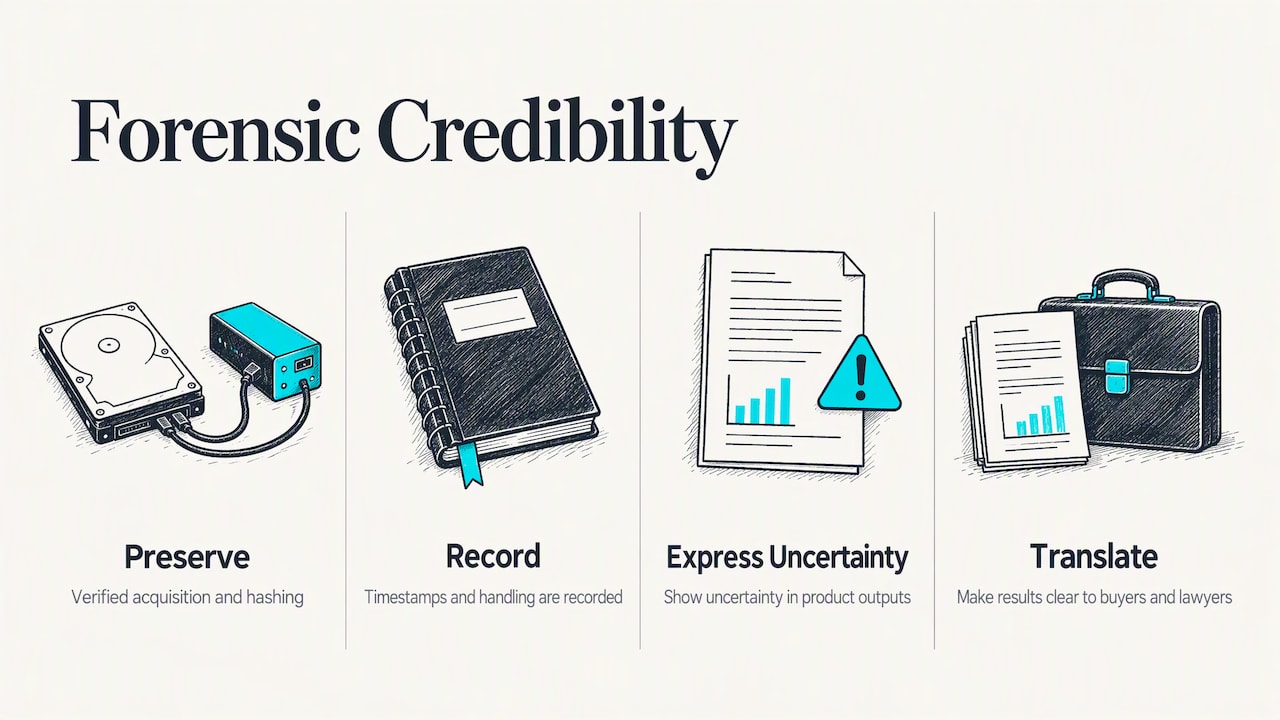
Metadata is where that question usually gets answered. If your product ingests logs, files or messages and reports on them, then how you preserve timestamps, record handling and express uncertainty is part of what you are selling. We believe the companies that win trust in a crowded market are the ones that design for scrutiny from the start: verified acquisition, hashing, a custody log nobody has to reconstruct, and outputs that a non-technical reader can follow.
The second half is translation. Founders often know their technology deeply and struggle to put it in terms an investor or a buyer’s legal team will act on. Our job is to help close that gap, so that forensic rigor shows up as a clear commercial story rather than a footnote in a datasheet.
— Thiago Vieira
A checklist for startups building with metadata
If your product touches forensic metadata, test it against these questions before a customer or opposing expert does:
- Does collection alter the source? If you read files through normal operating system calls, you may be changing access times. Document what your method touches.
- Can a third party verify integrity? Hash at acquisition and again at export, and make both values visible.
- Is every handling step logged? Who, what, when, with which tool version.
- Do you show uncertainty? Confidence levels on AI output, and clear labeling of preliminary versus verified results.
- Can you correlate across sources? Single-field answers invite challenge. Cross-artifact agreement strengthens them.
- Can your output be explained in two minutes to a non-engineer? If not, rewrite the report template before you rewrite the code.
- Is there a human in the validation loop? Particularly for anything that might be used in a dispute.
Our standard guide to the digital forensics investigation process maps these questions to the stages of an investigation, and our piece on digital evidence admissibility and cyber law standards covers the legal side.
Why this matters commercially
The market is growing. One market summary projects the global digital forensics market to reach USD 31.74 billion by 2030, up from USD 14.85 billion in 2025, and cites Bureau of Labor Statistics projections of 13% employment growth for forensic science technicians from 2024 to 2034. That is a figure from a salary-data aggregator summarizing government data, so treat the market forecast as one estimate rather than settled fact.
What the numbers suggest is demand for people and products that can produce defensible findings. For a startup, the competitive question is less “do we have metadata features?” and more “is our metadata handling credible enough that a buyer can stake a decision on it?”
FAQ
What is the difference between metadata forensics and forensic metadata analysis?
They describe the same practice. Metadata forensics is the broader field, and forensic metadata analysis is the act of examining specific artifacts such as timestamps, headers and logs to reach a conclusion. In practice, examiners use both terms interchangeably.
Can metadata be faked or altered?
Yes. File system timestamps can be changed, and some header fields can be forged. That is why examiners compare several sources and look for contradictions, such as mismatched timestamp sets on the same file, rather than trusting a single value.
Is metadata alone enough to prove something in court?
Rarely. Metadata supports authenticity, reliability and chronology, but its weight depends on how it was collected and documented. Without write-blocking, hashing and a chain of custody, a court or opposing expert can challenge it. Discuss any specific case with a qualified digital forensic examiner and your attorney.
Will AI replace digital forensics professionals?
Not in the core work. AI can flag and sort material quickly, but its output carries error rates and needs human validation. Tasks involving legal integrity and expert testimony still require a person who can explain and defend the method.
Sources
- National Institute of Justice guide
- 2026 technical overview of metadata extraction
- metadata-based associations in digital forensics
- SWGDE best practices for computer forensic acquisitions
- NIST evidence management steering committee report
- eDiscovery Certification Council
- automated metadata-based classification of incriminating artefacts
- error mitigation in digital forensic tools
- 2026 occupational analysis
- market summary