MSSP Partnership Strategy: A Founder’s Guide for 2026

An MSSP partnership strategy is a plan for how your product or service reaches customers through managed security service providers (MSSPs), the firms that run security monitoring and response for other businesses. For a cybersecurity or AI founder, the plan comes down to four decisions: which delivery model you offer, who owns the customer, who is accountable for each control, and what proof you can hand an MSSP that survives a buyer’s questions. Founders who settle those four before the first partner call close deals faster. We built Cybertech Acceleration around this kind of decision-making for solo and early-team cyber founders, and the rest of this guide follows the same order.
TL;DR
- An MSSP partnership is a distribution and delivery channel: the MSSP gets a differentiated service, you get reach into customers you could not sell to alone.
- Pick one delivery model first (referral, resale, co-managed or white-label). Each one decides who owns the customer relationship and the margin.
- Write down who implements each control, where, and what evidence backs it. Accountability is never self-explanatory once work is split.
- Commercial terms (registration windows, usage or subscription pricing, renewal protection) shape your economics more than the headline discount.
- If you are building for the US from outside it, your partner strategy and your market-entry plan are the same plan.
Table of Contents
- What an MSSP partnership actually is
- Choose your delivery model before you pitch
- Split responsibility in writing
- Commercial terms that decide your economics
- What to bring an MSSP: differentiation it can resell
- Using MSSP partners to enter the US
- Our perspective
- A 90-day partnership plan
- FAQ
- Sources
What an MSSP partnership actually is
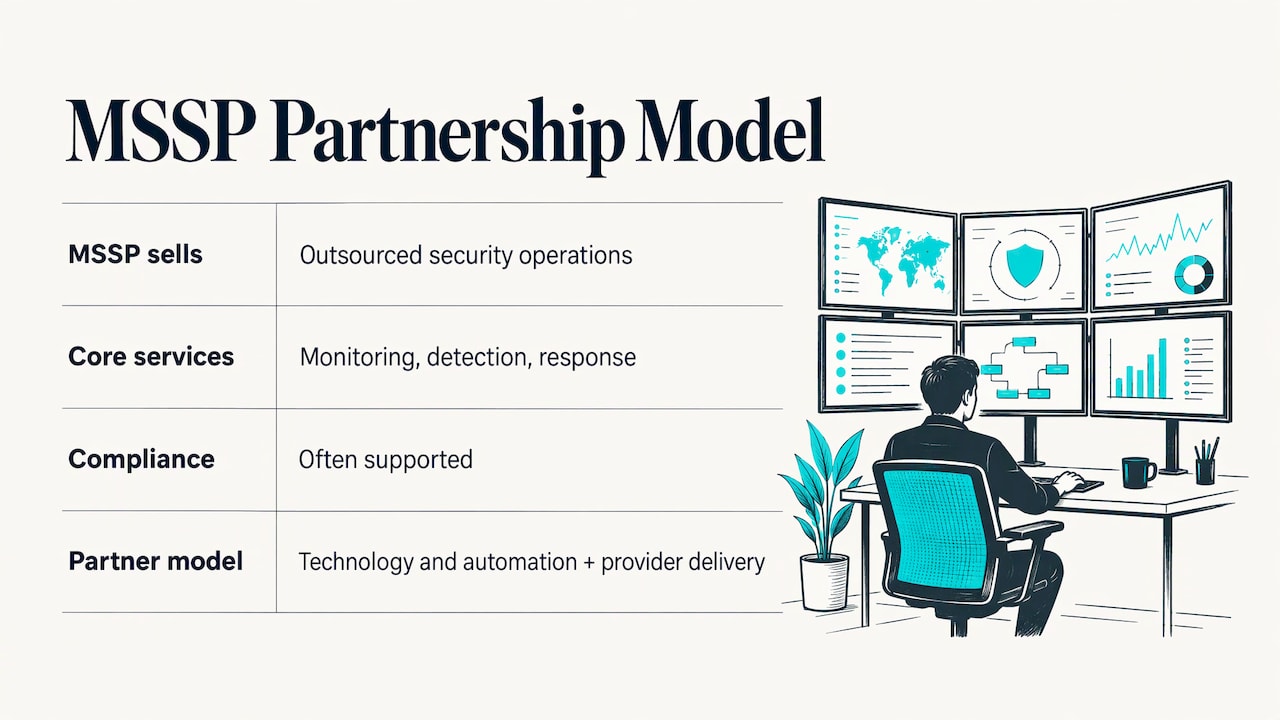
An MSSP sells outsourced security operations: monitoring, detection, response and often compliance support. A technology vendor or a specialist founder partners with it to put a product or capability inside that service. Large vendors describe the benefit in similar terms. Palo Alto Networks frames its MSSP program as a way to combine integrated technology and automation with the provider’s delivery, so partners can differentiate and reach new markets.
The logic holds for a small company too. An MSSP has customers, trust and a delivery team. You have a sharp capability the MSSP cannot build quickly. Done well, the MSSP’s offer becomes more distinctive and your product gets sold by people the buyer already trusts.
What changes for a startup is the leverage. A big vendor sets terms and the MSSP accepts them. A founder with a narrow, hard-to-copy capability negotiates from a different position, as long as the capability is demonstrable.
Choose your delivery model before you pitch
Most partner programs sort into a handful of models. Vendors describe them differently, but the underlying question is the same: who holds the license, who runs the tool, and who owns the end customer.
| Model | Who runs it | Who owns the customer | Best for |
|---|---|---|---|
| Referral | You | You | Founders with a deliverable they run themselves |
| Resale | You build, partner sells | Shared, usually the reseller | Products that need a trusted seller |
| Co-managed | Customer and MSSP share operation | Shared | Products needing hands-on tuning |
| MSSP-as-a-service / white-label | The MSSP | The MSSP | Products that disappear inside the MSSP’s brand |
Cymulate’s partner overview draws a clear line between three of these: MSSP-as-a-service, where the MSSP owns the license and runs the work; co-managed delivery, where operation is shared; and reseller delivery, where the customer buys the license. The Acronis MSSP program shows the white-label end: partners control branding, pricing and service delivery, with multi-tenant management and training included.
How to decide
Ask three questions in this order:
- Do you want your name on the customer’s invoice? If yes, referral or co-sell. If you are happy to be invisible, white-label.
- Can your product run without your people? If it needs your tuning, co-managed is the honest model.
- Does the buyer’s regulator care who did the work? If so, you need a model where responsibility is documented, not implied.
A founder who cannot answer these should not yet be negotiating with MSSPs. Answering them is a decision-making job, and it is much easier with people who have already run these partnerships than alone.
Split responsibility in writing
The most common failure in partner deals is not price. It is ambiguity about who does what when something goes wrong.
AWS’s guidance on US defense-contractor compliance makes the point sharply. For CMMC Level 2 (the Cybersecurity Maturity Model Certification, which US defense suppliers must meet), multi-provider environments need documentation of who implements each control, where it is implemented, and what evidence supports it. Handing a control to a partner does not hand over accountability.
For your partnership agreement, build a simple responsibility sheet with one row per function:
- Sales and lead ownership: who registers the opportunity, who talks to the buyer.
- Delivery: who deploys, who monitors, who responds.
- Support tiers: what the MSSP handles at level one, what escalates to you, and how fast.
- Evidence: who produces the logs, reports and records, and who stores them.
- Incident ownership: who tells the customer, and who keeps the record if the case goes to court.
The last two rows are where a forensics-minded product earns its place. An MSSP that can show a buyer an unbroken evidence trail has something its competitors do not.
Commercial terms that decide your economics
Headline margin is only one lever. Terms inside the program rules often matter more.
- Registration windows. OpenText’s program guide requires end-customer registration within 10 days of the managed-services contract and onboarding within 90 days for its specified SaaS model. Miss a window and the deal can fall outside the program.
- Pricing structure. The same guide documents pay-per-use and subscription options, and notes that pricing varies by country and requires a quote. Usage-based pricing suits an MSSP with unpredictable client volume. Subscription suits predictable revenue for you.
- Renewal protection. Skyhigh Security says its program protects partner incumbency and renewals to reduce channel-conflict worries. As a founder, ask whether your own agreement says anything about who keeps the account at renewal.
- Contract protections. Terms around data handling, subcontracting and liability shape the relationship as much as price. This write-up on contract terms to demand before signing is a useful checklist for what a security-sensitive agreement should cover.
Margins and channel conflict
Channel conflict happens when you and your partner pursue the same customer. The fix is a written rule, not goodwill. CRN reported that Secureworks CEO Wendy Thomas said partner-involved deals had grown to more than half of new Taegis sales before the company committed to partner-assisted sales for all new North American business, citing trusted-advisor relationships and less channel conflict. The lesson for a small company is that partners extend your reach through customers’ trusted advisers, provided the rules about who sells to whom are clear.
On cost, LimaCharlie says its MSSP partners have used automation and tool consolidation to cut operating costs and launch MDR faster. Treat that as the model for what you offer: a capability that lowers an MSSP’s cost or opens a new service line is easier to partner on than one that only adds a line item.
What to bring an MSSP: differentiation it can resell
MSSPs hear the same pitch from every vendor: better detection, lower noise, more automation. What they rarely hear is a capability that makes their service defensible to a skeptical enterprise buyer or a court.
That is the angle we encourage at Cybertech Acceleration. Our program helps founders build evidence-grade proof into their products, the kind that holds up with US buyers and in court. For an MSSP, that is a reason to partner: its customers can rely on records that stand up when an incident turns into a dispute.
If your product is sold through a partner, your partner deck should answer:
- What does the MSSP’s customer get that they could not get before?
- What does the MSSP stop paying for, or start earning?
- What evidence will the MSSP hand the customer after an incident?
- How fast can the MSSP launch it?
Sell the outcome in the MSSP’s language: new revenue, lower cost per client, stronger renewals. The B2B sales material in our guides on the cybersecurity sales funnel for startups and the closer in cybersecurity deals covers how to carry a partner conversation through to a signature.
If you are a consultant rather than a product company, the same logic applies in reverse: you can extend your service portfolio through a security operations provider and keep the client relationship yourself.
Using MSSP partners to enter the US
For founders outside the US, MSSPs can be the fastest route to American buyers because they carry trust you have not yet earned. They also impose US expectations: documented controls, response times and evidence.
Two practical points:
- Plan the market as well as the partner. A partnership without a US entity, pricing and a clear buyer profile stalls at contracting. A framework for market entry consulting scope and process helps you sequence those steps. We lay out the cyber-specific version in our US market entry playbook, and for UK teams in the entry guide for UK cybersecurity startups.
- Know where responsibility stays. If you are a US company going the other way, note that under the EU’s NIS2 directive, obligations of in-scope entities remain with them even when security work is outsourced, while some requirements also apply directly to providers. An EU partner agreement has to reflect both sides.
Our perspective
Most MSSP partnership advice is written by vendors with a program to sell. It starts with margin tiers and ends with a logo on a partner page. The founders we work with face an earlier problem: they decide alone, and they decide the wrong things first.
We think the order should be reversed. First decide what you are, a product the MSSP embeds or a service it co-delivers. Then decide what you can prove. A forensic-grade evidence trail is the difference between an MSSP that can say it responded and one that can show it, to a buyer, an insurer or a judge. That is why our program brings together exited founders, CISOs, MSSPs and a court-appointed digital forensics expert: the people who sit on the other side of your partner negotiation help you prepare for it.
Distance from the usual hubs does not have to slow you down. Our network of portfolio companies, alumni and 350+ cyber founders exists so a founder in Lisbon, Sao Paulo or Berlin can get the introduction a founder in Austin gets by default.
Thiago Vieira
A 90-day partnership plan
If you want a concrete sequence, use this one.
- Weeks 1 to 2: define the offer. Choose your delivery model and write the one-paragraph value statement for an MSSP.
- Weeks 3 to 4: build the responsibility sheet. Draft who owns sales, delivery, support, evidence and incident communication.
- Weeks 5 to 6: set terms. Decide registration rules, pricing structure (usage or subscription), renewal protection and who owns the account at renewal.
- Weeks 7 to 10: approach three to five MSSPs. Lead with the outcome, not the feature list. Offer a short pilot with a named customer.
- Weeks 11 to 13: review the pilot. Measure time to launch, cost per client and the evidence the MSSP could produce after a test incident.
A pilot with a narrow scope beats a signed framework agreement with no live customer. It gives you numbers to take to the next MSSP.
FAQ
What is an MSSP partner?
An MSSP partner is a company that works with a managed security service provider to deliver or extend its services. It can be a technology vendor, a specialist founder or a consultant. The partner supplies a product or skill, and the MSSP supplies customers and delivery.
How does an MSSP partner program work?
A program sets the rules: how you register customers, how you are paid, what training and technical support you get, and who owns the relationship. Programs differ. Some, like the OpenText program described above, set time windows for registering customers and onboarding. Others focus on engineering help and joint marketing.
How much does an MSSP partnership cost?
It depends on the model. Costs can be perpetual licenses, pay-per-use or subscription fees, and they often vary by country and require a quote. As a founder building your own program, your costs are mostly the time to document responsibilities and support the pilot.
Which MSSP partnership model should a startup choose first?
Choose the model that matches how your product runs. If your team operates it, referral or co-managed fits. If it can run on its own and you are comfortable being invisible, white-label gives the MSSP the most control. Settle ownership of the customer before you settle the discount.
Sources
- Palo Alto Networks
- MSSP-as-a-service, where the MSSP owns the license and runs the work; co-managed delivery, where operation is shared; and reseller delivery, where the customer buys the license
- Acronis MSSP program
- multi-provider environments need documentation of who implements each control, where it is implemented, and what evidence supports it
- end-customer registration within 10 days of the managed-services contract and onboarding within 90 days
- protects partner incumbency and renewals
- partner-involved deals had grown to more than half of new Taegis sales
- extend your service portfolio through a security operations provider
- obligations of in-scope entities remain with them even when security work is outsourced