AI Audit Trails: What to Log and How to Prove It

An AI audit trail is a chronological, tamper-evident record of what an AI system did, who or what triggered it, under whose authority, and what came out. A plain application log does not meet that bar. A usable trail lets a skeptical third party, such as an enterprise buyer, an auditor, an insurer or a court, reconstruct a specific decision months later and trust that nobody edited the record in between. This guide covers what to capture, what the rules say, the mistakes that sink trails under scrutiny, and how founders can turn the trail into something that closes deals.
TL;DR
- An AI audit trail is evidence, not telemetry: actor, context, original input and output, timestamp, and a way to detect tampering.
- For high-risk systems, the EU AI Act requires automatic event logging over the system’s lifetime. The US has no single equivalent, but buyers and litigators ask for the same things.
- Record at the query level (black-box access). It is more portable and defensible than relying on model internals or explainability dashboards.
- Capture the governance rationale too: approvals, waivers and policy versions, not only prompts and responses.
- For a startup, a verifiable trail shortens security reviews and gives procurement a reason to pick you.
Table of Contents
- What an AI audit trail actually is
- The five components every trail needs
- Black-box logging beats waiting for model internals
- What the rules say
- Mistakes that break a trail under scrutiny
- Why the trail helps you sell
- Our perspective
- A 30-day plan to get started
- FAQ
- Sources
What an AI audit trail actually is
Most software already logs something: errors, access, requests. That is not an audit trail. An AI audit trail is a tamper-evident chain of evidence showing what work an AI system performed, who was responsible, and whether the record can be independently verified. Another way to put it: it lets a reviewer work out who requested the work, which identity performed it, what authority it used and what changed.
Three differences separate a trail from ordinary logs:
- It is built for a reader who does not trust you. Debug logs serve your engineers. A trail serves someone who may be on the other side of a dispute.
- It is complete over time. Events are recorded automatically across the system’s lifetime, not sampled when someone remembers.
- It can be verified. The record carries proof that it was not altered after the fact.
The same idea sits behind what digital forensics calls chain of custody. If you want the evidence-handling side, our technical guide to chain of custody for digital evidence shows how the same discipline applies to any record that may someday be challenged.
The five components every trail needs
Practitioners converge on a short list. According to Veratrace’s breakdown of AI audit trails, an effective trail contains:
| Component | What it means in practice | Common failure |
|---|---|---|
| Actor attribution | The specific human, service account or AI agent responsible | Shared API keys that hide who did what |
| System context | Platform, model and version, orchestration layers used | Logging the product name but not the model version |
| Original input-output pairs | The actual prompt and the actual response | Storing summaries or truncated text |
| Precise timestamps | When each step executed | Timestamps added later by a batch job |
| Tamper-evident verification | Cryptographic hashes that expose later edits | Plain database rows anyone with admin access can change |
Summaries are the trap. A summary tells a reviewer what you believe happened. The raw pair shows what happened. Keep the original record as the evidentiary unit and derive everything else from it.
Add the governance rationale
Technical telemetry alone often fails under scrutiny. Researchers working on accountability for large language models argue that trails should sit in a thin, system-agnostic layer between the AI workflow and governance tools, and should record the governance rationale (approvals, waivers, policy versions) as a first-class object next to the technical events. Practically, if a human approved an exception to a policy, the trail should say who, when, under which version of the policy, and why.
Seal records at the point of execution
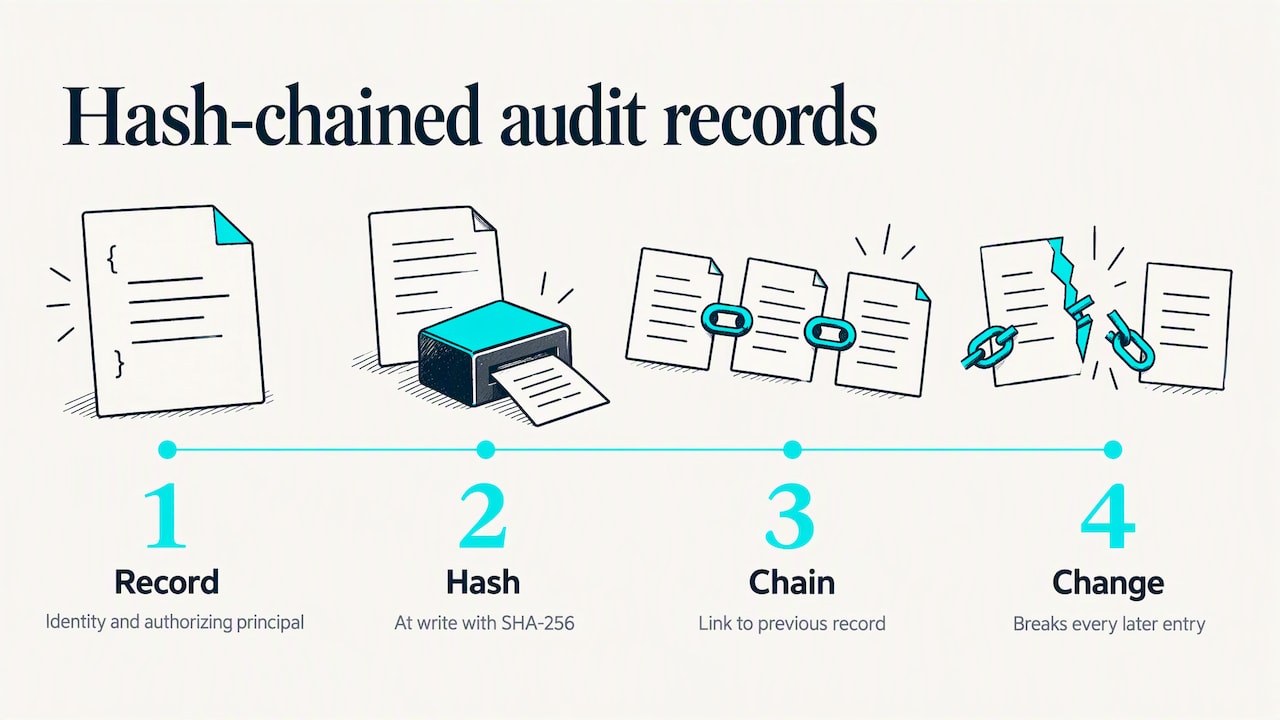
The strongest designs hash each record when it is written and chain it to the previous one, so changing any entry breaks every entry after it. An IETF draft for an agent audit trail format specifies a JSON record structure with mandatory fields for agent identity and the authorizing principal, and it is a useful reference for field design even though it is still a draft and not a finished standard. Hash chaining with SHA-256 is a common choice. The point is non-repudiation: nobody, including you, can quietly rewrite history.
Black-box logging beats waiting for model internals
A common worry is that auditability requires opening the model. It usually does not. Researchers examining what access auditors actually need argue that query-level, black-box access, meaning recorded inputs and outputs, is often more standardized, easier to scale and more defensible, because it does not depend on the model’s inner workings.
This has a practical consequence for startups building on third-party models. If you call a hosted model, you cannot inspect its weights, but you can record every request and response. That record stays valid even if you swap models or retrain. The same authors caution against leaning on internal explainability tools, which can change and lose context. Keep the raw source records.
A workable starting setup:
- Wrap every model call in one logging layer, so no code path skips it.
- Write the raw input, output, model identifier and version, calling identity and timestamp in the same event.
- Hash and chain events as they are written.
- Store the chain in append-only storage with separate access controls from the application team.
- Test restoration: pick a random decision from last quarter and reconstruct it end to end.
What the rules say
EU AI Act
The clearest legal text is European. Article 12 of the EU AI Act requires high-risk AI systems to have automatic logging capabilities that record events throughout their lifecycle, so the logs can help identify risks, support post-market monitoring and track system operation. For remote biometric identification systems the logs must include usage periods, reference databases, matched input data and the identities of the people verifying results.
Dates matter here. The consolidated text of Regulation (EU) 2024/1689 on EUR-Lex reflects that the application dates for many high-risk requirements were staged into 2027 and 2028. Check the current consolidated text for your use case before you plan a roadmap around a date. We walk through the commercial side in EU AI Act compliance and why traceable evidence wins startup deals.
United States
The US has no single federal AI logging mandate comparable to Article 12. Requirements arrive piecemeal: sector rules, state laws, contract terms and litigation. One regulatory analysis notes, for example, that New York City’s Local Law 144 requires bias-audit documentation and public disclosure for automated employment tools, which is narrower than a general audit-trail duty. If you sell into hiring, lending, health or legal workflows, read the rules for that sector, and ask counsel which apply to you.
Courts are the other pressure. When an AI-assisted process produces a result someone disputes, the question becomes whether you can show how it was made. Our pieces on whether AI document review methodology is discoverable and on Louisiana Act 250 and attorney diligence around AI evidence show how quickly records become the center of a dispute.
Standards
ISO/IEC 42001:2023 is the international management-system standard for AI, and audit work is often split into ethics, compliance, process and governance, and performance audits. A trail feeds all four, because each needs evidence that the control actually ran. If you already hold or are pursuing information security certification, the trail also supports it. See how SOC 2 and ISO 27001 compare for startups and how to build a lean ISMS.
Mistakes that break a trail under scrutiny
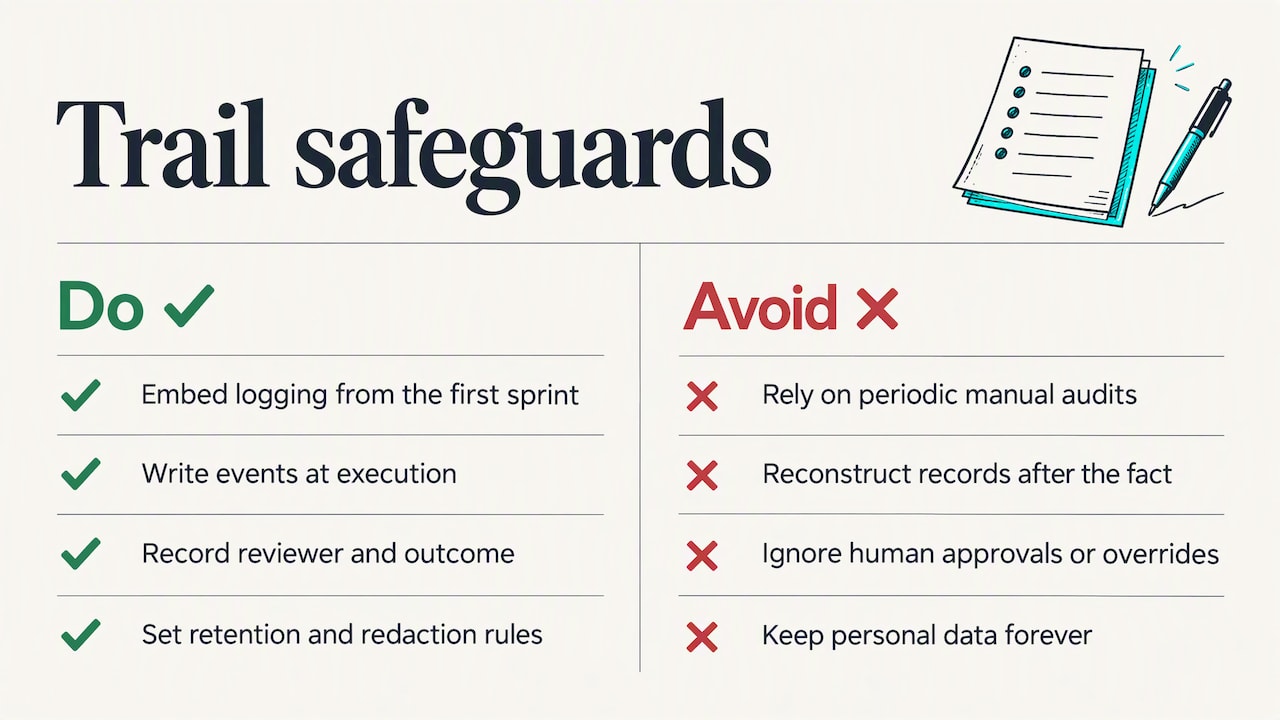
Relying on periodic manual audits. Interviews with experienced AI professionals, reported in research on auditor readiness, found the audit profession struggling to keep pace with AI and named manual, periodic audits as a frequent pitfall. The alternative they advocate, often called RegOps, embeds automated audit logging into the software development life cycle so auditability is a design requirement from the first sprint.
Logging after the fact. If a script reconstructs the record later, it is a story, not evidence. Write the event at execution.
Ignoring the human step. An output that a person approved or overrode is a different event from one that shipped automatically. Record the review, the reviewer and the outcome.
Keeping personal data forever. A complete trail can collide with privacy duties. Decide retention periods and redaction rules up front, and align them with your privacy program. Our GDPR plan for SaaS startups covers the basics.
Treating the trail as a compliance tax. This is the costliest one. A good trail is a sales asset.
Why the trail helps you sell
Founders often file audit logging under cost. Buyers see it as risk reduction. Industry commentary describes the tamper-evident trail as the evidentiary foundation for vendor accountability and billing reconciliation, and it can tip an enterprise sales cycle when two vendors look alike on features.
Think about the security questionnaire. One vendor answers “we log activity”. Another hands over a sample record, shows how it is hashed, and demonstrates reconstructing one decision in minutes. The second vendor gives the buyer’s risk team something to defend internally. That matters, because the buyer is the one who will be asked questions if the AI misbehaves.
It also helps with insurers and with partners who inherit your risk. The more your product acts autonomously, the more they will ask who authorized what. We call the output of this discipline a decision receipt, and we describe the idea in Decision Receipts: the standard for AI accountability.
Our perspective
We run an accelerator built around digital forensics, so we look at AI audit trails through the eyes of someone who may have to defend a record. Here is what we tell founders.
First, design for the hostile reader. The reviewer who matters is not your friendly customer champion but the lawyer, auditor or procurement officer who is paid to doubt you. If your trail survives that reader, every friendly reader is easy.
Second, translate. Most technical teams can build hashing and append-only storage. Fewer can explain, in one paragraph a buyer’s finance and legal teams accept, why the record is trustworthy. That translation from technical proof to business narrative is a large part of what we work on with portfolio companies, because credibility is the bottleneck in cybersecurity and AI sales, not features.
Third, do not wait for a regulation to tell you. Rules differ by country and change. A founder selling in the US today and in Europe next year is better served by one trail design that satisfies the stricter reading than by two retrofits.
— Thiago Vieira
A 30-day plan to get started
- Week 1: inventory. List every place your product calls a model, takes an AI-driven action or lets a human override one.
- Week 2: schema. Define one event format with actor, context, input, output, timestamp, policy version and approval fields.
- Week 3: seal and store. Add hash chaining and append-only storage, with access separated from the product team.
- Week 4: rehearse. Have someone outside the team pick a past decision and reconstruct it using only the trail. Fix every gap they find, then package a sample record and a one-page explanation for your sales team.
FAQ
What is the difference between an AI audit trail and regular logging?
Regular logs help engineers debug. An audit trail is built for outside reviewers: it records who acted, with what authority, the original input and output, and carries proof against later edits. It is complete over the system’s lifetime rather than sampled.
Do I need access to the model’s internals to audit it?
No. Researchers argue that recording inputs and outputs at the query level is often more robust and scalable than white-box access. It also survives model changes, so it works well for startups building on hosted models.
Is an AI audit trail legally required in the US?
There is no single federal rule requiring one. Obligations come from sector regulations, state and local laws, and contracts, so check the rules for your use case with counsel. In the EU, high-risk systems must have automatic logging under Article 12 of the AI Act.
How do I make logs tamper-evident?
Hash each record at the moment it is written, chain each hash to the previous record, and store the chain in append-only storage with separate access controls. Any later change then breaks the chain and shows up in verification.
Can the audit trail help close enterprise deals?
Yes. Buyers’ risk and procurement teams want evidence they can defend internally, and a verifiable trail gives them that. Treat it as part of your sales material, with a sample record ready for security reviews.
Sources
- AI audit trail is a tamper-evident chain of evidence
- accountability for large language models
- IETF draft for an agent audit trail format
- what access auditors actually need
- Article 12 of the EU AI Act
- Regulation (EU) 2024/1689 on EUR-Lex
- One regulatory analysis
- research on auditor readiness