LLM Audit Trails: What to Log and How to Make Them Hold Up

An LLM audit trail is a tamper-evident, chronological record of every model call and security-relevant action in your system, built so you can show what happened long after the fact. Ordinary logging helps you debug. An audit trail helps you answer a customer, a regulator or a court. If you sell an AI or cybersecurity product, that difference decides whether a buyer trusts your claims.
This guide covers what to record for each prompt, model call and tool action, how to make the record hard to alter, how to treat sensitive data, and which rules shape retention. It ends with a replay drill you can run before release.
TL;DR
- An audit trail is complete, append-only and kept for a defined period. Debug logs are sampled, mutable and short-lived. Treat them as two systems.
- Record identity, request, model, policy and integrity data for every call, and give each request one ID that follows it through every service.
- Link events with a hash chain so any edit becomes detectable, and keep sensitive content in a separate controlled store.
- The EU AI Act sets a retention floor of at least six months for high-risk systems. NIST guidance in the US is voluntary but widely used as a reference.
- Prove the trail works by having someone who did not build it reconstruct a high-risk action from the logs alone.
Table of Contents
- What an LLM audit trail is, and how it differs from logging
- What to record for every prompt, model call and tool action
- What one event looks like
- Making the trail complete and tamper-evident
- Sensitive data, access and retention
- Which rules shape LLM audit trails
- Using the trail to investigate and demonstrate
- Our perspective
- Taking an evidence-grade product to market
- FAQ
- Sources
What an LLM audit trail is, and how it differs from logging
Researchers describe an LLM audit trail as a chronological, tamper-evident, context-rich ledger of lifecycle events and decisions that ties technical provenance to governance records. The same paper frames it as a layer that sits between very different technical workflows and the governance regimes that oversee them.
That definition explains why “LLM logging” and “LLM audit trail” are not synonyms. Practitioners draw the line like this:
| Observability and debug logs | Audit trail | |
|---|---|---|
| Purpose | Find and fix problems | Show what happened, after the fact |
| Coverage | Often sampled | Complete, every event |
| Mutability | Can be edited or dropped | Append-only, hash-linked |
| Retention | Short, tuned for cost | Defined period, set by policy and law |
| Audience | Engineers | Auditors, security, legal, customers |
One engineering guide makes the same point: audit events should not be sampled, should be append-only and hash-linked, and should keep enough version and reference data to reconstruct a run without putting sensitive content into the hot-path log.
A practical consequence: do not merge the two. Keeping audit and observability data in separate stores, joined by a shared request ID, lets each follow its own retention and mutability rules. Merge them and you end up with an audit store full of debug noise, or a tracing tool whose retention you cannot change.
What to record for every prompt, model call and tool action
The most common mistake is logging the final answer and nothing else. The final transcript rarely explains what the system actually did. A usable record groups its fields into five categories, as described in one published format specification:
- Identity: the user and the agent or service acting.
- Request: timestamp, route, a fingerprint of the input, and classification signals.
- Model: model metadata, version, parameters and token counts.
- Policy: evaluation results and guardrail decisions.
- Integrity: cryptographic signatures and hash-chain pointers.
Here is how that translates into fields you can implement:
| Field group | What to capture |
|---|---|
| Correlation | Request ID generated at the edge, parent-event reference, sequence number |
| Actor | Authenticated end user or service account, tenant, feature or route |
| Prompt | Template ID and version, rendered-prompt hash, system prompt version |
| Retrieval | Document IDs, versions or hashes, relevance scores |
| Model | Returned model ID, sampling parameters, finish reason, token usage |
| Guardrails | Verdicts from input and output checks |
| Tools | Tool-definition version, arguments, result, calling identity |
| Delivery | What the user actually received, attempt number |
| Integrity | Hash of the previous event, optional signature |
The per-attempt detail comes from a detailed capture-point walkthrough that lists the returned model ID, sampling parameters, template version, rendered-prompt hash, retrieved document references, guardrail verdicts, finish reason, usage, delivered content and attempt number.
Treat prompts like code deployments
Prompt templates, model parameters and guardrail settings change behavior as surely as a code release. Governance guidance notes that auditors increasingly see these as configuration changes that need approval metadata, effectively treating prompt engineering as code deployment. Record who changed a template, who approved it and when it went live, so every logged call points to an exact, reviewable version.
Log the exact input, not a summary
Summaries and truncated logs fall short when someone has to evaluate a decision. One engineering team argues that auditors need the exact input, including retrieved context and system prompts, because a decision can only be judged when its full context is visible. The tension with privacy is real, and the next sections show how to resolve it: store hashes and references in the trail, and keep the raw content in a controlled vault.
Agents need two layers
Agentic systems add tool calls, and tool calls are where real-world side effects happen. A useful trail captures the LLM request and each tool invocation, including arguments, result and identity. Practitioners also recommend logging the intent layer separately from the action layer, because agents often rewrite their own context and the initial state is lost if you do not capture it synchronously.
What one event looks like
A minimal event, written once and never edited, can include a request ID, timestamp, actor identity, model metadata, input and response hashes, policy-check status, token counts and latency, as a reference logging pattern describes. The request ID matters most: a minimal record should carry one so it can be matched to service logs, traces and guardrail events for the same request.
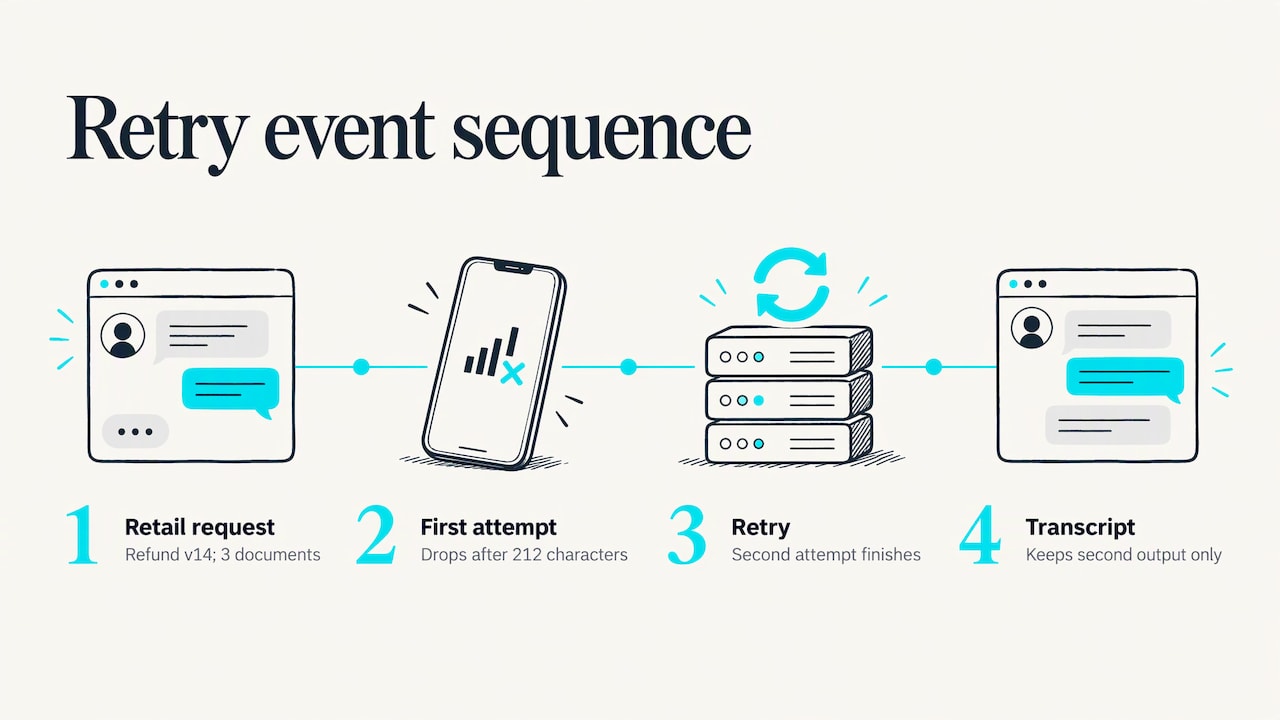
Now a worked scenario, adapted from a published investigation example. A support-chat request from a retail tenant uses a refund template at version 14 and three retrieved documents, one of them a refund policy at version 7. The user’s connection drops after 212 characters have been delivered. The system retries, the second attempt finishes, and only that output lands in the transcript.
If you logged only the transcript, you would never know a partial answer reached the user first. That is why the same walkthrough argues for separate attempt events for retries and streaming. When a customer says the bot told them something different, the attempt-level record settles it.
Making the trail complete and tamper-evident
A record you can quietly edit is not evidence. The research approach is to make the trail append-only and tamper-evident with a hash chain that links each event to the one before it, with cryptographic signatures for stronger designs. If anyone alters or deletes an event, the chain breaks and verification fails.
A few implementation habits make the chain trustworthy in practice:
- Synchronized UTC timestamps. Mixed time zones and clock drift make cross-service ordering impossible.
- Schema versions and sequence numbers. They let you spot gaps and interpret old events after your format evolves.
- Parent-event references and one correlation ID. A reference format for regulators names these as the fields needed to reconstruct order across application, gateway, model, retrieval, tool, approval and delivery events.
- Write-once storage for the chain head. Periodically anchor the latest hash somewhere your main application cannot write.
- Synchronous capture for high-risk actions. If the log write fails, the action should not proceed.
For a deeper look at the engineering, see our guide to tamper-proof logging and our broader piece on what to log and how to prove it.
Sensitive data, access and retention
The richest log is also a liability. Prompts contain personal data, customer secrets and sometimes credentials. The guidance that holds up: keep sensitive content in a separate controlled store with its own access and retention rules, and never log secrets, API keys, tokens or card numbers.
In practice that means:
- The audit event holds hashes, IDs and version references. The raw prompt and response sit in a vault, reachable by ID for authorized reviewers only.
- Redact or tokenize identifiers before they reach the hot path.
- Restrict who can read the trail, and log every read, so the audit trail audits itself.
- Set retention per data class. The event metadata may live for years while raw content expires sooner, subject to legal holds.
Retention periods should come from your legal obligations and customer contracts, not from storage cost. Ask counsel which rules apply to your sector and customers before you fix the numbers.
Which rules shape LLM audit trails
No single US statute dictates an LLM audit log format. The picture is a mix of binding foreign law, voluntary frameworks and sector rules.
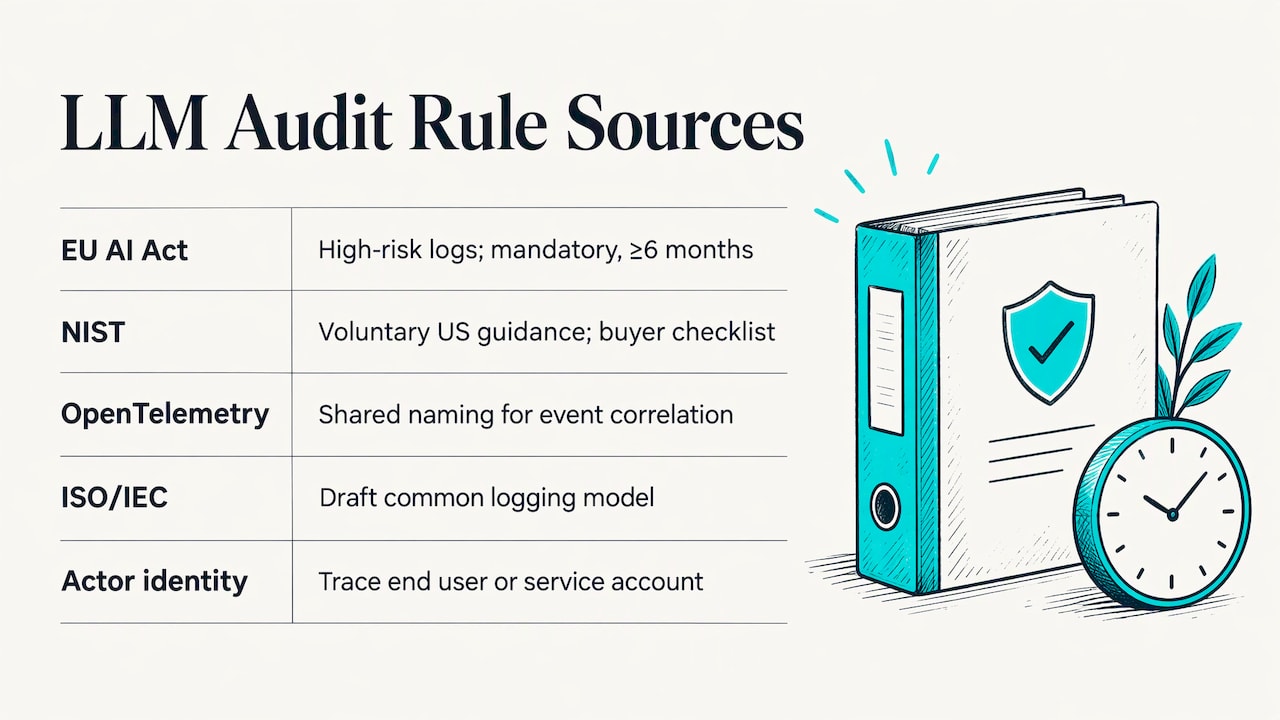
EU AI Act. For high-risk AI systems placed on or used in the EU, logging is mandatory. The European Commission’s implementation guidance explains that providers must retain automatically generated logs under their control for an appropriate period of at least six months unless Union or national law says otherwise, and that deployers have a corresponding obligation for logs under their control. Article 12 requires high-risk systems to allow automatic event recording. If you are a US company selling into Europe, this applies to you through your customers and your own placement of the system on the EU market.
NIST. The same guidance describes the NIST AI Risk Management Framework and the NIST Generative AI Profile as voluntary, US-origin governance guidance. US enterprise buyers often use them as a checklist in security reviews, so mapping your trail to them helps in procurement even though no one compels it.
OpenTelemetry. Its GenAI semantic conventions offer shared naming for correlating model, message, tool and evaluation events, which saves you inventing a schema.
ISO/IEC work. A draft international standard on logging events in AI systems, prEN ISO/IEC 24970, describes common capabilities and an information model. It is a draft, so watch it rather than certify against it.
Whichever applies, identity is the field regulators lean on. The authenticated end user or service account must be traceable, so high-risk decisions map back to a responsible human or process. Applicability always depends on your organization, system and jurisdiction, so confirm with legal counsel. We cover the commercial angle in why traceable evidence wins startup deals under the EU AI Act.
Using the trail to investigate and demonstrate
A trail earns its keep during an incident. A request ID generated at the edge and carried through every service turns scattered records into one story: model calls, tool calls, guardrail decisions and human approvals line up under one identifier.
The investigator’s questions are consistent: who asked, what the model saw, which sources it retrieved, which policy fired, what tool ran, and what the user finally received. If your schema answers those six without anyone opening source code, it is working.
A replay drill before release
Do not wait for an incident to find gaps. One practitioner guide suggests a replay drill before release:
- Pick a high-risk action, such as a refund, a data export or a permission change.
- Capture its full trace.
- Hand it to a reviewer who did not build the system.
- Ask them to reconstruct what happened from the logs alone, replay the policy decision and find the retrieved sources.
- Confirm the approval scope and the state of the business object before and after the tool call.
Every question the reviewer cannot answer is a missing field. Fix it, then run the drill again.
Our perspective
Most AI startups treat logging as an engineering chore until a buyer’s security team asks for evidence. Then the question is no longer whether the model works. It is whether you can prove what it did.
We built Cybertech Acceleration around that gap. We are the first US accelerator dedicated exclusively to digital forensics, and our view is that judicial-grade evidence capability is a product feature, not paperwork. A hash-chained, replayable trail turns “trust us” into something a procurement team, an investor or a court can verify.
Our work with founders is translating that technical strength into a business story. A founder who can show a reviewer exactly how a decision was reconstructed closes deals faster than one who describes logging in the abstract. That is the differentiation we help cybersecurity and AI companies build, in the US and abroad.
Thiago Vieira
Taking an evidence-grade product to market
If you are building an AI or cybersecurity product and want forensic-grade evidence to become a selling point, that is what our program is designed for. Cybertech Acceleration helps founders add judicial-grade forensic capability, turn it into a commercial pitch, and enter the US market with warm introductions and local support. See the program on our main page.

Founders outside the US can look at our Soft Landing offer for structured market entry, and teams interested in Texas can read about the Cybertech Texas Mission.
FAQ
What is an example of an LLM audit trail?
A single event might hold a request ID, timestamp, user identity, model version, hashes of the input and response, guardrail results, token counts and latency. Each event points to the previous one by hash, so the series forms a chain. Raw prompt content sits in a separate controlled store and is linked by ID.
Is LLM logging the same as an audit trail?
No. Logging for debugging is often sampled and editable, and it is kept briefly. An audit trail is complete, append-only and retained for a defined period. Many teams run both and join them with a shared request ID.
How long should I keep LLM audit logs?
It depends on the rules that bind you. For high-risk systems under the EU AI Act, the Commission’s guidance describes a floor of at least six months for logs under your control, unless other law says otherwise. US sector rules and customer contracts may require longer, so check with counsel.
Should I log full prompts and responses?
Auditors tend to want the exact input, including retrieved context and system prompts. Keep that content in a separate vault with strict access and retention rules, and keep only hashes and references in the main trail. Never write secrets, API keys or card numbers to any log.
How do I know my audit trail works?
Run a replay drill. Have a reviewer who did not build the system reconstruct a high-risk action from the logs alone. Any question they cannot answer shows a missing field.
Sources
- ties technical provenance to governance records
- audit events should not be sampled
- detailed capture-point walkthrough
- configuration changes that need approval metadata
- auditors need the exact input
- reference logging pattern
- reference format for regulators
- implementation guidance
- describes common capabilities and an information model