Data Integrity Verification: Methods, Tools, and Steps

Data integrity verification is how you prove that data is exactly what it was when you last trusted it: not changed, destroyed or lost, whether by accident or by an attacker. In practice you do it by computing a cryptographic hash or a digital signature when the data is in a known-good state, then recomputing and comparing later. If the values match, the data is intact. If they do not, something changed.
This guide covers the methods that work, how to run file integrity checks step by step, where verification stops being an IT chore and becomes evidence, and what to know about encryption export rules if you ship software that uses these tools.
TL;DR
- Integrity verification means proving data has not been changed in an unauthorized or accidental way. Hashes detect change; digital signatures also prove who vouched for the data.
- Validation checks data on the way in. Verification checks that data is still accurate and unaltered after it has been stored, moved or merged.
- File integrity checks work only if the reference values are trusted: generate them from a known-clean system and store them offline or signed.
- If your product’s output may end up in a dispute, an audit or court, design the verification trail (who, when, which algorithm, which version) from day one.
- Software that uses encryption can fall under export controls. In the US, check the Export Administration Regulations before you ship abroad.
Table of Contents
- What integrity verification actually means
- The main methods, and what each one proves
- How to run file integrity checks, step by step
- Common mistakes that make verification worthless
- When verification has to hold up as evidence
- Our perspective: forensic-grade integrity is a market advantage
- Encryption export rules: what to check if you ship software
- How to choose your approach
- FAQ
- Sources
What integrity verification actually means
NIST defines data integrity as the property that data has not been changed, destroyed, or lost in an unauthorized or accidental manner. Two words carry the weight: unauthorized and accidental. A disk error that flips a bit and an intruder who edits a log both break integrity, and a good verification method catches both.
Integrity is one of the three pillars of information security, alongside confidentiality and availability. NIST’s guidance on identifying and protecting assets against data-integrity attacks stresses doing the work before an attack happens, not after. That matters for the way you think about verification: it is a control you put in place early, with reference values captured while you still trust the data. The same logic applies to AI systems, where training data, model files and outputs all need a trustworthy record; this overview of AI and information security touches on the compliance side of that.
Verification, validation and data quality
These three terms get mixed up, and the mix-up causes real gaps in controls.
- Validation asks whether a value is acceptable when it is created or updated: right format, right length, inside an allowed range.
- Verification asks whether data is accurate and consistent, usually when it is migrated or merged.
- Integrity verification goes one step further and asks whether the exact bytes you hold are the exact bytes you recorded, regardless of whether they were ever valid or useful.
Data quality is the broader business question of whether data is fit for its purpose. A file can have perfect integrity and still be poor quality (it was wrong when it was recorded). It can also be high quality and fail an integrity check because someone opened and resaved it. You need all three, but only integrity verification gives you a yes-or-no answer about tampering.
The main methods, and what each one proves
There are four techniques you will meet in nearly every real system. They differ in what they prove.
| Method | What it proves | What it does not prove | Typical use |
|---|---|---|---|
| Checksum or hash (SHA-256) | The data matches a reference value | Who created the data or the reference | Downloads, backups, file monitoring |
| Keyed hash (HMAC) | Data matches and the reference came from a holder of the shared key | Which of several key holders signed | API messages, internal pipelines |
| Digital signature | Integrity, authentication of the signer, non-repudiation | That the signer was honest | Software releases, documents, evidence |
| Integrity monitoring | Continuous detection of unauthorized change | The cause of a change | Servers, configuration, critical files |
Hashing
Hashing is the workhorse. A hash function turns data of any size into a short fixed-length value; change one bit and the value changes completely. Microsoft’s developer documentation confirms the principle: hash values can be compared with a protected value to determine whether data was altered. The word “protected” is the whole game. If an attacker can change both the file and the stored hash, the check proves nothing.
On algorithm choice, NIST’s testing guide notes that federal agencies are required to use approved cryptographic checksums such as SHA-256 to maintain the integrity of sensitive data. For anything new, start with SHA-256 or stronger and avoid older algorithms with known weaknesses.
Digital signatures
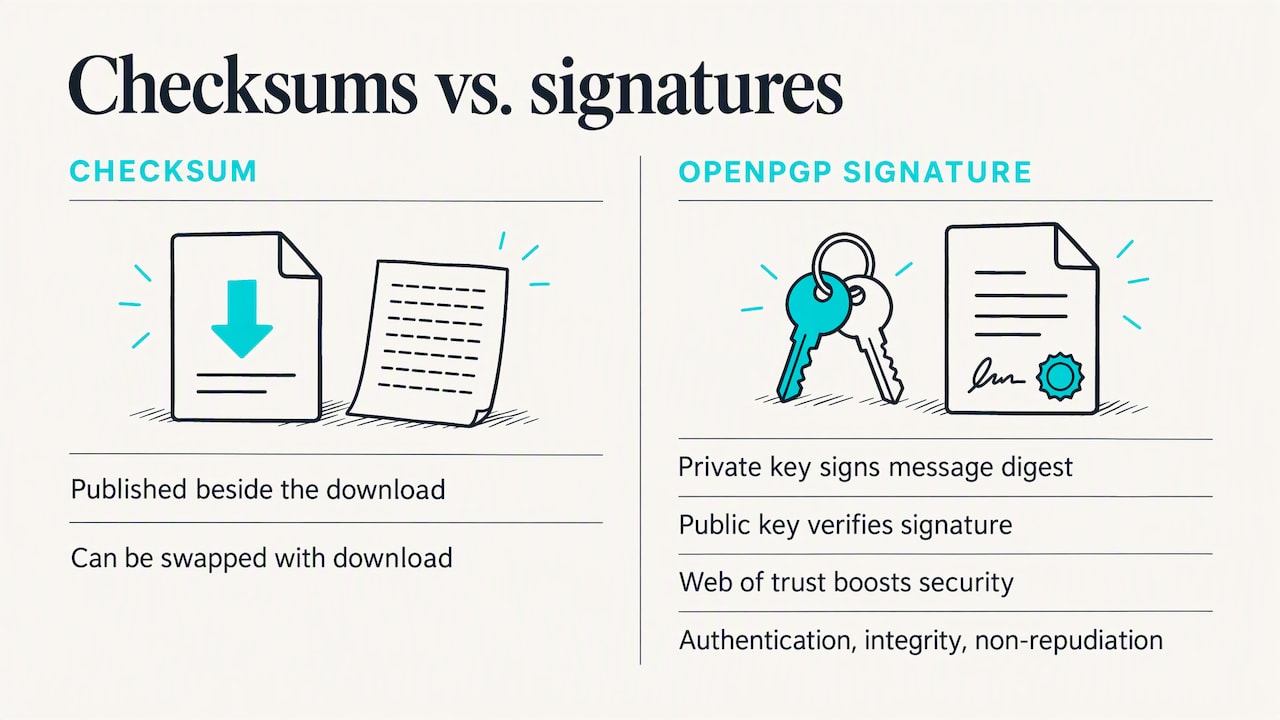
A hash tells you the data is unchanged relative to a number. A signature tells you who stands behind that number. Under the federal Digital Signature Standard, the signer uses a private key on a message digest and anyone with the matching public key can verify it, giving authentication, integrity and non-repudiation.
The Apache Software Foundation’s release process shows how this plays out. It says that, when a key is connected to its web of trust, verifying an OpenPGP signature offers superior security to checksums, because a checksum published next to a download can be swapped along with the download.
Integrity monitoring
Hashing a file once is a check. Hashing it on a schedule, and alerting on differences, is monitoring. We cover how teams run it below.
How to run file integrity checks, step by step
The process is the same whether you are checking a downloaded installer, a backup set or a production server. TechTarget summarizes it as choosing critical files, generating and comparing hashes or digital signatures, and using monitoring tools to watch for unauthorized changes. Here is that expanded into a working routine.
- Decide what matters. You do not need to hash everything. Start with system binaries, configuration files, authentication files, application code, audit logs and anything you may need to produce as evidence.
- Capture a baseline from a clean state. Generate hashes right after a trusted install or release, on a system you believe is uncompromised.
- Store the baseline where an attacker cannot reach it. NIST’s guidance describes keeping checksums in a trusted database and periodically recomputing them to compare against the stored values. The same guide’s point on reference databases is that they work best when built from known-secure systems and kept offline, so an attacker cannot edit the reference alongside the target.
- Recompute and compare on a schedule. Daily for critical systems is common; after every deployment is better. Automate it, because manual checks get skipped.
- Triage every mismatch. Most differences are legitimate updates. Tie each one to a change ticket. The ones you cannot explain are your findings.
- Sign or timestamp the baseline. A signed baseline lets you show later that the reference itself was not rewritten.
- Log the verification itself. Record who ran it, when, with which tool and algorithm version. This log is what turns a technical check into something a third party can rely on.
A worked example: verifying a release download
You download a software package and its published SHA-256 value. You compute the hash of your copy and compare the two strings. If they match, your copy is identical to the one the publisher hashed. If the publisher also provides a signature, verify that too: it protects you in the case where the download page itself was compromised and the hash was replaced along with the file. The same two-layer pattern, hash for the content and signature for the author, is how most mature software supply chains work.
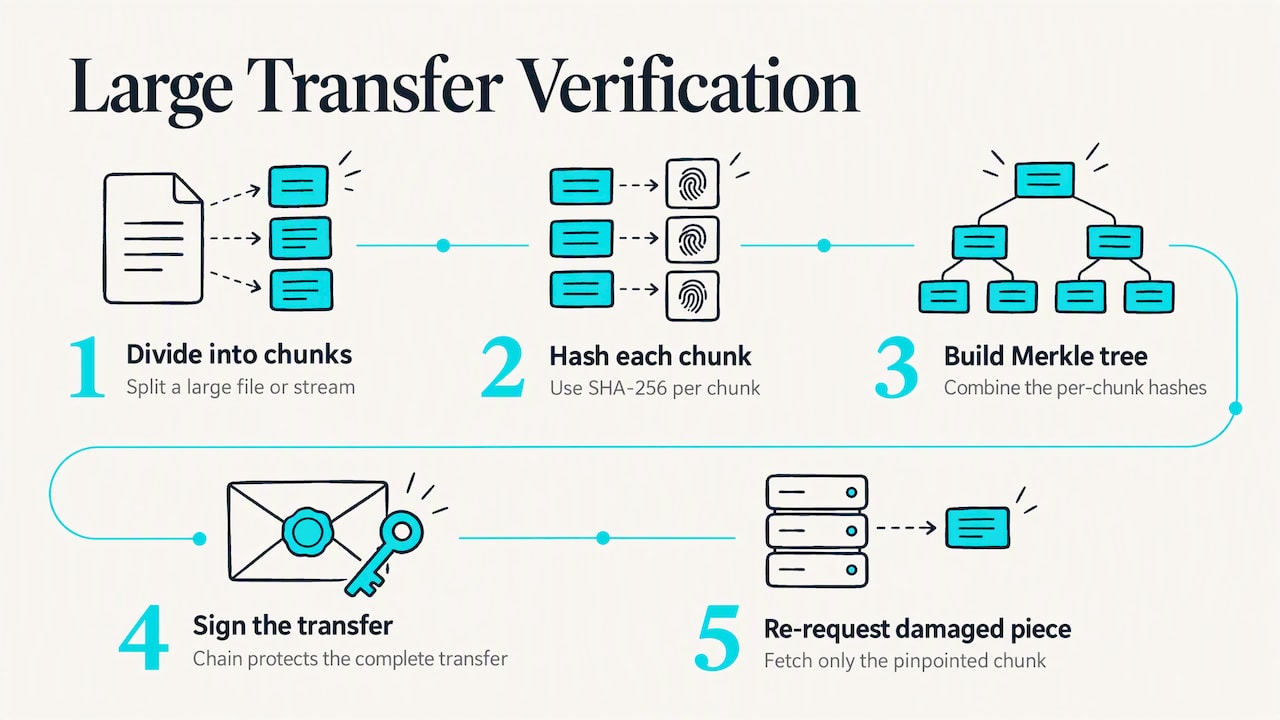
Verifying large transfers
For big files or streams, verifying only the final hash means you find out about corruption at the end. Newer protocol work uses per-chunk hashes. One recent IETF draft describes SHA-256 Merkle trees for per-chunk integrity and a signature chain for complete transfers, which lets a receiver pinpoint and re-request only the damaged piece. It is a draft, not a standard, but the chunk-level idea is already common in how storage and distribution systems work.
Common mistakes that make verification worthless
Most failed integrity programs fail for ordinary reasons, not exotic attacks.
- Storing the hash beside the data. Anyone who can edit the file can edit the hash. Keep references offline, in a separate system, or signed.
- Baselining a compromised system. A baseline taken after the intrusion faithfully records the intrusion.
- Checking too rarely. A monthly check leaves a month of unexplained change to reconstruct.
- Ignoring alerts because of noise. Tune monitoring to exclude expected churn (temp files, caches) so that real alerts stand out.
- No record of the check. If you cannot show how and when you verified, you have an opinion, not evidence.
When verification has to hold up as evidence
For most teams, a failed hash check is an incident ticket. For some, it is the center of a dispute. Security products that generate logs, recordings, alerts or forensic artifacts can find those outputs questioned by a customer’s counsel, an insurer, a regulator or a court. At that point, the question moves from “is the data intact?” to “can you show, to someone who does not trust you, that it is intact and how you know?”
That standard asks for more than a hash:
- a documented chain of custody for the data,
- tooling whose behavior has been independently tested,
- reference datasets and procedures that others can reproduce,
- a clear record of what your method can and cannot establish.
NIST runs public programs in this area, covering forensic tool testing and reference file sets. We walk through what they do and where their limits lie in our piece on NIST digital forensics, evidence limits, CFTT and NSRL.
Our perspective: forensic-grade integrity is a market advantage
We work exclusively with cybersecurity and AI startups on digital forensics, and the pattern we see is consistent. Founders build excellent detection, but their buyers keep asking the same unspoken question: can I trust what this product tells me, and could I defend it if someone challenged it?
Integrity verification is where that trust either exists or does not. A product that hashes its artifacts, signs its outputs, timestamps its logs and documents its method gives a buyer something concrete to say yes to. A product that only claims accuracy leaves the buyer to take it on faith. Our view is that judicial-grade evidence capability is not a compliance burden to bolt on late; it is a differentiator that shortens sales conversations in a crowded market.
The second half of the problem is translation. Engineers describe integrity in terms of algorithms and key management. Buyers and investors need it as a business statement: what risk goes away, what dispute becomes winnable, what audit gets easier. Our approach is to help founders turn the technical work into that narrative, so the forensic component becomes part of the pitch rather than a footnote in the documentation.
— Thiago Vieira
Encryption export rules: what to check if you ship software
Verification tools rely on cryptography, and shipping cryptographic software across borders can trigger export rules. This is a legal area, so treat the points below as orientation and take advice from export counsel before you release anything.
- United States. Encryption items are controlled under the Export Administration Regulations administered by the Bureau of Industry and Security. Part 740 of the EAR sets out license exceptions, including License Exception ENC for encryption commodities, software and technology, with their own conditions and notification requirements. Whether your product qualifies depends on its classification and destination.
- European Union. The EU’s rules on cryptography as a dual-use good follow the Wassenaar Arrangement, and trade inside the EU is generally liberalized, though licensing for exports outside it can still apply. Confirm the current dual-use regulation and national licensing authority for your member state.
- Authentication-only functions. How a function is classified depends on what it does. Do not assume that a feature used only for integrity checks is treated the same as one that encrypts data; get a classification opinion.
For teams moving in either direction between the US and Europe, export classification belongs on the same checklist as incorporation, data protection and customer contracts. It is part of what we help founders map in a structured soft landing.
How to choose your approach
Use your situation to pick the starting point.
| Your situation | Start with |
|---|---|
| Distributing downloads or releases | Published SHA-256 plus a signature on the release |
| Running servers or endpoints | File integrity monitoring with an offline or signed baseline |
| Moving data between systems | Hash before and after migration, and compare |
| Selling a security or AI product into regulated buyers | Signed, timestamped outputs and a documented verification method |
| Expecting disputes or litigation | All of the above, plus chain of custody and independently tested tooling |
If your program also covers the wider security posture, our guides on vulnerability management program best practices and MSSP versus in-house security show where integrity controls sit alongside the rest of your stack.
FAQ
Is hashing used for data integrity?
Yes. You compute a hash of the data when it is in a known-good state, store it somewhere protected, and compare a fresh hash later. A match means the data is unchanged. The stored value must itself be protected, or an attacker can change both.
Which technique is best for verifying data integrity?
It depends on what you need to prove. A SHA-256 hash detects change. A digital signature adds proof of who vouched for the data. For continuous protection of servers, use file integrity monitoring with a baseline kept offline or signed.
What is the difference between data validation and data verification?
Validation checks whether a value is acceptable when it is created or updated, such as its format or range. Verification checks accuracy and consistency afterward, often after migration or merging. Integrity verification adds a check that the data has not been altered since you recorded it.
How often should I run file integrity checks?
For critical systems, daily is a common baseline, and after every deployment is better. Less critical files can be checked weekly. What matters most is that checks are automated and every mismatch is tied to a known change or investigated.
Do encryption export rules apply to integrity tools?
They can, because the tools use cryptography. In the US, start with the Export Administration Regulations and get a classification opinion from export counsel. Requirements differ by country, so check each destination before you ship.
Sources
- has not been changed, destroyed, or lost in an unauthorized or accidental manner
- identifying and protecting assets against data-integrity attacks
- AI and information security
- hash values can be compared with a protected value
- approved cryptographic checksums such as SHA-256
- authentication, integrity and non-repudiation
- offers superior security to checksums
- using monitoring tools to watch for unauthorized changes
- SHA-256 Merkle trees for per-chunk integrity and a signature chain for complete transfers
- license exceptions, including License Exception ENC
- follow the Wassenaar Arrangement