EDR vs XDR: Check Staffing and Test Evidence Before You Buy
Start with EDR if host-level visibility is still a gap in your environment: it is the foundation that XDR builds on, not a competing choice. EDR watches and responds to activity on individual endpoints, while XDR correlates that endpoint data with email, network, cloud, and identity telemetry. Move to XDR once you have mature integrations and the operational capacity to act on cross-source alerts, and look at MDR if you lack 24/7 coverage.
TL;DR:
- XDR’s value depends on clean, normalized telemetry and maintained connectors; map day one sources first, because missing feeds limit correlation and add integration work.
- Correlation across sources can merge separate alerts into one incident, but weak logic may amplify noise, while normalization can add detection lag.
- MITRE ATT&CK coverage commonly falls between 48% and 55%, and many techniques lack practical endpoint rules, so request mappings against your threat model.
- Host agents can be disabled or evaded, so add network detection when lateral movement or data theft could escape endpoint monitoring.
- MDR is a staffed service, not another product; confirm who monitors alerts and responds to incidents before buying detection software.
Table of Contents
- What EDR is and how it works
- What XDR is and how it differs technically
- Scope, detection model, and response: the practical differences
- Who should start with EDR, who should move to XDR, and where MDR or NDR fit
- Deployment realities: agents, data volume, and staffing
- How to evaluate EDR and XDR vendors before you buy
- What independent testing and government guidance actually show
- Why forensic-grade telemetry matters beyond detection
- FAQ
- Sources
What EDR is and how it works
Endpoint detection and response software runs as an agent on laptops, servers, and workloads, feeding activity back to a central management console. That architecture, a lightweight host agent paired with a server that aggregates and analyzes telemetry, is what NIAP’s protection profile formally defines, including the testable behaviors agents must support and the boundaries of what counts as EDR versus adjacent tooling.
The agent collects process execution data, file modifications, local network connections, and system events, then applies detection logic to flag suspicious patterns. A mature EDR deployment gives you:
- Continuous endpoint monitoring with minimal performance drag on the host.
- Detection rules and behavioral analytics tuned to catch known and emerging attack patterns.
- Threat-hunting tools that let analysts query historical telemetry across the fleet.
- Automated remediation such as process termination, host isolation, and file quarantine.
- Forensics-ready logs that preserve the detail needed for incident reconstruction.
When evaluating a product, Microsoft’s comparison of EDR and XDR confirms the core distinction decision-makers should hold onto: EDR’s job is endpoint activity, specifically process, file, network, and system event data, monitored and remediated at the host level.
Independent research shows endpoint products’ MITRE ATT&CK technique coverage typically falls within a moderate range, and many ATT&CK techniques have no practical corresponding detection rule, according to USENIX security research. That finding matters because vendors often lead with ATT&CK coverage claims. Treat the coverage as one input, not the final word, and ask how a vendor’s agent performs against techniques relevant to your actual threat model.
What XDR is and how it differs technically
Extended detection and response takes the same kind of host telemetry EDR produces and fuses it with data from email gateways, network sensors, cloud workloads, and identity providers. Instead of analyzing each source in isolation, an XDR platform runs correlated analytics across all of them, looking for patterns that would never surface from endpoint logs alone.
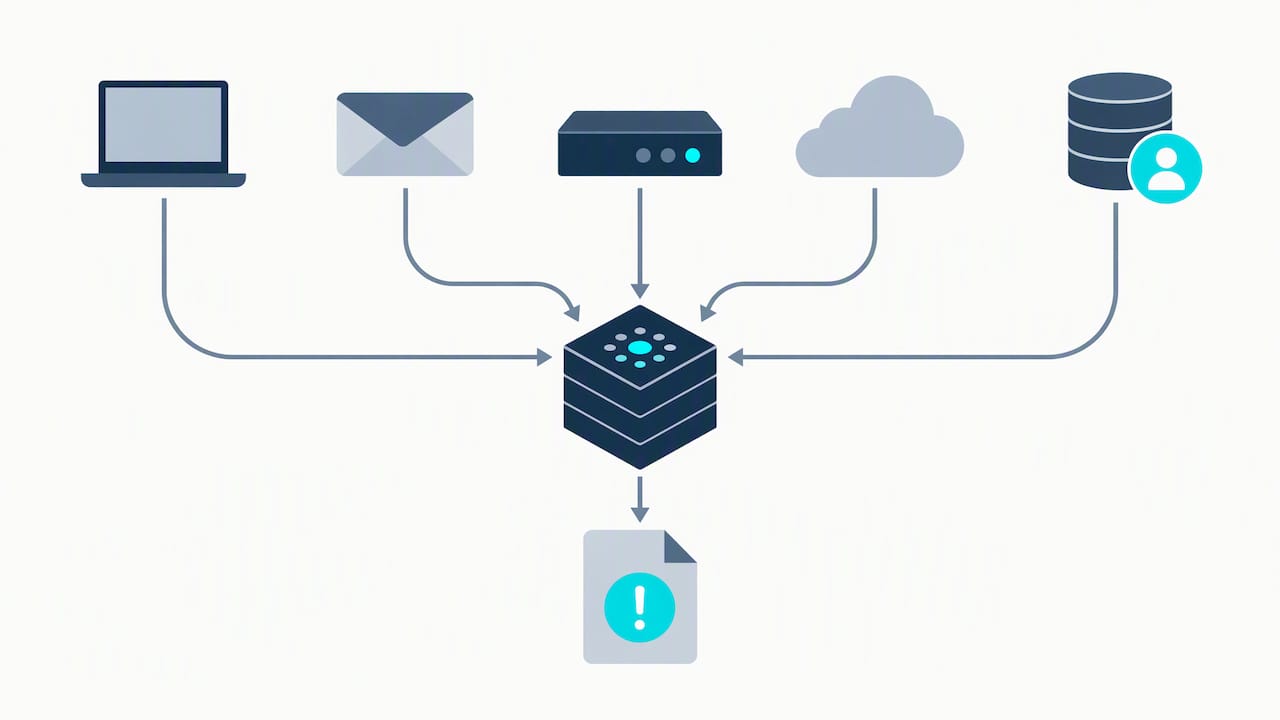
There are two broad delivery models worth separating when you compare products. Native XDR comes from a single vendor that already owns your endpoint, email, or cloud tooling and extends its own telemetry pipeline, which tends to simplify integration but ties you to that vendor’s ecosystem. Open or hybrid XDR stitches together telemetry from multiple best-of-breed tools through APIs and a shared analytics layer, which preserves flexibility but shifts integration work onto your team.
Whichever model you evaluate, a credible XDR deployment should deliver:
- Cross-source correlation that links an endpoint alert to a related email or identity event automatically.
- Enriched investigation views that show the full attack chain instead of isolated alerts.
- Automated response playbooks that act across layers, not just on the host.
- Open APIs and connectors that let you pull in telemetry from tools you already run.
Microsoft’s security guidance describes this as XDR integrating endpoint data with network traffic, cloud services, and email logs to produce broader detection and correlation than any single source supports on its own. That breadth is the entire value proposition, but it only pays off when the correlation engine has clean, normalized data to work with. A platform that ingests five telemetry sources but cannot reconcile their timestamps and entity names will generate noise, not insight.
Scope, detection model, and response: the practical differences
The gap between EDR and XDR shows up most clearly on four axes that actually affect your day-to-day operations rather than on a feature checklist.
- Scope and visibility: EDR sees everything happening on a monitored host and nothing happening on the wire, in the inbox, or in a cloud console; XDR extends visibility into those other layers but depends entirely on how many sources are actually wired in.
- Detection model: EDR relies on host-based rules, heuristics, and behavioral analytics tied to a single machine’s activity; XDR adds a correlation layer that looks for patterns across sources, which can catch multi-stage attacks but also means false positives from one feed can cascade into a broader alert.
- Response: EDR response is host-scoped, isolating a machine, killing a process, quarantining a file; XDR response is meant to orchestrate action across layers, such as disabling a compromised identity while isolating the endpoint tied to it, through automated playbooks.
- Operational load: EDR deployment is comparatively contained since you are managing one agent type across your fleet; XDR adds integration work for every telemetry source you connect, plus the ongoing cost of ingesting and storing that volume of data.
The detection-latency trade-off deserves a closer look. A well-tuned EDR agent can flag malicious process behavior in near real time because it is reasoning about a single, well-understood data source. XDR’s cross-source correlation often adds a processing step, normalizing and matching events from different systems, which can introduce lag depending on how the platform is architected. That lag is usually worth it when the payoff is catching an attack chain that would never trigger a host-only alert, but it is a real trade-off, not a free upgrade.
Alert volume follows the same pattern. Endpoint-only detection produces a narrower, more predictable alert stream. Multi-source correlation can either reduce alert fatigue, by merging what would have been five separate alerts into one correlated incident, or increase it, if the correlation logic is immature and simply forwards every source’s noise into a shared queue.
Who should start with EDR, who should move to XDR, and where MDR or NDR fit
Matching the technology to your organization’s actual profile matters more than chasing the newer acronym.
- Choose EDR first if you have limited visibility into endpoint activity today, a compliance mandate that specifically calls for host-level monitoring, or a smaller security team that needs one well-understood tool before adding complexity.
- Consider XDR once you operate across multiple clouds or hybrid infrastructure, have known visibility gaps spanning email, network, and identity, and already have the integration maturity to connect and maintain those data sources.
- Layer in MDR when your team lacks round-the-clock coverage; MDR is a managed service that operates EDR or XDR tooling on your behalf rather than a product you deploy yourself, a distinction Forrester’s analysis of XDR draws explicitly.
- Add NDR for defense in depth when you need visibility into lateral movement or exfiltration that endpoint agents alone can miss, particularly in environments where sophisticated attackers might disable or evade a host agent.
Pro Tip: Before buying XDR, map which telemetry sources you can actually connect on day one; a platform’s correlation value is capped by the weakest or missing data source in your stack.
Federal guidance reinforces the EDR-first sequencing for organizations still building visibility: M-22-01 directs U.S. federal agencies to adopt EDR to improve detection and host-level visibility before expanding into broader detection architectures. If you want more detail on managed options once you reach that staffing question, our earlier look at MSSP versus in-house security operations walks through the trade-offs.
Deployment realities: agents, data volume, and staffing
Choosing a detection architecture is the easy part. Running it is where most of the budget and headcount actually go.
- Agent lifecycle management across Windows, macOS, Linux, and container hosts means constant versioning, telemetry tuning, and compatibility testing, and skipping this work directly erodes detection coverage over time.
- Telemetry storage and retention costs scale with every source you add; an XDR deployment pulling in network, cloud, and email logs alongside endpoint data can multiply your ingestion volume several times over compared to EDR alone.
- Analyst workflows and playbook maturity determine whether correlated alerts actually get triaged faster, or just pile up in a queue that nobody has the capacity to work through.
- Integration complexity for cloud, identity, and email connectors is ongoing maintenance, not a one-time setup, since each source’s API and schema can change independently.
Advanced attackers sometimes disable or evade host agents entirely, which is why combining endpoint telemetry with network-level visibility is considered a sound defense-in-depth practice according to arXiv research on EDR performance. That single point of failure is worth weighing before you assume endpoint coverage alone is sufficient for your risk profile.
Staffing is the piece most organizations underestimate. Bureau of Labor Statistics data on information security analysts is a useful reference point when you are estimating hiring timelines and the labor market you are competing in for SOC talent. A platform that adds five new telemetry sources without a corresponding increase in analyst capacity will not improve your security posture, it will just generate more unread alerts. If your team is already stretched, our comparison of MSSP and in-house security costs is a reasonable next read before you commit to either architecture.
How to evaluate EDR and XDR vendors before you buy
A structured evaluation keeps you from buying features you cannot operate. Work through this checklist with your security, cloud, and identity teams before any proof of concept starts.
- Confirm telemetry coverage matches your actual environment: which OS platforms, cloud providers, email systems, and identity providers does the product support natively versus through third-party connectors.
- Ask for ATT&CK mapping detail, not just a coverage percentage, since independent testing shows technique coverage varies widely and many techniques have no practical detection rule at all.
- Request third-party testing evidence such as NIAP protection profile conformance for EDR components or MITRE Engenuity evaluation results, and ask what the vendor’s results did not catch, not only what they did.
- Verify integration APIs are documented and stable enough to support the specific connectors your environment needs, especially for cloud and identity sources.
- Test response automation against your own playbooks during a proof of concept rather than a vendor-scripted demo.
- Check data portability: can you export raw telemetry and alert history if you switch vendors later.
- Clarify the pricing model, since cost usually scales with data volume or endpoint count, and ask how pricing changes as you add telemetry sources.
- Define PoC success metrics up front, such as time to detect a specific technique or false-positive rate against your production traffic, and involve cloud, identity, and legal stakeholders early so the trial reflects real operational conditions.
Ask vendors directly about agent CPU and memory overhead, documented false-positive rates from recent evaluations, and support SLAs for incident escalation. Vague answers to any of these are a signal worth weighing heavily.
What independent testing and government guidance actually show
Third-party evidence is more reliable than vendor marketing, but it comes with caveats worth understanding before you lean on it.
- NIAP’s protection profile for EDR defines concrete, testable requirements for host agent behavior, giving buyers a baseline that goes beyond marketing claims.
- MITRE ATT&CK evaluations are useful but incomplete: coverage percentages in the 48% to 55% range are common, and many techniques simply lack a practical endpoint detection rule, per USENIX’s analysis.
- U.S. federal guidance treats EDR as the foundational control, prioritizing host-level visibility before broader detection investment.
- Network detection can fill gaps that endpoint agents miss, including lateral movement and exfiltration activity, making it a common third leg alongside EDR and SIEM in what some practitioners call the SOC visibility triad, as described in ExtraHop’s MITRE ATT&CK white paper.
EDR and XDR are tools you buy; MDR is the human service that operates those tools and responds to incidents. Buying an XDR platform with no operations capability behind it can leave alert fatigue unresolved rather than solved.
That framing comes from Forrester’s commentary on XDR, and it is the single most useful corrective for teams evaluating these categories: the technology category you buy and the operational capacity to run it are two separate purchasing decisions, and skipping the second one undermines the first.
Why forensic-grade telemetry matters beyond detection
Detection architecture decisions do not stay inside the SOC. The quality of the telemetry an EDR or XDR platform produces, how clean, time-stamped, and reconstructable it is, determines whether an incident holds up as evidence later, not just whether it gets flagged. We think about detection priorities through that lens because forensic readiness and product credibility are the same conversation for cybersecurity and AI startups trying to earn trust with buyers and investors.
A startup that can show a clear, evidence-grade telemetry trail from detection to root cause has a stronger pitch than one that can only show an alert fired. That distinction shapes how we evaluate the startups we work with and how we help them translate detection capability into a narrative that holds up with technical buyers and legal teams alike.
— Thiago Vieira, Founder, Cybertech Acceleration
FAQ
What does EDR and XDR mean?
EDR stands for endpoint detection and response, software that monitors and remediates activity on individual devices like laptops and servers. XDR stands for extended detection and response, which correlates that endpoint data with telemetry from email, network, cloud, and identity sources, as explained in Microsoft’s EDR versus XDR comparison.
How does MDR differ from EDR?
EDR is a software product you deploy and operate yourself, while MDR is a managed service in which a provider’s team runs detection tooling and responds to incidents on your behalf. Forrester’s analysis notes that buyers often conflate the two, which leads to under-resourced detection programs when a tool is purchased without the operational capacity to run it.
Is Splunk an EDR or SIEM?
Splunk is best known as a SIEM and data analytics platform that ingests and correlates logs across an environment, rather than an endpoint agent-based EDR product. The distinction matters because SIEM, EDR, and XDR solve related but different problems: log aggregation and correlation versus host-level detection and response.
What are the top 5 EDR tools?
There is no single authoritative ranking of EDR tools, since performance varies by environment, threat model, and the specific MITRE ATT&CK techniques tested. Rather than chasing a fixed list, evaluate candidates against your own telemetry needs, request NIAP or MITRE Engenuity evaluation results, and run a proof of concept against your production traffic.
Should startups prioritize EDR or XDR for forensic readiness?
Host-level EDR telemetry is usually the stronger starting point for forensic readiness, since it captures the detailed process, file, and system event data that investigations rely on. Startups building toward markets that expect judicial-grade evidence capabilities often benefit from locking in clean, reconstructable endpoint telemetry before layering on broader XDR correlation, a sequencing we work through with founders in our Cybertech Acceleration program.
Sources
- EDR vs XDR explained — Microsoft Security
- M-22-01: Improving detection of cybersecurity vulnerabilities and incidents on federal systems through Endpoint Detection and Response (EDR) — White House/CISA
- XDR defined: giving meaning to extended detection and response — Forrester blog
- How does Endpoint Detection use the MITRE ATT&CK Framework? — USENIX/Academic analysis