Building a Cyber Company Alone: A Solo Founder’s Playbook

You can build a cybersecurity company alone. Many founders have, and the work is the same as for any team: prove a problem is worth solving, earn the trust of skeptical buyers, and make the hard calls on co-founders, hires, pricing and market entry. The difference is that nobody sits across the table to challenge you. This guide covers the order to do things in, the decisions that deserve the most care, and the proof security buyers expect to see.
TL;DR
- Validate four things before building much: the problem, your solution, the market and buyer trust.
- Stay solo while you can ship and sell. Add a co-founder or hire when you hit a structural wall, not out of loneliness alone.
- Buyers discount generic claims. A narrow positioning, founder-level technical content and named customer evidence carry more weight.
- Trust artifacts such as a recent penetration test and a short proof of value shorten enterprise deals.
- If you are building for the US from outside the usual hubs, plan the entry early. Our program is built for exactly that situation.
Table of Contents
- Why solo cyber founders carry a heavier load
- Step 1: Pick a problem buyers already feel
- Step 2: Decide when to stay solo, add a co-founder or hire
- Step 3: Differentiate with a narrow claim and visible proof
- Step 4: Build the trust artifacts early
- Step 5: Plan US entry before you need it
- Perspective: you do not have to decide alone
- A 90-day plan for a solo founder
- FAQ
- Sources
Why solo cyber founders carry a heavier load
A solo founder in security makes a long list of decisions with nobody to pressure-test them: which problem to pick, whether to hire, what to charge, which country to sell in first. Founders with a co-founder often describe the same loneliness, because the biggest calls still land on one person.
The good news is that solo is a workable starting point. One essay on finding co-founders states plainly that a cybersecurity company can be built by a solo founder, and it cites Devo’s Pedro Castillo as an example. What matters is not whether you are alone. It is whether you build a way to get outside judgment, whether from advisors, design partners, other founders or a structured program.
Step 1: Pick a problem buyers already feel
Security is crowded and buyers are tired of pitches. Start narrow. Forgepoint Capital’s interview with Ross Haleliuk advises choosing one specific domain such as identity, product security or cloud security, going deep, and interviewing enough prospects and customers to separate important problems from ones security leaders will not prioritize. The same interview cautions that deep expertise can create confirmation bias, so even seasoned practitioners need discovery calls.
It also notes that current budget and attention still concentrate on established concerns such as endpoint, cloud, compliance and identity. If you are an AI founder entering security, that is a signal to attach your technology to a problem buyers worry about now, not only to a novel AI use case.
How much discovery is enough
There is no magic number, but the examples are instructive. The Front Lines go-to-market guide reports that Nudge Security planned 200 discovery calls in six months, and that Rencore interviewed more than 300 customers over two years. Those are extreme cases, but the pattern is consistent: repeated conversations reveal whether a problem is broad and urgent.
A practical solo version:
- List the 30 to 50 people who own the problem you think you are solving: CISOs, security engineers, MSSP owners, compliance leads.
- Ask about the last time the problem cost them time or money, and what they did about it. Do not pitch.
- Track the language they use. One BlueRock-style test is to ask prospects how they would describe what you do to their peers, then pattern-match their words, as described in this founder podcast.
- Look for willingness to pay, not praise. A case study on Andeavour’s founder treats a prospect’s willingness to buy when ready as stronger validation than compliments or hypothetical interest.
The four levels of validation
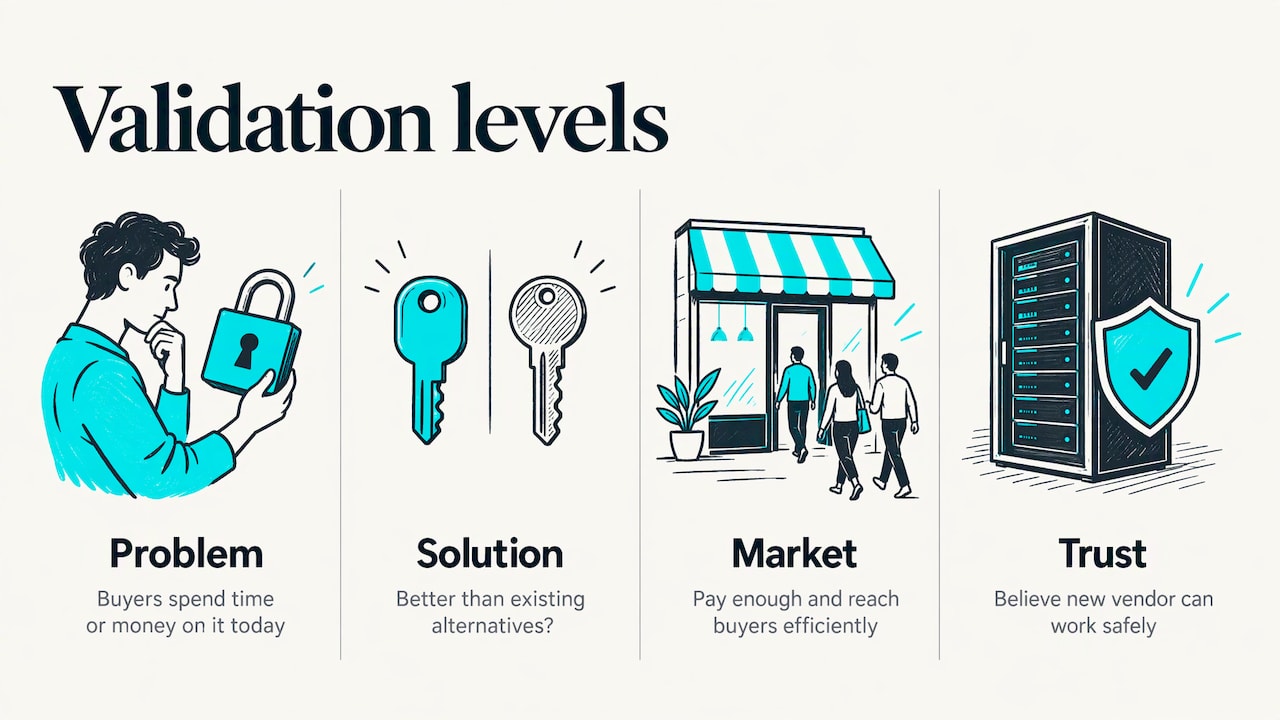
Deepak Gupta’s founder guide frames validation as problem, solution, market and trust. Problem: do buyers spend time or money on this today? Solution: is your approach better than the alternatives? Market: will buyers pay enough, and can you reach them efficiently? Trust: will they believe a new vendor can both make the product work and perform the function safely? Trust is the layer solo founders most often skip, and in security it is often the one that decides the deal.
Step 2: Decide when to stay solo, add a co-founder or hire
This is the decision solo founders agonize over most, and it deserves a rule rather than a mood.
Signs you can stay solo
CRV’s guidance on solo founders says to stay solo if the execution path is viable and keep going until you hit a structural wall you cannot build around. OpenForest’s framework agrees: go solo when you can ship version one yourself, time to launch is critical, you have a singular vision, or you are still validating the problem. Its litmus test is whether you can reach $10K in monthly revenue alone.
Signs you need a co-founder
CRV lists the structural gaps that justify a partner: you cannot ship an MVP, your decision-making is isolated, whole business functions are uncovered, or fundraising has stalled with feedback about team composition. A co-founder shares ownership, risk and strategic decisions. A first hire fills a specific functional gap for salary and a smaller equity grant. Those are different tools for different problems.
OpenForest also recommends a 90-day trial before formalizing a co-founder relationship, and four-year vesting with a one-year cliff for the equity split. In cybersecurity, a common imbalance is the deep technical researcher who dislikes selling, or the seller who cannot build the core product. Name yours honestly.
Making the first hire
Two guides are worth borrowing from. QuickInsight suggests testing a role with the cheapest reversible setup, such as a contractor or bounded project, to see whether the work keeps showing up in the same shape and whether you can judge the result without redoing it. If yes, a full-time hire is justified. Roles that need deep context, customer contact or sensitive information are harder to trial, so the job description has to carry more weight.
Quickly Hire argues that for a solo technical founder, the first hire is likely not another engineer but someone who can own go-to-market while you build. That fits a security pattern the Front Lines guide reports: Vicarius let go of early sales hires because, in the first year, the product only sold when the founder personally persuaded the customer. Founder-led selling comes first. Hire for the gap after you know what repeatable looks like.
| Situation | Likely move |
|---|---|
| You can ship and sell, still validating | Stay solo, add advisors and design partners |
| You cannot build the core product | Find a technical co-founder or senior contractor |
| Sales stall, product works | Founder-led selling first, then a go-to-market hire |
| Funding would remove a clear bottleneck | Raise for the specific hires it unlocks |
Where funding fits
Dark Reading’s report on bootstrapped founders describes GreyNoise’s solo founder raising capital because he was burning out and could not wait long enough to afford an engineer or salesperson. The same piece quotes runZero’s HD Moore on venture capital as a buffer that de-risks early hiring, while the founders agree money cannot make up for a product that misses customer needs. Treat funding as a way to buy time for the right hires, after the product fits.
Step 3: Differentiate with a narrow claim and visible proof
Security buyers have heard every promise. Mandos Cyber’s guide argues a solo founder should own a narrow, repeatable positioning claim rather than describe a broad category, collect named customer evidence, and publish founder-level technical explanation, because buyers discount generic vendor claims.
Mazo’s guide points to original research, disclosed vulnerabilities, real datasets and technical teardowns as high-trust channels, since they show practitioner competence without leaning on promotion. For a solo founder, this is an advantage: your own name and expertise are the brand.
Turn being small into a selling point
A case study from The Stack Stories describes Coastal, a two-person startup that swapped polished demos for a live demonstration of the product’s real behavior. It helped close a $410,000 deal, and the CISO cited confidence that the team would be there when the tool broke. Buyers are not only buying features. They are buying the founders’ ability to support them.
Step 4: Build the trust artifacts early
Security vendors are held to a higher standard than most. A few items to prepare before enterprise conversations:
- A short security overview and a completed standard questionnaire. Valuflash’s guide says early trust work should include these plus disciplined internal practices. Formal SOC 2 or ISO/IEC 27001 attestations grow more valuable as deals get larger, though they do not substitute for product quality.
- A recent penetration test. Ironbark Cyber’s guide calls it the highest-leverage item for enterprise questionnaires. Keep three versions ready: an attestation letter to share freely, an executive summary for use under NDA, and the full technical report for major deals only. Expect pushback if the last test is over a year old.
- A scoped proof of value. Mazo recommends a two-week proof of value on the buyer’s own data, with a defined scope and success criterion, ideally timed to a forcing event such as an incident, audit or customer requirement.
For early-stage products, the same thinking applies to your own code. Our guide to security by design for early-stage startups covers building those habits before the first questionnaire arrives. And if you are looking for early customers willing to shape the product, see how to build a design partner program that converts.
Step 5: Plan US entry before you need it
Many solo cyber founders build outside the big hubs and still sell to US buyers. Staged expansion is common. A Mint report says Indian cybersecurity startups often begin expanding abroad after reaching roughly $1 to $3 million in ARR at home, and describes cases of a local US entity before entry and phased moves into new regions. Another report on DataGuard notes that international products must account for differing customer and regulatory requirements, including frameworks such as GDPR and CCPA.
If you are selling from abroad, these guides go deeper: selling cybersecurity to US enterprises as a foreign startup, the UK-to-US entry guide and the Israeli startup go-to-market guide. Our US market entry playbook lays out the sequence.
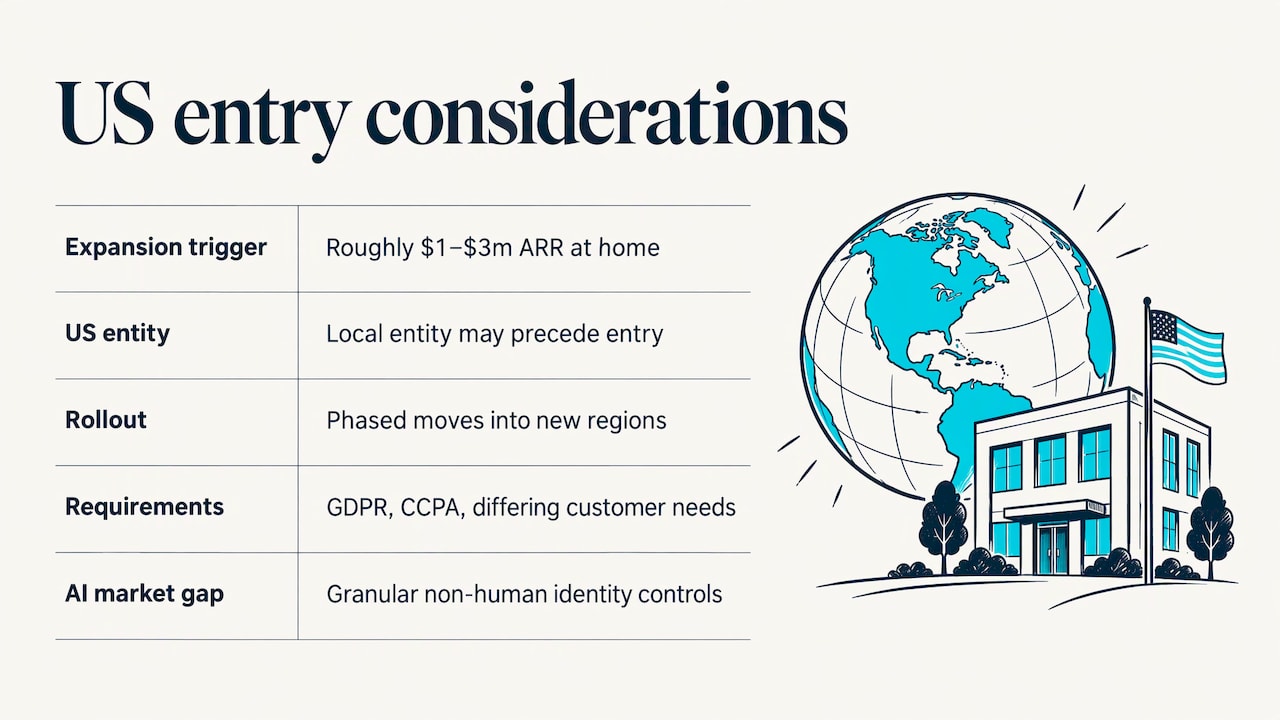
One more point for AI founders: a CyberDB framework suggests categorizing vendors by problem set rather than product name and looking for feature gaps in market leaders, such as granular controls for non-human identities that broad identity platforms lack. A gap like that is a market entry point.
Perspective: you do not have to decide alone
We built Cybertech Acceleration for the founder who carries the big decisions alone, or who has a co-founder and still feels alone. Most programs are built for large teams in the usual hubs. Our founders are often in Brazil, Portugal or elsewhere in Europe, building for US buyers.
In our experience, the hard questions are rarely technical: whether to bring in a co-founder, who to hire first, what to charge, and how to enter the US. That is why our November to March program puts exited founders, CISOs, MSSPs and a court-appointed digital forensics expert in the room, so each decision gets tested by someone who has made it before.
We also believe proof is the strongest differentiator a security product can have. Our approach is to help founders build evidence-grade proof into the product, so it holds up with US buyers and in court. The program closes with an in-person Texas Mission during SXSW, and the network around it includes portfolio companies, alumni and 350+ cyber founders.
Solo is a starting point, not a verdict. The goal is for you to stop making the biggest calls in isolation.
Thiago Vieira
A 90-day plan for a solo founder
If you are starting now, here is a sequence that respects the limits of one person’s time:
- Days 1 to 30: discovery. Run 20 to 30 conversations with people who own the problem. Write down their exact wording and the money or time the problem costs them.
- Days 31 to 60: narrow claim and thin build. Pick one domain and one repeatable claim. Build only what lets a design partner test it. Publish one technical piece under your own name.
- Days 61 to 90: proof. Run a scoped proof of value with one or two design partners on their data, with a success criterion agreed in writing. Schedule a penetration test if the product will touch customer data.
At day 90, review against the structural-wall test: can you ship, can you sell, are you deciding in isolation? Your answers tell you whether to stay solo, find a partner or make the first hire.
FAQ
Can one person really start a cybersecurity company?
Yes. Solo founders have built security companies, and the path is the same: validate the problem, build a narrow product, and earn trust with proof. What changes is the need to get outside input on big decisions, through advisors, design partners and peer founders.
Should I find a co-founder right away?
Not necessarily. Stay solo while you can ship and sell and are still validating. Consider a partner when you hit structural gaps such as being unable to build the core product, uncovered business functions or decisions made in isolation. If you do, test the working relationship for about 90 days and use vesting.
What should my first hire be?
It depends on the gap. A technical founder often benefits most from someone who owns go-to-market. A non-technical founder may need a senior technical contractor or co-founder. Trial the role as a contractor or bounded project first when the work allows it.
How do I earn trust with US buyers as a small team?
Own a narrow claim, publish technical work under your name, keep a recent penetration test and a completed security questionnaire ready, and offer a scoped proof of value on the buyer’s data. Show how you will support the customer, not only what the product does.
Sources
- a cybersecurity company can be built by a solo founder
- one specific domain such as identity, product security or cloud security
- Nudge Security planned 200 discovery calls in six months
- this founder podcast
- problem, solution, market and trust
- stay solo if the execution path is viable
- $10K in monthly revenue alone
- the first hire is likely not another engineer
- buffer that de-risks early hiring
- narrow, repeatable positioning claim
- high-trust channels
- $410,000 deal
- disciplined internal practices
- $1 to $3 million in ARR at home
- differing customer and regulatory requirements
- granular controls for non-human identities