US Company Formation: A Founder’s Guide to Doing It Right
Forming a US company takes a few days and a few hundred dollars in state fees. Forming the right one takes more thought. You choose an entity type, a state, a registered agent and a name. You file with the state, get an Employer Identification Number (EIN) from the IRS, and then stay compliant every year. For most venture-backed cybersecurity and AI startups, the answer is a Delaware C-corporation. This guide explains why, when it is the wrong answer, and what international founders trip over.
TL;DR
- Most startups that plan to raise venture capital form a Delaware C-corp. An LLC suits smaller, owner-funded businesses better.
- State registration usually costs less than $300 in most cases, but the exact fee depends on the state and the structure.
- The IRS issues EINs for free. Founders without an SSN or ITIN cannot use the instant online route and must apply by fax or mail.
- As of August 14, 2026, US companies are exempt from BOI reporting. Foreign-owned entities still have the IRS Form 5472 to think about.
- Forming the entity is only step one. Licenses, banking, tax filings and contracts follow.
Table of Contents
- What company formation actually does
- Choose the structure first
- Why so many founders pick Delaware
- Step by step: from name to bank account
- Getting an EIN, and what to do without an SSN
- Beneficial ownership reporting after August 2026
- The filing that catches foreign founders: Form 5472
- Ongoing compliance in the first year
- Our perspective: formation is where credibility starts
- Where we can help
- FAQ
- Sources
What company formation actually does
Company formation is the act of registering a legal entity that is separate from its owners. That separation is what protects your personal assets, lets you sign contracts in the company’s name, and gives investors something to buy shares in.
It is not permission to operate. Founders often mistake incorporation for the right to do business, but formation is a prerequisite, not a replacement for the licenses and permits that state, county and local authorities require. Which licenses apply depends on your industry and location. A software company selling to enterprises usually needs few. A company that does investigative work, or handles regulated data, may need more, so check before you sell.
Choose the structure first
The SBA calls business structure the foundational decision: it determines personal liability, tax obligations and your ability to raise money. It also advises talking to an attorney or accountant before you register, because changing structure later can trigger significant tax consequences.
For a technology startup, the realistic choice is between two entity types.
| C-corporation | LLC | |
|---|---|---|
| Best for | Startups planning to raise equity from VCs or angels | Small, bootstrapped or services businesses |
| Taxation | Taxed at the entity level; shareholders taxed on dividends | Pass-through by default; a foreign-owned single-member LLC has special reporting |
| Equity issuance | Standard share classes, option pools, preferred stock | Possible, but unusual and harder for investors to diligence |
| Investor familiarity | High. Standard term sheets assume it | Low. Many investors ask you to convert |
| Typical fit for cyber and AI startups | Product companies with IP and a funding plan | Consulting-led businesses with no outside investors |
If you expect to issue options to engineers, sign a SAFE or take a priced round, form a C-corp from the start. Converting later costs legal fees and can create tax problems.
Why so many founders pick Delaware
The State of Delaware says its main strategic advantage is the Court of Chancery, which is recognized for timely, consistent decisions on complex corporate matters. For startups with sensitive IP and layered governance, that predictability matters when a dispute arises between founders and investors.
The scale of adoption is the other argument. According to the Delaware Division of Corporations, 79% of US initial public offerings in 2022 and 67.6% of the Fortune 500 chose Delaware, along with thousands of subsidiaries of non-US companies. Investors and their lawyers know the Delaware corporate statute, so the paperwork moves faster.
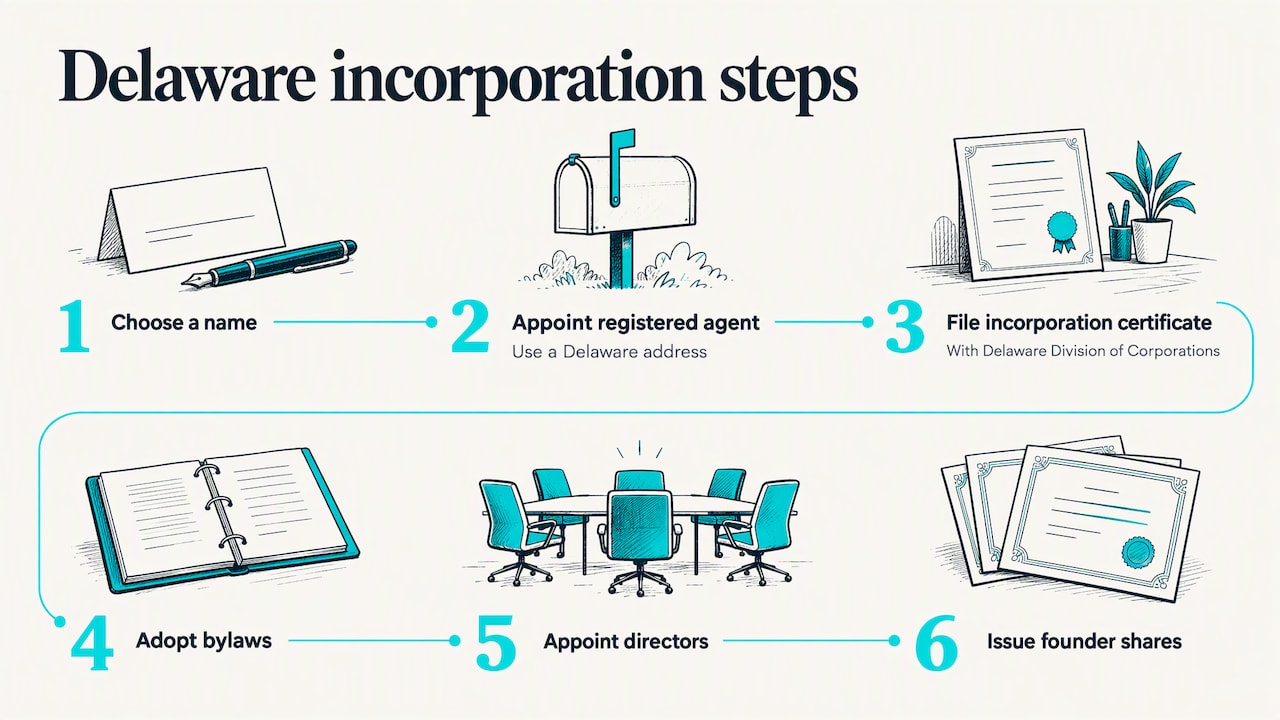
That is why searches for how to incorporate in Delaware are so common. The mechanics are simple: pick a name, appoint a registered agent with a Delaware address, file a certificate of incorporation with the Delaware Division of Corporations, adopt bylaws, appoint directors and issue founder shares.
When Delaware is not the best answer
Delaware is not automatic. If you will operate mainly in one other state, a Delaware entity usually has to register there as a foreign entity too. That means double compliance and double fees for a company with no outside investors and no plan to raise.
A Texas or Florida entity can make sense for a small company with a single-state footprint. A company that will raise a seed round from US investors almost always ends up in Delaware anyway. Ask your lawyer and your lead investor before deciding.
Our own guide to the Delaware C-corp for foreign cybersecurity startups goes deeper on the parent-subsidiary question that foreign founders face.
Step by step: from name to bank account
- Pick the state and the entity type. Use the table above. Confirm with counsel if you plan to raise money.
- Check and reserve the name. Search the state’s business registry. Names must be distinguishable from existing entities and carry a suffix such as Inc., Corp. or LLC.
- Appoint a registered agent. This is a person or firm with a physical address in the state who receives legal notices. Delaware requires one.
- File the formation document. For a corporation, that is the certificate (or articles) of incorporation. For an LLC, the certificate or articles of organization. The SBA notes that registration typically costs under $300, though fees vary by state.
- Adopt governing documents. Bylaws and board consents for a corporation, an operating agreement for an LLC.
- Issue founder equity. Do it right away, with vesting where investors will expect it.
- Get an EIN. See the next section.
- Open a bank account and set up bookkeeping. Banks usually want the formation documents, the EIN and identification for the owners.
- Register for state and local taxes and licenses where you actually operate.
Getting an EIN, and what to do without an SSN
An EIN is your company’s federal tax ID. The SBA warns about a recurring misconception: you do not need to pay an online service for it, because the IRS provides the application free of charge. Apply right after state registration.
The applicant must name a responsible party, the person who owns or controls the entity. For international founders, the catch is this: according to the instructions for Form SS-4, if the responsible party has no SSN or ITIN, the process changes and you apply by fax or mail rather than getting instant online processing. Plan for extra days, and do not schedule your first invoice or bank account opening for the day after you file.
A third-party agent can help with the paperwork, but you should not be paying a fee for the EIN itself.
Beneficial ownership reporting after August 2026
The rules changed this year, and many guides online are out of date. FinCEN states that US companies are exempt from Beneficial Ownership Information reporting and no longer have to file BOI reports. Under the final rule effective August 14, 2026, the obligation applies only to certain foreign companies registered to do business in the United States.
In practice, a Delaware C-corp you form today does not file a BOI report. A foreign parent company that registers to do business in a US state may be a different story, so read FinCEN’s questions and answers on the final rule or ask counsel before you register a foreign entity.
The filing that catches foreign founders: Form 5472
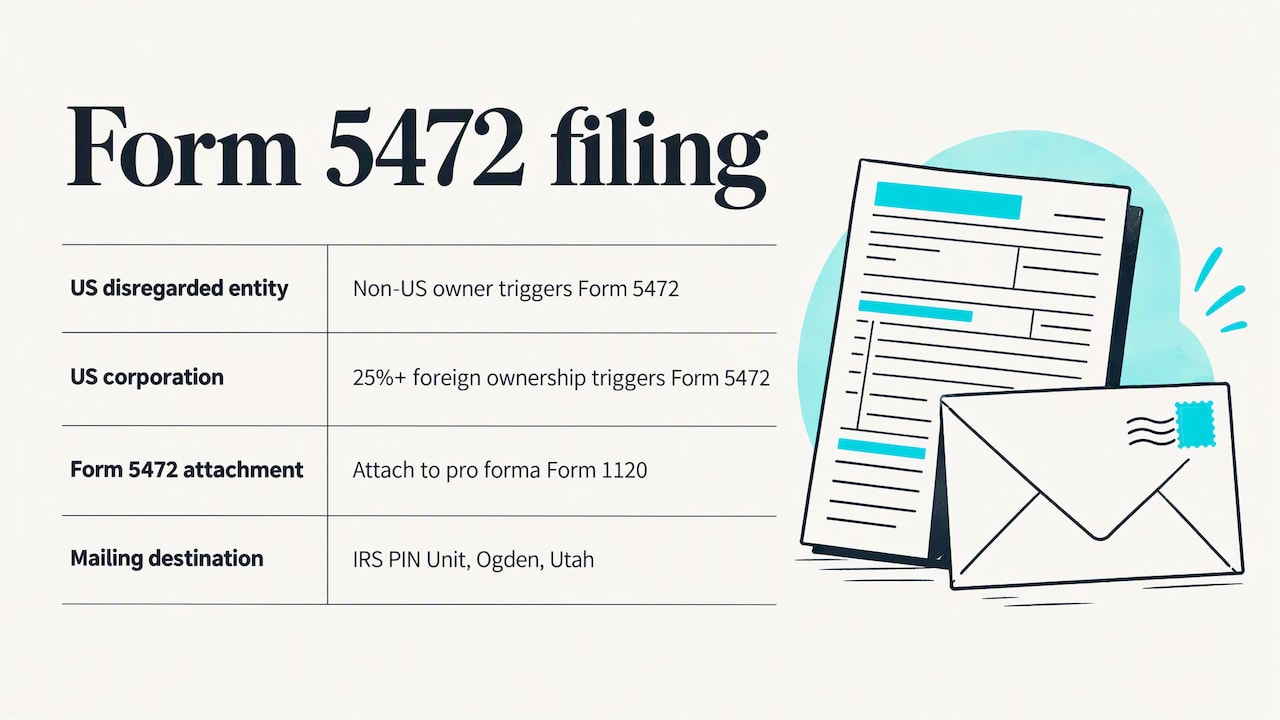
If a non-US person owns a US disregarded entity, such as a single-member LLC, the IRS still wants information. These entities must file Form 5472 to report transactions with related parties under sections 6038A and 6038C of the Internal Revenue Code. According to the IRS, the form is attached to a pro forma Form 1120 and mailed to a dedicated PIN Unit in Ogden, Utah, not to the usual filing address.
The stakes are real. Law firm Loeb notes that significant penalties apply for failing to file or filing incomplete forms. Founders who form an LLC from abroad, using a cheap online package, are the ones who miss it. Put Form 5472 in your compliance calendar the day you form.
The same obligation applies to a US corporation that is at least 25% foreign-owned. The IRS describes Form 5472 as the information return for a 25% foreign-owned US corporation, so a Delaware C-corp owned by a foreign parent should also plan for it.
Ongoing compliance in the first year
Formation is not a one-time event. Expect these recurring tasks:
- Delaware annual report and franchise tax. Delaware corporations must file the report and pay the tax with the Secretary of State by March 1 each year. Missing it risks penalties and loss of good standing.
- Registered agent renewal. Your agent bills yearly.
- Federal and state tax returns. A corporation files its own return. Add state returns wherever you have nexus.
- Foreign qualification. If you hire or have an office in another state, you may need to register there.
- Corporate records. Keep board consents, stock ledgers and option grants current. Investors check them in diligence.
Our US compliance checklist for foreign cybersecurity startups covers the cyber-specific layer on top of this.
Our perspective: formation is where credibility starts
We work only with cybersecurity and AI startups in digital forensics, and we see the same pattern. Founders treat the US entity as admin work and then discover it shapes every conversation that follows. A buyer’s procurement team asks who the contracting party is. An investor asks about the cap table. A partner asks where your evidence handling is governed.
We believe a company selling judicial-grade evidence capabilities should look judicial-grade itself. That means clean corporate records, the correct entity for its funding plan, and a calendar that does not depend on someone remembering a March deadline. Cheap formation is fine. Careless formation is expensive.
We also see founders move in both directions. International teams come to the US and need a soft landing: entity, banking, first customers. US companies look at Europe and need the same in reverse. In both cases the entity is the foundation, and the commercial story is built on top of it.
Our advice is to decide your entity type from your funding plan, not from a price list. Get a lawyer’s view on the Delaware question before filing. Then spend the time you saved on customers.
— Thiago Vieira
Where we can help
If you are a cybersecurity or AI founder planning a US entry, formation is one step in a longer sequence: structure, compliance, introductions and first revenue. Cybertech Acceleration is an accelerator dedicated to digital forensics, and our Soft Landing program supports international startups with local setup and market entry. If Texas is on your list, see the Cybertech Texas Mission. For the wider picture, read our guide to US market entry for cybersecurity startups.
FAQ
How much does it cost to form a US company?
The SBA says the total to register a business is typically under $300 in most cases, but fees vary by state and structure. Add the cost of a registered agent, annual state fees and legal help if you plan to raise money. Check your Secretary of State’s fee schedule for the exact amount.
Can a non-US founder form a company without an SSN?
Yes. You can form the entity itself without an SSN. The EIN step is what changes: without an SSN or ITIN, the Form SS-4 process requires fax or mail submission instead of immediate online processing. Allow extra time before opening a bank account.
Should I incorporate in Delaware?
If you plan to raise venture capital, usually yes. Delaware offers the Court of Chancery and a statute investors know well. If you will operate mainly in one other state and have no outside investors, a home-state entity may avoid double fees. Talk to an attorney or accountant first.
Do I still need to file a BOI report?
Not for a US company. FinCEN says that since the rule took effect on August 14, 2026, US companies are exempt. Certain foreign companies registered to do business in the US remain covered, so check the final rule if that describes you.
Is forming a company enough to start operating?
No. Formation is a prerequisite, but licenses and permits from state, county and local authorities may still be required, depending on your industry and location.
Sources
- less than $300 in most cases
- US companies are exempt from BOI reporting
- formation is a prerequisite, not a replacement for the licenses and permits
- Court of Chancery, which is recognized for timely, consistent decisions on complex corporate matters
- 79% of US initial public offerings in 2022 and 67.6% of the Fortune 500
- Form SS-4
- questions and answers on the final rule
- mailed to a dedicated PIN Unit in Ogden, Utah
- significant penalties apply for failing to file or filing incomplete forms
- information return for a 25% foreign-owned US corporation
- by March 1 each year