Non-Dilutive Funding for Cybersecurity Startups: Grants and Programs
Non-dilutive funding is money you raise without selling shares, and for cybersecurity startups it mostly means government R&D awards, national and EU grants, and prize challenges. In the US the largest door is the SBIR/STTR system, which includes America’s Seed Fund at the National Science Foundation. In Europe, national agencies and EU calls run smaller, co-financed grants. This guide covers what each program pays, who qualifies, what you owe afterward, and how founders combine grants with commercial traction.
TL;DR
- Non-dilutive capital does not cost you ownership. For cyber startups it mostly comes from federal SBIR/STTR awards, national grants such as Estonia’s or Luxembourg’s, and EU open calls.
- NSF’s America’s Seed Fund offers Phase I awards up to $305,000 and Phase II awards up to $1.25 million, but you generally need a for-profit US company controlled by US citizens or permanent residents.
- Most European grants are co-financing schemes: they pay a percentage of project costs, so you must show you can fund the rest.
- Grants come with reporting, deliverables and sometimes security appraisal. Plan for them before you apply.
- Grants fund R&D. Customers, credibility and market access still decide whether the product sells, so most founders run both tracks.
Table of Contents
- What non-dilutive funding means for a cybersecurity company
- US programs: SBIR, STTR and America’s Seed Fund
- Grants outside the US: Europe’s national and EU schemes
- Checking eligibility, costs and co-financing
- International founders: can you get funding when crossing the Atlantic?
- What you owe after you win
- Our perspective
- A practical plan for the first 90 days
- FAQ
- Sources
What non-dilutive funding means for a cybersecurity company
Non-dilutive funding is capital that does not require you to give up ownership or equity. Equity funding sells shares in exchange for cash, which reduces the percentage that founders and earlier investors own. The common non-dilutive forms are:
- Grants and awards, public or private, with no repayment.
- Small business loans, which are repaid with interest.
- Revenue-based financing, repaid as a percentage of future revenue.
When readers search for “cybersecurity grants,” they usually mean the first category. Those are the programs this article focuses on, because they are the ones built around technical risk: proof-of-concept work, prototypes, and early trials that a seed investor may find hard to price.
The NSF describes its awards as not loans, and says it aims to align funding with a founder’s vision and the potential societal and commercial impact, rather than with the financial incentives of investors. That is a useful way to think about the whole category. A grant reviewer asks whether the technology is novel, whether the risk is real, and whether there is a path to a market. Those are different questions from the ones a venture partner asks about returns.
US programs: SBIR, STTR and America’s Seed Fund
For US-based cybersecurity startups, the Small Business Innovation Research (SBIR) and Small Business Technology Transfer (STTR) programs are the starting point. Several federal agencies run their own SBIR topics, and cybersecurity appears across defense, homeland security, and science agencies.
What America’s Seed Fund pays
America’s Seed Fund, powered by NSF, funds R&D startups across the country. Phase I awards go up to $305,000 for proof-of-concept work, and Phase II awards up to $1.25 million for technology development. The NSF does not take equity in return.
A realistic path looks like this:
- Submit a short project pitch describing the technical innovation and the commercial opportunity.
- If invited, write a full proposal for Phase I.
- Use Phase I to prove feasibility, then apply for Phase II to build and test the technology.
- Use the results, plus early customer conversations, to raise private capital or sign pilots.
Program status and recent changes
SBIR/STTR authorization lapsed for six months and was restored when the Small Business Innovation and Economic Security Act of 2026 was signed on April 13, 2026. The law extends both programs through September 30, 2031. It also creates a new Phase II “strategic breakthrough” vehicle with a $30 million ceiling and adds more foreign risk screening. Agency topic lists and schedules change, so confirm current solicitations on each agency’s official SBIR page before you plan a submission.
Who is eligible
The eligibility rules decide the plan for many international founders, so read them early. To qualify for SBIR/STTR funding, a company must be a for-profit entity located in the United States, have fewer than 500 employees, and be owned and controlled by US citizens or permanent residents.
The official FAQ adds detail: awardees must be small, for-profit businesses more than 50% directly owned and controlled by US citizens or permanent resident aliens, although some SBIR agencies may fund firms majority-owned by venture capital operating companies, hedge funds, or private equity firms. Awardees must also have a US place of business, operate primarily in the US or significantly contribute to its economy, and perform the work in the US.
This answers a common question: can an LLC get grant money? Entity form is not the test. A US-located, for-profit company that meets the size and ownership rules can qualify, and an LLC can be that company. Ownership and location matter more than the legal wrapper.
Grants outside the US: Europe’s national and EU schemes
If you are a European startup, or a US company planning to enter Europe, several programs fund cybersecurity directly. Each has its own rate, cap and geographic rule, so the numbers below are best read as a map of what exists, not a guarantee of availability.
| Program | Where | What it funds | Amount and rate |
|---|---|---|---|
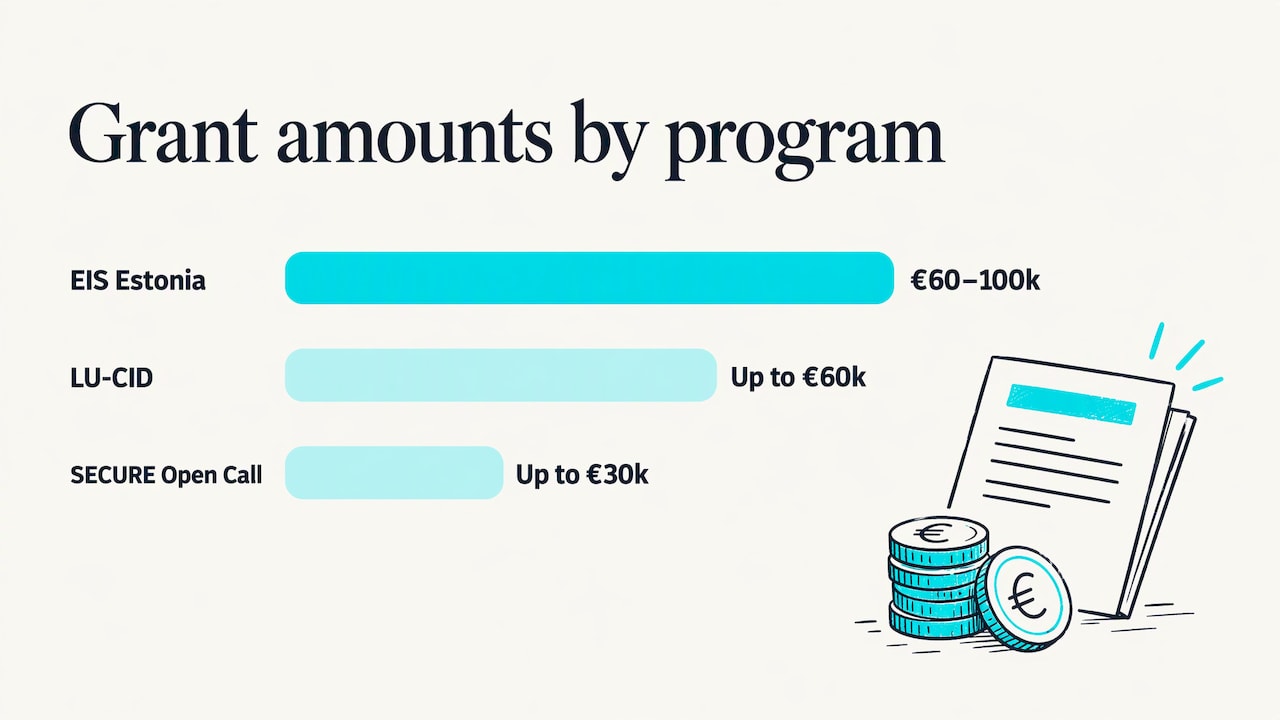
| EIS cybersecurity innovation grant | Estonia | Proof-of-concept, prototyping and testing, component development, product trials, feasibility studies | €60,000 to €100,000; 70% rate for de minimis aid, or 45%, 35% or 25% under General Block Exemption aid, depending on company size |
| LU-CID | Luxembourg | Eligible cybersecurity projects by Luxembourg SMEs | Up to €60,000 per project; 80% of costs for micro and small companies, 70% for medium-sized |
| SECURE Open Call | EU and EEA | Activities toward Cyber Resilience Act compliance for micro, small and medium enterprises | Lump sums up to €30,000 at 50% co-financing |
| CIF-NL | Netherlands | Projects led by a Dutch-established business, up to one year, on crypto-agility or simpler cybersecurity solutions | Temporarily closed at last check |
The Estonian scheme is a good example of how broad the eligible technical areas can be. It covers cybersecurity automation, AI in cybersecurity, quantum-resistant cryptography, and even space technology, so an AI security startup may find a fit it would not expect.
Two cautions on timing. Programs open and close in rounds, and one that is closed today often reopens. Treat each page above as the place to check the current window rather than relying on any article, including this one.
EU funding that is not a grant
Not every European program is non-dilutive. The EIC STEP Defence Scale Up call offers up to €30 million in direct equity to scale defence industrial capabilities for companies in the EU, associated EEA countries and Ukraine. Equity from a public investor is still equity, so read the instrument type before you count a program toward your non-dilutive plan.
Checking eligibility, costs and co-financing
Grant applications fail more often on fit than on technical quality. Before you write a word, check these items against the program page:
- Entity and location. SBIR needs a US for-profit with US ownership and control. LU-CID requires Luxembourg SME status and a valid business permit. CIF-NL projects must be led by a Netherlands-established business.
- Project stage. LU-CID does not retroactively finance projects already under development, so starting work before you apply can cost you eligibility.
- Co-financing. Most European schemes pay a share of costs. LU-CID asks applicants to demonstrate co-financing capacity through equity, bank loans, or free cash flow.
- Allowable costs. LU-CID covers personnel, project-specific costs, and general costs. Map your budget to those categories from the start.
- Application materials. For LU-CID these include financial and administrative information, an affidavit, a data-protection annex, and supporting documents. Build that folder before the call opens.
Reviewers also look at the maturity of the company’s own security practices. If your product handles sensitive data, it helps to show that you build securely yourself. Outside security testing and risk assessment can document that posture, and our own guide on security by design for early-stage startups covers the internal habits that make it credible.
International founders: can you get funding when crossing the Atlantic?
The honest answer is that eligibility follows the legal entity and where the work happens, so the structure of your company matters as much as your technology.
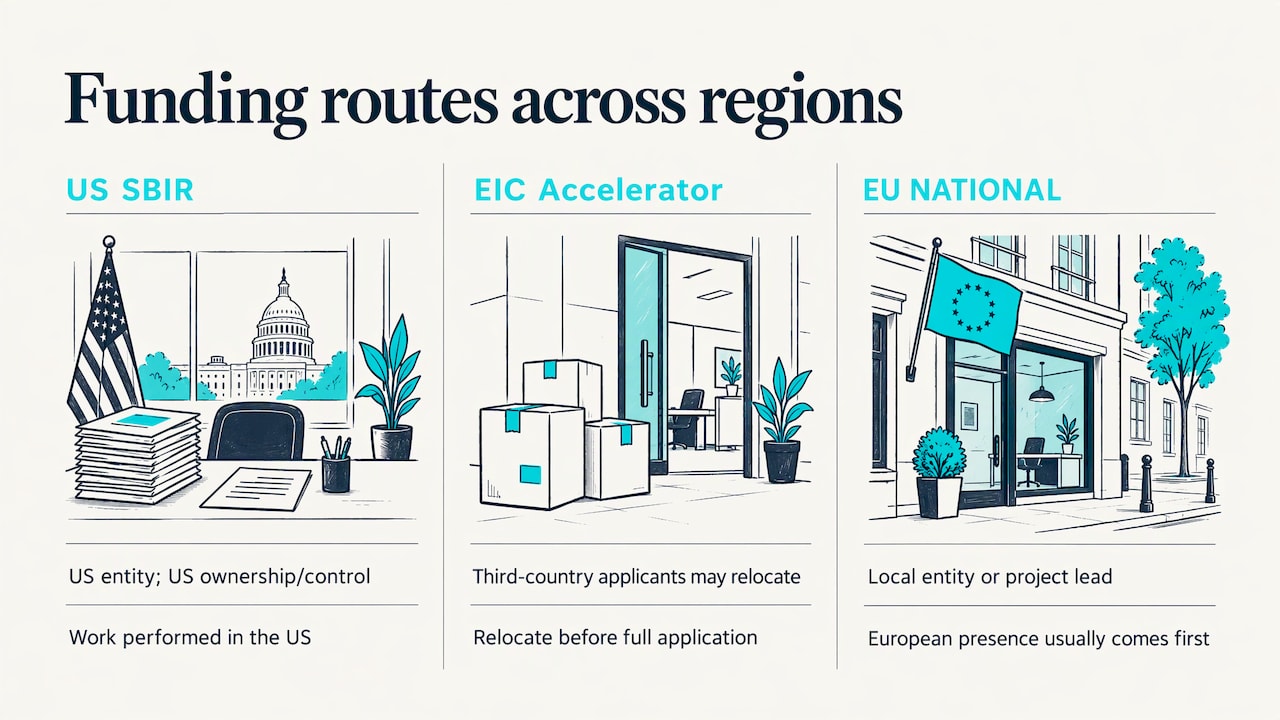
If you want SBIR money, the rules above require a US entity with US ownership and control, and work performed in the US. A foreign-owned startup that opens a US subsidiary does not automatically meet the ownership test. Look at who controls the company before building a plan around SBIR.
The EU side is more flexible in one respect. For the EIC Accelerator, third-country applicants may relocate their company to become eligible before submitting the full application. That is a deliberate step in the process, not a loophole, and it affects where you incorporate and hire.
For US companies heading to Europe, the national programs above are mostly tied to a local entity or a local project lead, so a European presence usually comes first. Founders in the other direction can read our entry guide for UK cybersecurity startups expanding to the US, which covers the structural choices that also shape funding options.
What you owe after you win
A grant is a contract. Read the obligations before you celebrate.
The Digital Europe Grant Agreement, for example, sets out deliverables, periodic technical reporting and financial statements, and payment arrangements. It includes specific rules for sensitive information, with security recommendations and EU-classified information. For projects that involve sensitive or classified content, a security appraisal may result in specific security rules being annexed to the grant agreement.
In practice, budget time for:
- Milestone reports and financial statements on the schedule in the agreement.
- Documentation of every cost you claim, in the categories the program allows.
- Handling restrictions if your work touches sensitive data, which can affect who on your team may work on it.
- Intellectual property terms, which differ by program. Read them before you sign.
Small teams often underestimate the admin load. Assign one person to own compliance with the grant from day one.
Our perspective
We work only with cybersecurity and AI startups, and we see the same pattern again and again: a founder with strong technology and a thin commercial story. Grants can pay for the build. They rarely build the case that a buyer, a partner or an investor needs in order to say yes.
That is why we focus on digital forensics. Judicial-grade evidence capabilities give a security or AI product something concrete to stand on: output that can be trusted, explained and defended. When we help founders translate technical depth into a business narrative, it also helps with grant reviewers, who must be convinced of the same thing: the problem is real, the approach is credible, and there is a market.
Our view is that non-dilutive funding and an accelerator are complementary. Use grants to de-risk the research. Use structured market entry, warm introductions and a network of peer companies to turn the result into revenue. Across our portfolio, that approach has helped generate over $600K in two years.
Thiago Vieira
A practical plan for the first 90 days
A short sequence keeps the search from sprawling:
- Decide your entity question first. Where you are incorporated and who owns the company determine which programs are open to you.
- Pick two or three programs, not ten. Match each to your stage: proof-of-concept money for early work, larger development awards once you have results.
- Write the eligibility sheet. For each program, list entity, location, ownership, cost categories, co-financing, and required documents. Strike anything you cannot meet.
- Do not start the funded work early. Some programs refuse retroactive financing.
- Pair the application with commercial evidence. Letters of interest, pilot conversations and a clear buyer profile strengthen a proposal and make the next round easier.
- Name an owner for reporting. Compliance is a job, not a side task.
FAQ
What is a non-dilutive fund?
It is capital you receive without selling ownership in your company. Grants, awards and some loans or revenue-based financing fall in this group. The key difference from equity is that your cap table stays the same, though you may owe reports, deliverables or repayment depending on the instrument.
Are there cybersecurity grants for startups in the US?
Yes. The main route is SBIR/STTR, including America’s Seed Fund at NSF, with Phase I awards up to $305,000 and Phase II up to $1.25 million. Other federal agencies post their own cybersecurity topics, so check each agency’s official SBIR page for current solicitations.
Can an LLC get grant money?
Yes, if it meets the program’s rules. For SBIR/STTR, the company must be a for-profit US business with fewer than 500 employees, owned and controlled by US citizens or permanent residents. The legal form is less important than ownership, size and location.
Can a foreign startup get US federal grants?
SBIR and STTR generally require a US-located company that is majority owned and controlled by US citizens or permanent residents and performs the work in the US. Foreign-owned companies should review those ownership rules carefully, and explore programs in their home country or the EU in parallel.
Do grants replace venture funding?
Usually they do not. Grants fund research and early development, with caps that reflect that. Many founders use them to reach a stronger product and a clearer market position before talking to investors or signing pilots.
Sources
- capital that does not require you to give up ownership or equity
- not loans
- the Small Business Innovation and Economic Security Act of 2026 was signed on April 13, 2026
- a company must be a for-profit entity located in the United States, have fewer than 500 employees, and be owned and controlled by US citizens or permanent residents
- more than 50% directly owned and controlled by US citizens or permanent resident aliens
- EIS cybersecurity innovation grant
- LU-CID
- SECURE Open Call
- CIF-NL
- EIC STEP Defence Scale Up call
- security testing and risk assessment
- third-country applicants may relocate their company to become eligible before submitting the full application
- sets out deliverables, periodic technical reporting and financial statements, and payment arrangements
- a security appraisal may result in specific security rules being annexed to the grant agreement