Accelerator vs Incubator: Tech Founders, Don’t Pick by Stage Alone

An incubator nurtures an idea over months or years, while an accelerator compresses growth into a fixed sprint for startups that already have a working product and early traction. If you are still validating a concept, an incubator gives you room to figure things out. If you have an MVP and traction and want to raise capital fast, an accelerator is built for exactly that, though top programs accept well under 2% of applicants.
TL;DR:
- Accelerators commonly exchange seed funding for 5% to 10% equity, while top programs accept fewer than 2% of applicants, so tailor applications carefully.
- Accelerator participants were 3.4% more likely to raise venture capital and raised $1.8 million more on average, but results varied with program design.
- Research found programs combining structured entrepreneurship training with basic services improved venture performance, while funding and coworking alone showed little effect.
- Before applying, confirm whether attendance requires relocation, since visa rules, founder availability, and access to your home market can affect participation.
- Compare curriculum depth, mentor relevance, and published cohort outcomes rather than choosing by brand recognition or alumni logos alone when assessing fit.
Table of Contents
- What is a startup incubator?
- What is a startup accelerator?
- Key differences founders should compare before applying
- How to decide: a founder’s checklist
- What research shows about accelerator impact and program design
- What this looks like in practice
- Cybertech Acceleration: built around forensic credibility
- FAQ
- Sources
What is a startup incubator?
A startup incubator exists to help founders turn a raw idea into a working business model. There is no fixed end date in most cases, and the pace is set by how long it genuinely takes to validate an idea, build a founding team, or figure out whether a product has real demand. Incubators tend to operate more like a long-term support structure than a sprint, which makes them a natural fit for ventures that are not yet ready for the pressure of a cohort-based program.
Most incubators bundle a handful of services that founders can draw on as needed rather than on a set schedule:
- Shared workspace and basic office infrastructure for teams without a home base yet.
- Mentorship from entrepreneurs or industry specialists, usually available on request rather than on a curriculum.
- Legal, accounting, or administrative support to help first-time founders avoid early structural mistakes.
- Networking events and introductions to other founders, local investors, or potential partners.
- Occasional grants or non-dilutive funding, though this varies widely by program and region.
The services on offer, and how structured they are, differ a great deal from one incubator to the next: some are university-affiliated and free, others are run by economic development agencies, and others are private and selective. A practitioner comparison from Harvard Business School Online describes this long-term, on-demand model as the defining trait that separates incubators from accelerators.
Incubators tend to work best for solo founders still shaping their idea, teams that have not fully formed yet, and pre-MVP projects that need time and low-pressure resources to test assumptions before committing to a specific product direction. If your biggest open question is still “does anyone actually want this,” an incubator gives you the room to answer it without a clock running.
What is a startup accelerator?
An accelerator is a fixed-term, cohort-based program that compresses months of normal startup progress into a few intense weeks. Instead of open-ended mentorship, founders go through a structured curriculum alongside a group of peer companies, usually ending in a Demo Day or investor pitch event. The format assumes you already have something to show: a working MVP, some early users or revenue, and a team that can commit full-time to an intensive schedule.
Typical accelerator offerings include:
- Seed capital in exchange for equity, often in the 5 to 10 percent range.
- A Demo Day or investor pitch event at the end of the program, built to generate fundraising momentum.
- Intensive, scheduled mentorship from operators, investors, and subject-matter specialists.
- A peer cohort of founders working through the same curriculum at the same time, which creates built-in accountability.
- Structured sessions on fundraising, go-to-market strategy, and investor readiness.
This format produces measurable results for the startups that get in. Research tracking accelerator participants from 2013 to 2019 found that accelerated startups were 3.4% more likely to raise venture capital and raised, on average, $1.8 million more in capital in the year following their application, compared to startups that applied but did not get in. Participants also generated more revenue, hired more full-time staff, and paid higher wages than non-participants.
Accelerators fit teams that have already cleared the idea-validation stage: you have an MVP, some proof that people want it, and the bandwidth to drop other priorities for a few months. If your main goal right now is raising capital or compressing a year of growth into a quarter, this is the format built for that outcome. Sector-specific accelerators add another layer: a cybersecurity or AI startup entering a program built around its specific credibility challenges tends to get more out of the cohort than a generalist program, because the curriculum and mentor network already understand the problem it is solving. How accelerators help cybersecurity founders scale walks through what that looks like in practice.
Key differences founders should compare before applying
Once you understand the basic shape of each model, the decision usually comes down to a handful of concrete factors. Here is how incubators and accelerators typically compare across the dimensions founders care about most:
- Venture stage: incubators generally serve pre-MVP, idea-stage founders; accelerators expect an MVP and some early traction already in place.
- Timeline: incubator support is flexible and can run for months or years; accelerator programs are typically compressed into a fixed term.
- Funding and equity: incubators are often non-equity or grant-based; accelerators commonly provide seed capital in exchange for equity, often in the 5 to 10 percent range.
- Selectivity: incubators tend to have a more open application process, while top-tier accelerators often accept under 2% of applicants.
- Program intensity: accelerators run structured, scheduled curricula with heavy mentor contact and a Demo Day; incubators offer services on an as-needed basis without a fixed syllabus.
- Location: accelerators more often require relocation or in-person attendance for the cohort period; incubators are more likely to be local or flexible about remote participation.
- Services provided: both offer mentorship and networking, but accelerators add investor access and pitch training as a core, not optional, component.
| Dimension | Incubator | Accelerator |
|---|---|---|
| Venture stage | Idea or pre-MVP | MVP with early traction |
| Timeline | Months to years, flexible | Typically 2 to 6 months |
| Funding/equity | Often non-equity or grant-based | Commonly 5 to 10% equity for seed capital |
| Selectivity | Generally more accessible | Top programs often under 2% acceptance |
| Location | Often local or remote-friendly | Frequently requires relocation for the cohort |
Pro Tip: Before applying anywhere, write down whether your immediate goal is validating demand or raising capital. That single answer eliminates most of the wrong-fit applications.
Location deserves its own moment of thought. A cohort-based accelerator often expects founders to be physically present for the program’s duration, which can mean relocating a team for a few months. For international founders, this is less a formality than a real operational decision, since it affects visas, logistics, and whether a co-founder can leave their home market at all. Programs that pair acceleration with structured market-entry support, sometimes described as a soft-landing service, reduce that friction by handling the local setup work rather than leaving founders to figure it out alone.

How to decide: a founder’s checklist
Rather than debating “incubator or accelerator” in the abstract, run through a short diagnostic based on where your startup actually stands today:
- Do you have a working MVP, or are you still testing the core idea?
- Have you seen any validated demand, such as paying customers, signed pilots, or active users?
- Is your founding team fully formed, or are you still solo or short a co-founder?
- Are you and your team able to relocate or commit full-time for a fixed period?
- Is your immediate goal fundraising and rapid scale, or product and market validation?
If most of your answers point to “not yet,” an incubator’s slower pace gives you room to close those gaps without the pressure of a cohort clock. If your answers point to “yes, and we need capital fast,” an accelerator’s compressed timeline and investor exposure are built for that moment.
Once you know which model fits, prioritize programs by curriculum quality and mentor relevance over brand recognition alone. A generalist accelerator with a famous name is less useful to a forensics-focused cybersecurity startup than a smaller program whose mentors and investors already understand that specific market. Look for programs that publish or can describe measurable outcomes from past cohorts, not just a list of alumni logos.
When you prepare an application, reviewers are generally looking for a few concrete signals: a clear problem statement, evidence that someone besides the founders wants the product, a founding team that can execute without hand-holding, and a specific reason this program (not a generic one) helps you reach your next milestone.
Pro Tip: Tailor your pitch deck to the program’s specialization. A cybersecurity startup applying to a forensics-focused accelerator should lead with its evidentiary or compliance angle, not a generic product overview.
What research shows about accelerator impact and program design
The strongest evidence on accelerators comes from studies that track what happens to founders who apply but do not get in, compared to those who do. That comparison is what makes the Wharton-tracked results meaningful rather than anecdotal.
Accelerated startups were 3.4% more likely to raise VC funding and raised an average of $1.8 million more in capital in the year following application, compared to non-participants. knowledge.wharton.upenn.edu
That average outcome hides a lot of variation, though. Quasi-experimental research from the London School of Economics found that accelerators combining structured entrepreneurship schooling with basic services significantly increased venture performance, while programs offering only funding and coworking space showed little effect on their own. In practice, this means the label “accelerator” guarantees far less than the actual program design behind it: curriculum depth, mentor relevance, and cohort composition explain much of why some graduates thrive and others see little benefit. When comparing programs, weigh structured education and a relevant investor network more heavily than square footage or a well-known brand name.
What this looks like in practice
The clearest pattern we have seen: a solo founder with an unvalidated idea belongs in an incubator, and a formed team with an MVP and early users belongs in an accelerator. Labels matter less than specifics, though. Look past the name and check the curriculum depth, how relevant the mentor network actually is to your sector, and whether the program can point to measurable outcomes. For a cybersecurity, AI, or forensics startup, a sector-specific program changes the calculus entirely, because generic mentorship rarely addresses the credibility problem these founders actually face.
— Thiago Vieira
Cybertech Acceleration: built around forensic credibility
If you are building a cybersecurity or AI startup, the credibility gap is often the real obstacle, not the technology. We run an accelerator focused exclusively on digital forensics, which means we help founders integrate judicial-grade evidence capabilities into their product and translate complex technical work into a pitch that investors and clients actually understand.
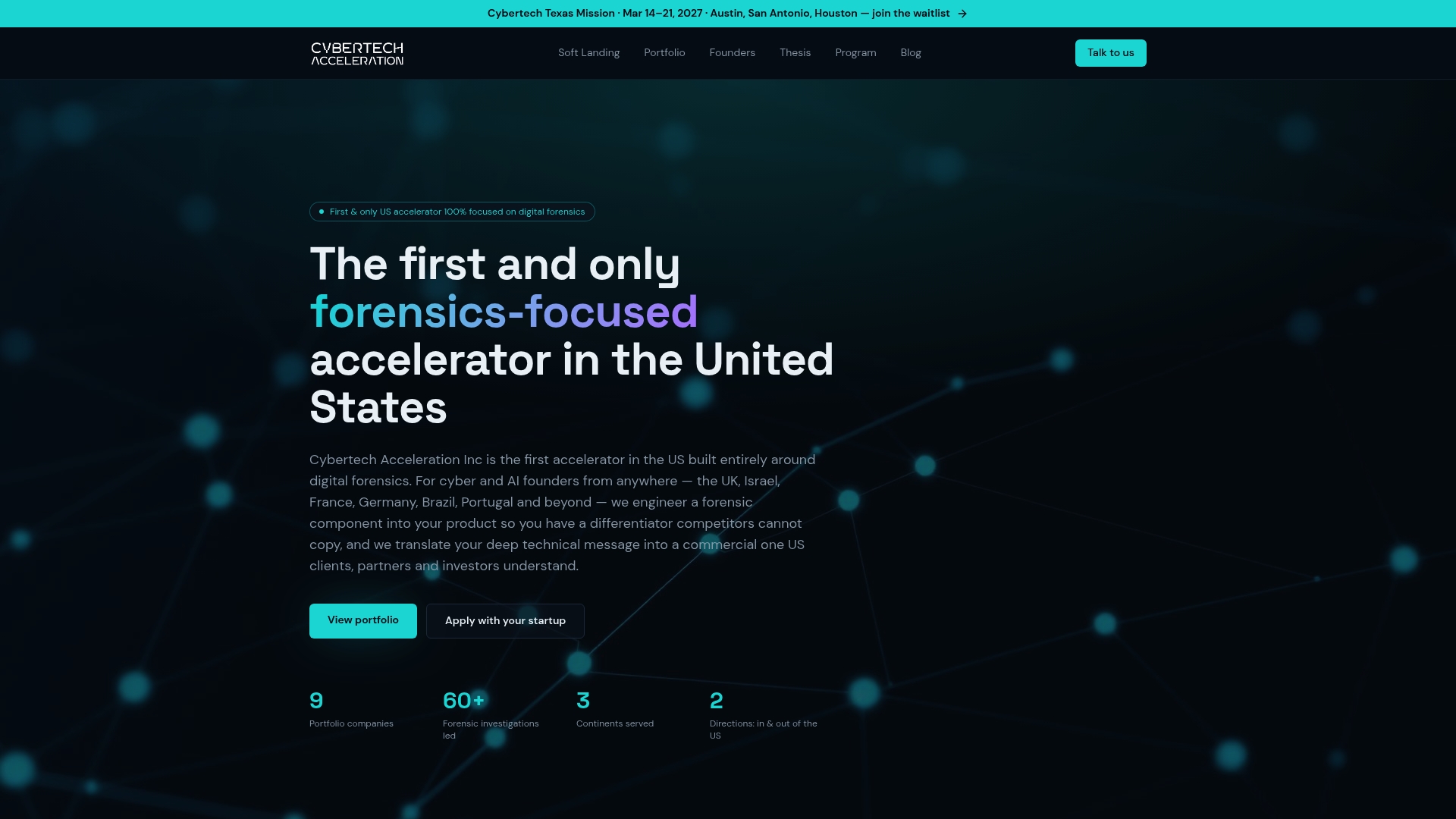
Our programs are built for different stages of market entry:
- Cybertech Acceleration: our core program, pairing forensic differentiation with structured go-to-market support.
- Soft Landing: hands-on help for international founders setting up and operating in the US market.
- Cybertech Texas Mission: an experience for founders ready to engage the US market directly.
If a forensics-led edge sounds like what your startup needs, learn more and apply at Cybertech Acceleration.
FAQ
What is the main difference between an incubator and an accelerator?
An incubator offers open-ended, long-term support to help founders develop an idea into a viable business, while an accelerator runs a fixed-term, cohort-based program for startups that already have an MVP and early traction. The timeline and funding structure differ accordingly: incubators are often flexible and non-equity, accelerators are typically compressed and equity-based.
Do accelerators always take equity?
Most accelerators take an equity stake in exchange for seed capital, commonly in the 5 to 10% range, though terms vary by program. Incubators are more often non-equity or grant-based, so the funding model is one of the clearest signals of which type of program you are evaluating.
How selective are startup accelerators?
Selectivity varies widely, but top-tier accelerator programs often accept under 2% of applicants, making them highly competitive. Incubators generally have a more accessible application process, which fits their role in supporting earlier-stage, less proven ventures.
Can a startup join both an incubator and an accelerator?
Yes, many founders start in an incubator to validate their idea and build a founding team, then move into an accelerator once they have an MVP and early traction. The two models serve different stages, so sequencing them is a common path rather than an either-or choice.
Does Cybertech Acceleration offer support for international founders?
Yes, our Soft Landing service helps cybersecurity and AI founders from outside the United States set up and operate in the US market alongside our core accelerator program. Pricing and program details are available directly through Cybertech Acceleration.