Warm Investor Introductions: How Cyber Founders Get Them

A warm investor introduction is a message from someone the investor already trusts, saying your company is worth their time. For a cybersecurity or AI founder building for the US from outside the usual hubs, it is rarely a favor you ask a stranger for. It is a position you build: you join a network where investors, portfolio founders and operators already know your work, and then you ask a specific person for a specific introduction. At Cybertech Acceleration, a cybersecurity-only program, that network is the point of the program, and this guide shows the routine step by step.
TL;DR
- A warm intro works because the connector spends their own reputation on you. TechCrunch describes it as an introduction through a second-degree connection, and says investors favor people they have already backed.
- Fit comes before access. Build a short list of investors who match your stage, sector and check size, then look for the shortest credible path to each.
- Choose the connector whose relationship with the investor is closest and most recent, not the most famous name you can reach.
- Send the connector a blurb they can forward without editing, and ask for a double opt-in so the investor agrees first.
- International founders should fix the basics US investors expect (a US entity, US customers) before the intros start.
Table of Contents
- What a warm introduction is, and what it does
- Step 1: Qualify investors before you look for a path
- Step 2: Map the paths in
- Step 3: Choose the connector
- Step 4: Write the request the connector can forward
- Step 5: Follow up without burning the connector
- Tailoring intros if you are building for the US from abroad
- Why a cyber-only network changes the math
- Our perspective
- Meet US investors in person in Texas
- FAQ
- Sources
What a warm introduction is, and what it does
Cold outreach asks an investor to evaluate you from nothing. A warm introduction hands them a reason to pay attention: someone whose judgment they respect has already decided you are worth thirty minutes. The investor’s first question shifts from “who is this?” to “is this interesting?”
That shift is real, but it is limited. A warm intro opens a door. It does not make the investment decision, and the investor still needs evidence and fit. Treat it as access, then earn the rest with a clear company story, traction and proof that your product holds up with US buyers.
For cybersecurity founders the second half is where you can stand out. Investors see many security pitches. A founder who can show evidence-grade proof built into the product, the kind that survives a buyer’s scrutiny and a courtroom, gives the connector something concrete to say. Our guide to building an investor pitch for a cybersecurity startup covers how to turn technical depth into a commercial story.
Step 1: Qualify investors before you look for a path
Most failed intro requests fail at fit, not at access. Asking a connector to vouch for you with an investor who does not write your kind of check wastes the connector’s goodwill and your one shot.
A practical way to build the list, following 1752.vc’s guide to finding and ranking investors:
- Pick 15 to 25 companies one or two rounds ahead of yours and record who invested in each.
- Read portfolio pages and partner writing to see which partner led deals most like yours.
- Check recent rounds and fresh fund money, including SEC Form D filings on EDGAR (the public notices companies file when they raise money privately).
- Ask founders one round ahead which three investors in their round they would introduce you to, and why.
For each name, note the partner and firm, the evidence of fit, who could introduce you, and any flags such as a competitor in the portfolio or no activity in the last year.
Two filters save the most time. First, confirm the firm leads at your stage. CRV’s guide on building an investor target list points out that a follower cannot get you the first offer, and that you can estimate check size by dividing fund size by the number of investing partners: a $400M fund with 10 partners needs each partner to deploy about $40M, which makes small seed checks impractical. Second, check the portfolio for direct competitors. In security, one overlapping company can end a conversation before it starts.
A research thesis on matching founders and investors, published on arXiv, found that direct ties relate strongly to the probability of investment, and that the chances fall as social distance grows. That is the reason to rank by path as well as by fit.
Score fit and path together
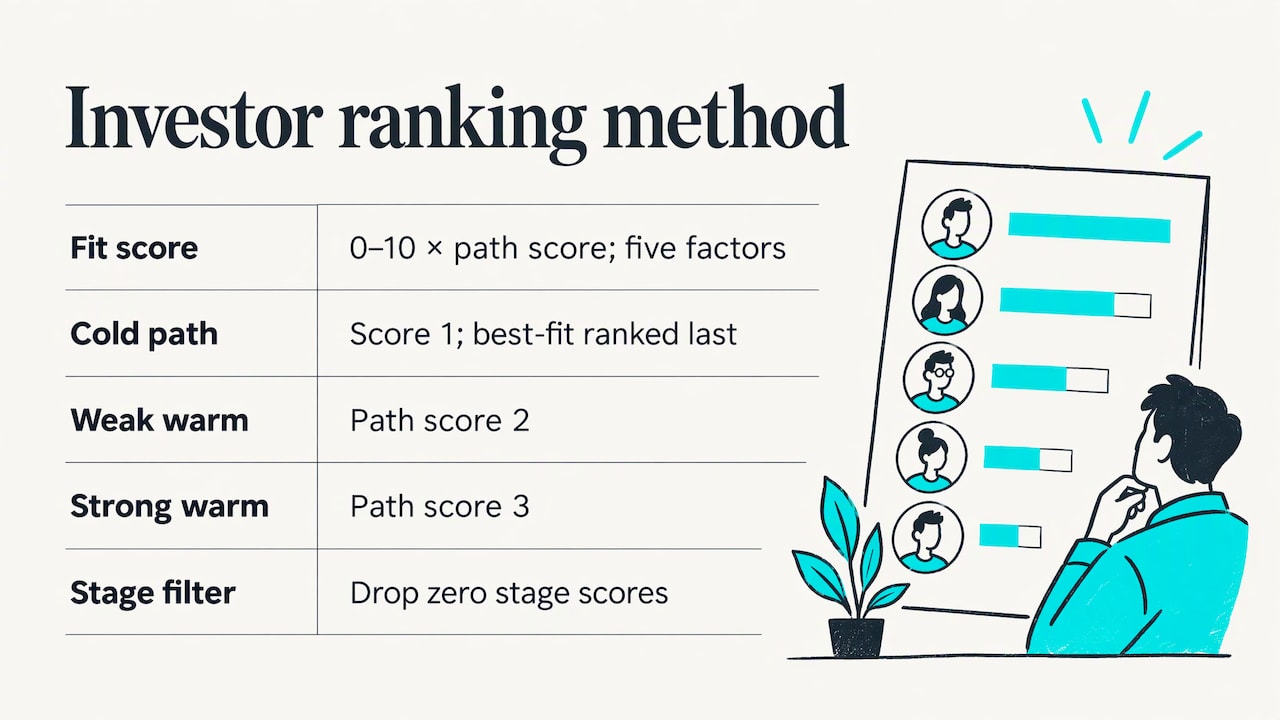
One simple method from the same 1752.vc guide multiplies a fit score (0 to 10 across stage, sector, check size, lead status and recency) by a path score: 1 for cold, 2 for a weak warm path, 3 for a strong one. Drop anyone who scores zero on stage. In its worked example, the best-fit investor ranked last only because the path was cold, which tells you where to spend your relationship-building time.
Step 2: Map the paths in
For every investor on the list, ask one question: who do I know who knows this person, and would they vouch for me? Add that as a column in your tracker.
The usual sources of paths, roughly from strongest to weakest:
- Founders the investor has already backed.
- Your customers or design partners that sit in the investor’s portfolio.
- Existing investors or advisors who are reputable but cannot lead your round.
- Lawyers, accelerator mentors and operators who work with the investor often.
- Friends, former colleagues and people you met once.
This ordering follows the logic in Magid & Co’s chapter on building relationships, which ranks the best introducers as someone who has made the investor a lot of money, then a strong portfolio company that is your customer, then an existing investor, then a trusted friend. The same chapter notes that founders are the most underused source of intros, because they remember what raising was like.
If you do not have these relationships yet, the work is to create them. A design partner program with a customer who sits in an investor’s portfolio does double duty: it proves demand and creates a path. Our US market entry playbook shows how the commercial side and the investor side feed each other.
Step 3: Choose the connector
The most famous person you can reach is not automatically the best choice. Pick the person whose relationship with the investor is recent, direct and relevant to your sector. Someone who backed the investor’s last deal, or who has worked with the partner on a security company, carries more weight than a well-known name who met the partner at a conference years ago.
Two cautions apply:
- Avoid connectors who introduce everyone to everyone. Magid & Co’s guide argues their introductions carry no signal, because investors read the introducer’s credibility as part of the evaluation.
- Do not ask someone who barely knows your business. A lukewarm intro where the contact cannot speak to your work can do more harm than none at all.
Ask the connector directly how well they know the partner. If the answer is vague, look for another path.
Step 4: Write the request the connector can forward
Your connector is doing you a favor with their time. Make it a thirty-second job.
Angel Gambino’s guide to forwardable intros gives a workable formula. Keep the blurb under 250 words and answer five questions:
- What do you do?
- Why does it matter?
- What is your traction?
- Who are you, and why are you the team that wins?
- What are you looking for?
Add one line on why this investor should care, referencing their thesis or a related portfolio company, and close with a low-commitment ask such as 20 minutes. Write it so the connector can press forward with no editing, and leave out tracking links.
TechCrunch’s walkthrough suggests two to three paragraphs: that you are raising, your company name and URL, a one-sentence summary, a paragraph on why it is interesting, and the ask, including the round size.
For a security startup, the “why it is interesting” line should be specific and checkable: a named customer type, a pilot in a regulated industry, or a product capability buyers can verify. Here is the shape of a strong request:
Subject: Intro request: [Investor name] / [Company], security for [segment]
I’m raising a [amount] [round] to [specific use]. [Investor] backed [portfolio company] in [area], which is close to what we do: [one-sentence product description]. We have [traction]. Would you be comfortable asking whether [Investor] is open to a 20-minute call? Below is a short blurb you can forward as is.
The request names the exact investor and gives the connector a yes-or-no decision, which is the point.
Use a double opt-in
In a double opt-in, the connector first checks that the investor wants the introduction and only then connects you. The Holloway Guide to Raising Venture Capital describes it this way, and adds that you should Bcc the connector when you thank them and later confirm the connection worked. It is slower, but both sides arrive having already agreed to talk.
Step 5: Follow up without burning the connector
Once the introduction lands, move quickly. Reply on the original thread within a day, thank the connector, move them to Bcc and propose one small next step, such as a 20-minute call. Have a send-ahead deck ready, since investors often ask for one before agreeing to meet.
If you hear nothing, give it a few days, then send one useful nudge. Do not ask the connector to chase. When the process ends, in a yes or a no, send the connector a short update so they know how their goodwill was used. Log every pass reason in the investor’s own words. “Wanted more enterprise traction” is not a rejection of you; it is the agenda for your next update and, six months later, a reason to write again.
Tailoring intros if you are building for the US from abroad
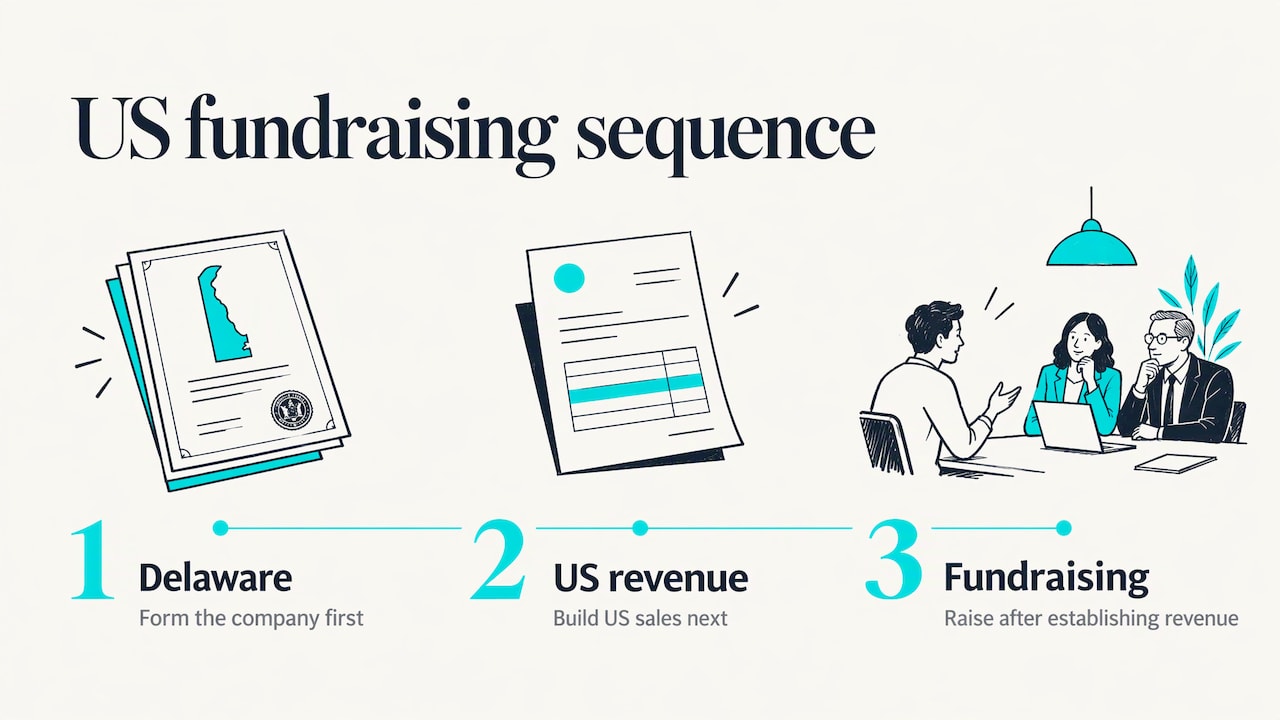
International founders face an extra filter: investors want to see that you can sell in the US and that the company is structured for a US round. Turing Venture Capital’s fundraising chapter describes a ladder: a Delaware C-corp with a US-resident founder, US bank account and US customers is the lowest friction, while a foreign entity with US revenue can add weeks and legal cost to restructure later. Its advice is Delaware first, US revenue next, fundraising after. Our guide to US company formation walks through doing this properly.
Tensor Ventures’ fundraising playbook gives European founders two further pieces of advice: look for European investors with strong US ties and a record of getting portfolio companies US money, and build roughly 20 warm introductions before coming to the US, ideally as a Delaware C-corp.
For emerging-market founders, TAG Capital’s analysis suggests presenting market size in two layers, your home market plus a global extension the investor already understands, and pairing home-market comparables with one or two EU or US ones. For a security company, regulatory complexity at home can be framed as a moat rather than a burden.
If you are a US company moving the other way, into Europe, the same principle holds: the introduction should come from someone the European investor already trusts, and the first conversation should show local traction rather than only a US story.
Choosing your funding mix
Intros are only one part of financing a US launch. Some founders pair an equity round with nondilutive funding options so the equity raise starts from a stronger position. Decide this before the first investor call, because the answer shapes what you ask for.
Why a cyber-only network changes the math
A cold email is a request from nobody. A warm intro is a request from somebody who has something to lose. The hardest part for a solo or early-team founder outside the hubs is not the email, it is having a somebody.
Cybertech Acceleration is built around that gap. It is a cybersecurity-only program for solo and early-team founders, running November to March. Exited founders, CISOs, MSSPs and a court-appointed digital forensics expert work with founders on co-founder, first hires, pricing and US market entry, and the program makes introductions inside a network of portfolio companies, alumni and more than 350 cyber founders. Since 2025, our founders have generated €600K+ in investment and new revenue.
That network matters for the route in Step 2: portfolio founders and operators who know your work are the connectors investors listen to. If you are weighing programs, our guide on how to choose a cybersecurity accelerator lists the questions worth asking.
Our perspective
Most founders treat introductions as a favor to collect. We see them as the output of work done in public: a pilot a customer will talk about, a product feature a buyer can verify, a founder peer who has watched you ship.
For cyber founders that work has a specific shape. Investors and buyers in the US ask whether your product’s claims will hold up under scrutiny, so we help founders build evidence-grade proof into the product itself, proof designed to hold up with US buyers and in court. A connector who can say that about you is spending their reputation on something solid.
Solo founders also carry every decision alone: co-founder, first hires, pricing, where to enter the US. In our program, exited founders, CISOs and MSSPs sit on the other side of those decisions with you, and the introductions that follow come from people who have seen your reasoning, not just your deck. That is why we keep cohorts small, charge US$ 3,000 and take no equity.
Thiago Vieira
Meet US investors in person in Texas
The program closes with the Cybertech Texas Mission during SXSW, an in-person week in the US for the cohort. It is where the relationships built from November to March turn into face-to-face conversations with buyers and investors. If you are building for the US and want the introductions to come from inside a cyber network, see the Cybertech Texas Mission.
Founders from Portugal, the UK, Germany and Israel can also look at our country-specific pages, such as US Soft Landing for UK cyber startups, to see how US entry fits the way they are building at home.
FAQ
How many warm introductions do I need?
It depends on the round and your market, but plan on a list, not a single shot. Tensor Ventures suggests European founders aim for around 20 warm introductions before coming to the US. Work the list in order of fit multiplied by path, and keep a tracker so no thread goes cold.
Is a warm intro always better than a cold email?
Not if it is weak. A connector who does not really know you adds little, and a vague forward can signal you could find no one better. Strong warm paths are worth the wait; where no good path exists, a sharply targeted cold email is a reasonable way to start a relationship.
What should I ask the connector to say?
Give them the words. Include why the investor in particular should care, your sharpest proof point and the ask, in a blurb they can forward unchanged. A short script of what you would like them to emphasize also helps, including that you are building relationships before you raise if that is the case.
When should I start asking for intros?
Start relationship-building months before you need money, and ask for introductions once you have traction and a clear story. Asking before you are ready spends the connector’s reputation on a company the investor will pass on.
Sources
- TechCrunch
- 1752.vc’s guide to finding and ranking investors
- building an investor target list
- published on arXiv
- Magid & Co’s chapter on building relationships
- Angel Gambino’s guide to forwardable intros
- Holloway Guide to Raising Venture Capital
- Turing Venture Capital’s fundraising chapter
- Tensor Ventures’ fundraising playbook
- TAG Capital’s analysis