How to Translate Your Tech Into Business Value

To translate tech into business, take each technical capability and say what it changes in the buyer’s workflow. Then say what business result that change earns, saves or protects. If you can’t reach a result the buyer cares about, the feature isn’t part of your pitch yet. That is the whole method. The hard part is doing it for each audience (a CISO, a CFO, an investor) and backing it with proof they can verify. At Cybertech Acceleration we work on this with cybersecurity and AI founders every cohort, because a strong product with a weak story stalls in the US market.
TL;DR
- Move in three steps: feature, then operational effect, then business impact. Stop at a consequence the buyer can price.
- Lead with the buyer’s problem and desired outcome, not with your architecture.
- Different listeners need different translations: investors, economic buyers, security teams and partners each weigh the same product differently.
- Use analogies to introduce a term, then explain the mechanism and tie it to a benefit straight away.
- Proof carries the story. For cyber and AI products, evidence that holds up under scrutiny is the strongest differentiator.
Table of Contents
- Why technical founders get stuck
- The feature to impact ladder
- Start with the buyer’s problem, not your product
- One product, several audiences
- Explaining a hard concept without dumbing it down
- Name the buying trigger
- Back the story with proof the buyer can verify
- Adapting the story when you enter the US
- Test the wording before you scale it
- Our perspective
- FAQ
- Sources
Why technical founders get stuck
You know exactly how your detection engine, your agent or your data pipeline works. The buyer does not, and does not need to. The buyer needs to decide whether your product solves a problem worth budget.
Gartner’s guidance on technology positioning warns that feature-heavy messaging, missing customer context and too much information at once can undermine a technology pitch. It recommends positioning around a defined buyer, that buyer’s business need, the product category, a compelling reason to buy and meaningful differentiation, instead of a broad feature inventory.
Three habits show up again and again in technical founders:
- Starting with how it works. The first slide is the architecture diagram.
- Stopping at the feature. “We detect lateral movement in under a second” is a capability, not a reason to buy.
- Using one story for everyone. The same deck goes to a CISO, a venture investor and a procurement lead.
Each of these has a fix, covered below.
The feature to impact ladder
A useful way to structure the translation is a ladder with three rungs. A guide on technical-to-business translation frames it as moving from feature to operational effect to business impact, then adapting the argument to each decision-maker. Its examples include cybersecurity for medical devices.
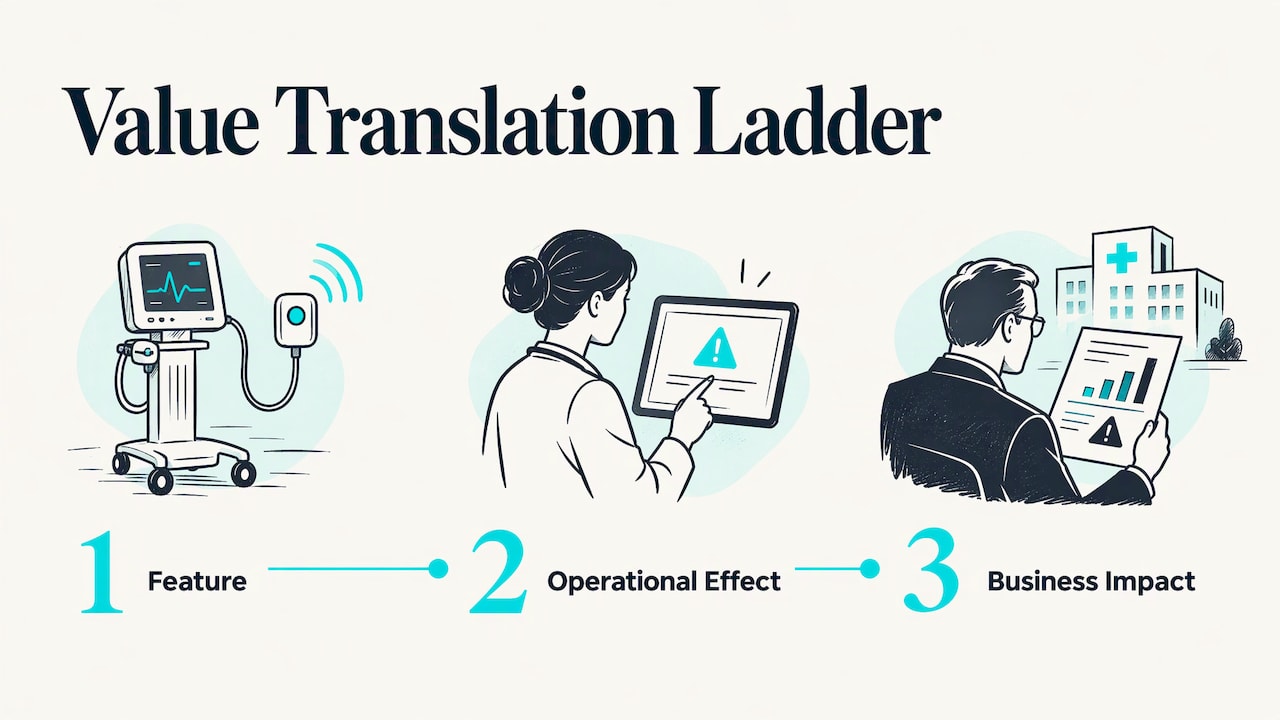
Rung 1: the feature
This is what your product does, in your engineers’ words. Example: “Our agent captures tamper-evident logs of every automated response action.”
Rung 2: the operational effect
This is what changes in the customer’s day. Example: “After an incident, the security team no longer reconstructs what happened from scattered logs. The record already exists, in order, and cannot be quietly edited.”
Rung 3: the business impact
This is the result the customer earns, saves or protects. Example: “When a breach leads to a dispute with an insurer or a regulator, the company can show what happened and when, and spend less time and legal budget doing it.”
Pragmatic Institute makes the same point from the marketing side: a value proposition should translate features into tangible results such as revenue, labor cost, risk or customer experience.
If you climb the ladder and cannot reach rung 3, one of two things is true. You don’t yet understand the customer’s problem well enough, or the feature matters less commercially than you thought. Both are useful findings. Both are cheaper to discover in a conversation than after a failed pilot.
A quick worked example
Suppose you build an AI tool that triages phishing reports.
| Rung | Weak version | Strong version |
|---|---|---|
| Feature | A fine-tuned classifier with a low false-positive rate | Same, but kept out of the opening |
| Operational effect | Faster triage | Analysts stop reading the reports that are obviously harmless and open only the ones that need a human |
| Business impact | Better security | The same team handles a growing report volume without a new hire, and real threats are reviewed sooner |
Notice that the strong version adds no new facts about the technology. It changes where the sentence ends.
Start with the buyer’s problem, not your product
Gartner suggests leading with the buyer’s business problem and desired outcome, then connecting the customer’s situation and its impact to the resolution, supported by customer examples and quantifiable outcomes.
April Dunford adds a useful twist for sales stories. In her Business of Software talk she recommends beginning with a market insight and the alternatives buyers have today, agreeing with the buyer on what a good solution should do, and only then showing how your product fits that agreed standard. The buyer then judges you against criteria they helped write.
A simple narrative structure that works for startups, drawn from Founding Sales, covers six points:
- Who has the problem.
- How they handle it today.
- Why that approach falls short.
- What changed, which is why now.
- How your product addresses it.
- What evidence supports the claim.
Write those six answers in plain sentences before you open a slide tool. If a sentence needs a footnote to be understood, rewrite it.
One product, several audiences
A study from Mälardalen University on communication between startups and their stakeholders finds that investors tend to prioritize scalability and return, customers usability and operational efficiency, and partners technical detail and strategic alignment. The same technology is read through different priorities, so the translation has to change with the listener.
In enterprise cybersecurity sales the audience list is longer. Strategyzer’s B2B playbook advises mapping decision-makers, economic buyers, recommenders, influencers, end users and potential saboteurs and adapting the value proposition to each one’s priorities. In practice for a cyber founder:
| Listener | What they want to hear | Translation to lead with |
|---|---|---|
| CISO | Fewer incidents, less analyst load, defensible decisions | Risk reduced, time saved, how it fits their stack |
| CFO or economic buyer | Cost, risk exposure, budget fit | Cost avoided or consolidated, with a number in their terms |
| Security analyst (end user) | Does it make my day easier? | Workflow change, fewer false alarms |
| Legal or compliance | Can we defend this? | Records, audit trail, regulatory fit |
| Investor | Market size, repeatability, why you win | Wedge, traction, proof and growth path |
If you sell to security leaders, our guide on how to sell to CISOs goes deeper on the buyer’s side of the table. For the investor column, see how to build an investor pitch for a cybersecurity startup.
Teams that also need to connect engineering choices to commercial outcomes in their own product roadmap sometimes bring in outside help on linking technology to business outcomes. For the messaging itself, the discipline is the same: one audience, one problem, one outcome per page.
Explaining a hard concept without dumbing it down
Simplifying is not the same as hiding rigor. Harvard Innovation Labs recommends introducing a technical term with a simple visual analogy, explaining the mechanism at system level, and connecting the term immediately to a concrete benefit. It also advises saving detailed methods and measurement protocols for the questions, instead of letting them crowd out the core explanation in a short pitch.
A cybersecurity example: Darktrace co-founder Poppy Gustafsson described using an “enterprise immune system” analogy to explain AI-based detection. The system learns what is normal for an organization and flags departures from it. The analogy opens the door, and the mechanism follows.
A three-sentence template you can adapt:
- Analogy: “Think of it as X.”
- Mechanism: “Technically, it does Y at the level of the system.”
- Benefit: “For you, that means Z.”
Technical readers also care that nothing is falsified in the simplification. Lindsay Brunner’s guide to technical storytelling argues that explanation should make reasoning, constraints and tradeoffs navigable instead of replacing rigor with a gloss. Her story map asks you to establish the reader’s decision, a recognizable problem, constraints, your approach and tradeoffs, evidence, and a clear next action. That is a good checklist for a technical blog post or a security whitepaper.
Name the buying trigger
Good stories attach to a reason the buyer is acting now. Frontlines.io’s interview with Nightfall AI co-founder Rohan Sathe describes reframing security from blocking AI use to enabling secure AI adoption, which lines the story up with an executive priority. Same technology, different framing: the buyer is no longer being asked to buy a control, but to unblock a strategy.
For your own product, ask: what is happening in the buyer’s company that makes this problem urgent this quarter? A new regulation, a board question after a competitor’s breach, an AI rollout, an insurance renewal. Put that trigger in the first two sentences.
Back the story with proof the buyer can verify
Founding Sales recommends comparing your solution with existing approaches using the same measures customers already use, and treating third-party validation as a way to lend credibility to superiority claims. Three rules follow:
- Use the buyer’s metric. If the customer measures mean time to respond, show that, not your internal benchmark.
- Pair numbers with a short customer story. One quantified result and one before-and-after account beat ten adjectives. Prezly’s storytelling guide recommends a before-and-after account that makes the move from the customer’s current problem to the desired state visible.
- Don’t confuse activity with fit. A response-rate improvement shows that a message reached people. As the translation guide cited above cautions, it does not by itself establish product-market fit.
In cybersecurity, proof has a particular shape. US buyers, their lawyers and their insurers ask what your product’s records can show after something goes wrong. We cover this in why forensic-grade proof sells cybersecurity in the US, and our pages on evidence by design and FRE 902(13) and 902(14) show how product data can be built to be admissible in US court. A story that ends with “and here is the record you can put in front of a judge” is rare, and rare is what differentiation means.
If you also run early customer programs, a design partner program is one of the fastest ways to get the quoted, measured proof that the story needs.
Adapting the story when you enter the US
A founder from Lisbon, Berlin or São Paulo often carries a pitch that worked at home. A pitch built for one market should not be merely translated into another. The US version should explain the buyer’s pain, urgency, category, differentiation, proof and implementation path in the commercial language American buyers use. US buyers often ask for local references, documentation and clarity about who stands behind the product, and an unclear story reads as risk.
Four adjustments usually matter:
- Category. Name the category a US buyer already budgets for, and say how you differ inside it.
- Proof in US terms. Reference customers, security attestations and evidence standards American buyers recognize.
- Price and packaging. Show what a pilot costs and what it becomes, in dollars.
- Directness. Put the outcome first. Long technical context before the point reads as hedging.
The same logic applies in reverse for US companies entering Europe: lead with the local buyer’s problem and local requirements, not with the story that worked in Austin or Boston.
The B2B cybersecurity sales funnel for startups shows where each version of the story sits in the buying journey, and LinkedIn lead generation for cybersecurity founders covers getting the first message in front of the right people.
Test the wording before you scale it
Strategyzer recommends drafting a value proposition, testing it through structured customer interviews, identifying patterns and revising the wording using customers’ own validated language. Do this in five steps:
- Write one sentence per rung for your top three features.
- Book ten calls with people who match your buyer profile.
- Say the business-impact sentence and note which words they repeat back.
- Replace your phrasing with theirs.
- Repeat with each audience in the table above.
The words buyers repeat become your headline copy, your deck titles and your outbound subject lines. When the same company-wide message is later adapted for enterprise stakeholders in your marketing, a guide on adapting messaging for enterprise buyers shows how buyer-journey thinking shapes content.
Our perspective
We see one mistake above all others in cyber founders: they treat the story as a layer of polish applied after the product is built. We think the story is a product decision.
The strongest cyber story we know ends in evidence. A CISO can forgive a young company a lot, but not a claim that falls apart under questioning. That is why we ask founders to build proof into the product itself, so that what the product records can stand up with US buyers and in court. A forensic expert in the room changes how founders talk: claims become specific, because someone will ask how you would show it.
Being alone with these decisions makes it worse. A solo founder has no colleague to say the pitch is still written for engineers. Our program gives founders outside the usual hubs a room of people who have sold, bought and defended security products, so the translation is tested against real buyers’ reactions before the first US meeting.
Thiago Vieira
FAQ
What does it mean to translate tech into business language?
It means describing what your technology does in terms of the customer’s results: revenue earned, cost saved or risk reduced. You keep the technical truth but change the order, starting with the buyer’s problem and ending with an outcome they can measure.
How do I explain a technical product to a non-technical decision-maker?
Introduce the idea with a simple analogy, explain the mechanism in one or two sentences at system level, and tie it straight to a concrete benefit. Keep detailed methods for follow-up questions, as Harvard Innovation Labs advises.
What is technical storytelling for startups?
It is a way of presenting your technology as a story with a recognizable problem, constraints, your approach, evidence and a clear next action. The reader’s decision is the center, not the architecture. Done well, it keeps the rigor and makes it understandable.
Should I use the same pitch for investors and customers?
No. Investors weigh scalability and return, customers weigh usability and operational efficiency, and enterprise deals involve several roles with different priorities. Keep one core story and write a distinct opening and proof set for each audience.
Sources
- feature-heavy messaging, missing customer context and too much information at once
- translate features into tangible results
- market insight and the alternatives buyers have today
- Founding Sales
- communication between startups and their stakeholders
- decision-makers, economic buyers, recommenders, influencers, end users and potential saboteurs
- simple visual analogy
- “enterprise immune system” analogy
- reframing security from blocking AI use to enabling secure AI adoption
- before-and-after account