US Subsidiary Setup: A Founder’s Guide for Foreign Startups

For most foreign cybersecurity and AI startups, the right US subsidiary is a Delaware or home-state C-corporation, wholly owned by the parent, with an EIN, a registered agent and a clear reason to exist. Formation itself is quick. The hard part is deciding what the entity will do, because that decision drives your tax filings, your ability to raise US capital and how US buyers see you. We built this guide for founders selling into the US from outside it, and we wrote it so you can make those decisions before you pay anyone to file anything.
TL;DR
- A US subsidiary is a separate legal company in a US state, owned by your foreign parent. Its liabilities and taxes sit with it, not with you.
- For hiring salespeople, signing US contracts or raising US money, a C-corporation is the standard choice. A default LLC pushes US tax filings onto the foreign parent.
- Formation can take days. Expect state fees, a registered agent, an EIN and, once you are 25% or more foreign-owned, an annual IRS Form 5472.
- Ongoing compliance (annual state report, franchise tax, federal return, related-party reporting) costs more attention than the formation does.
- Set up the entity when the US business needs it, not before. A signed pilot or a US hire is a good trigger.
Table of Contents
- What a US subsidiary is, and why founders form one
- Subsidiary, branch or representative office
- C-corporation or LLC
- The setup steps, in order
- What it costs and how long it takes
- Ongoing compliance: where the real work sits
- Tax law keeps moving
- When to form, and in what order
- Where Cybertech comes in
- Our perspective
- FAQ
- Sources
What a US subsidiary is, and why founders form one
A US subsidiary is a company formed under the law of a US state and controlled, usually more than half owned, by a foreign parent. Because it is its own legal person, its debts, taxes and regulatory duties belong to it. That separation is what Foothold America describes as protection for the parent, and it is the main reason US law firms steer foreign companies toward it.
The Mintz checklist for foreign companies lists the situations where a subsidiary makes sense: a long-term US presence, a wish to separate parent and US operations, liability limits in a litigious market, tax efficiency, easier movement of foreign workers and access to US bank accounts.
For a security or AI founder there is a commercial reason too. US enterprise buyers send vendors through procurement, insurance and security questionnaires. A US contracting entity, a US bank account and a US address make that process smoother. Our guide to selling cybersecurity to US enterprises as a foreign startup covers what happens after the entity exists.
Subsidiary, branch or representative office
There are three ways to be present in the US, and they carry very different consequences.
| Structure | Legal status | Tax position |
|---|---|---|
| Subsidiary | Separate US company owned by the parent | Corporate subsidiary taxed at 21% federal rate; 30% withholding on dividends to the parent, reducible by treaty |
| Branch | Part of the foreign parent | Taxable US presence; 21% federal rate plus 30% branch profits tax, reducible by treaty |
| Representative office | Part of the foreign parent, no separate entity | May avoid US federal corporate income tax only if activities are very limited |
The tax figures come from the SelectUSA Taxes chapter, published by the US Department of Commerce. With a branch or representative office, the parent carries US liabilities directly. That matters when you sell security software, where a breach claim or contract dispute could reach the parent’s assets at home.
A representative office is not a formal federal category in the US, which is one more reason founders who plan to sell, hire and sign contracts skip it.
C-corporation or LLC
This is the decision founders get wrong most often, because formation websites push the LLC as the simpler product.
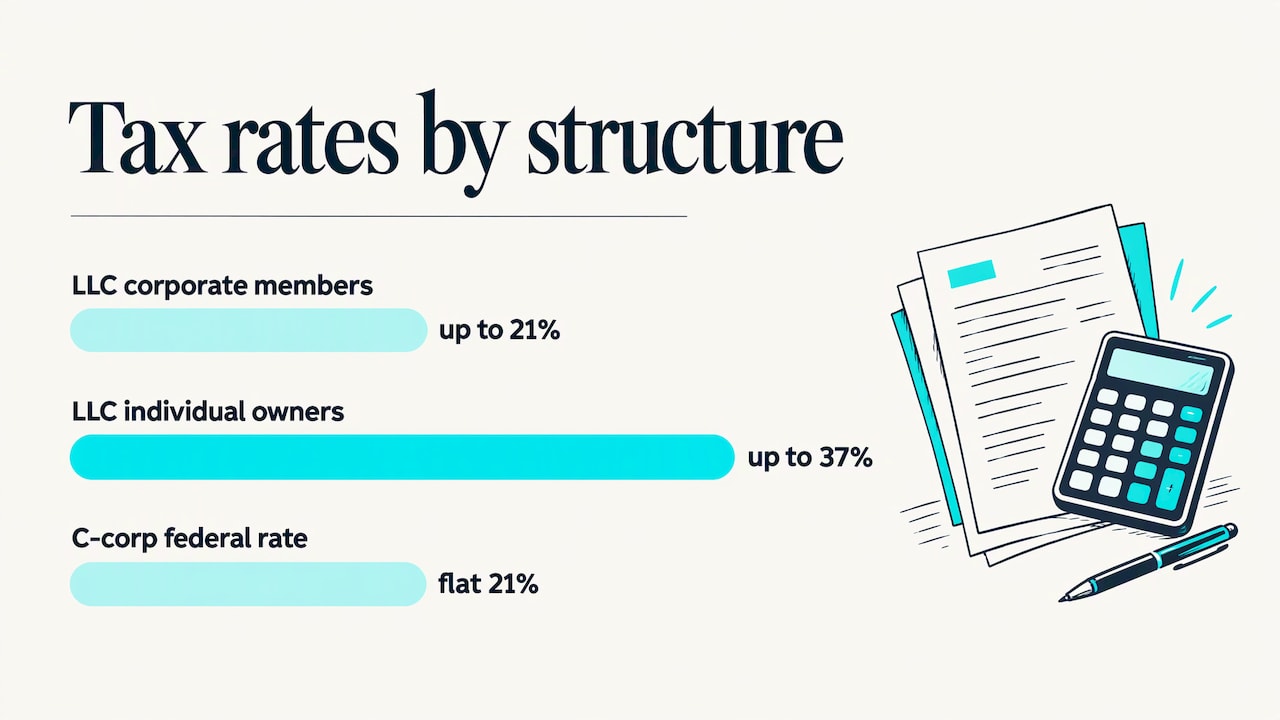
The core difference is tax treatment. An LLC defaults to pass-through treatment, so its profits are treated as the owners’ profits. For a foreign parent, LawMay P.C. explains that this can mean withholding at up to 21% for corporate members and up to 37% for individuals. The parent must also register with the IRS and file even if no profit is ever sent home. A C-corporation pays a flat 21% federal rate, and that single layer is the only one on retained earnings. An S-corporation is not available to non-US residents or foreign corporations.
An LLC can elect to be taxed as a corporation, so the legal form and tax form are separate choices. But the election adds a step and, as Mintz notes, extra due diligence for future investors.
Choose the C-corporation if any of these apply:
- You will raise US capital. Many US investors will not invest in an LLC.
- You will offer US employees equity.
- You will hire salespeople or sign contracts under a US name.
- You want clean reporting back home.
In Foothold America’s May 2026 comparison, a senior US expansion advisor describes the LLC as rarely right for foreign parents. The LLC fits only a wholly owned operation with no outside investors and active US tax counsel.
Larger groups sometimes use a hybrid: a C-corporation holding company that faces capital markets and owns the core IP, with wholly owned LLCs beneath it for different states or assets. At seed stage you almost never need this. One C-corp is enough.
The setup steps, in order
The Mintz seven-step list and the SelectUSA Investor Guide agree on the sequence. Here it is with the points where founders stumble.
1. Choose the entity type and the state
A company may register in any of the 50 states. Delaware is the usual choice for venture-backed companies: Holland & Knight reports that more than 66% of Fortune 500 companies and 81% of companies going public in the US are Delaware entities. Delaware’s own corporate law office is candid that Delaware is not the cheapest option. You pay for predictable law and an efficient state registry.
If your team and customers will sit in one state, forming there can also work. Just know that a Delaware entity operating elsewhere must register in that other state too.
2. File the certificate of incorporation
In Delaware the certificate names the entity, its registered agent and, for a stock corporation, the authorized shares and par value. Delaware also notes that incorporating is not a license to do business, so check industry or local licenses separately.
3. Adopt bylaws, appoint directors and officers
Bylaws set how the company is run. The board appoints officers. Delaware’s office warns that skipping board composition, share issuance and capital structure at the start is often a cause of later disputes. For a wholly owned subsidiary this is simple, but write it down.
4. Issue shares to the parent
The board issues shares to the parent, typically 100%. SelectUSA says a common minimum paid-in capital is $1,000. Keep a record of the capital you put in. It becomes relevant for transfer pricing and the parent’s accounts.
5. Get an EIN
The Employer Identification Number is the company’s federal tax ID. You need it to open a bank account, hire and file taxes. Banks often ask for it along with formation documents, so request it as soon as the entity exists.
6. Appoint a registered agent
Every entity needs one with a street address in the state of formation. The agent receives legal papers and state notices, so choose a reliable one. A missed notice can become a missed deadline.
7. Qualify in other states
If the subsidiary operates in another state, it must register as a foreign corporation there, with an application and fee. Hiring one remote salesperson in Texas can trigger this, so map your hires to states before you start.
The filing order is the easy part. The mistakes happen when the entity is formed before anyone decided who owns the IP, who signs customer contracts and who pays whom. Our US company formation guide walks through those decisions for founders.
What it costs and how long it takes
The SelectUSA Business Structure chapter gives these ranges (March 2025):
- State formation filing fees: generally a few hundred to a few thousand dollars.
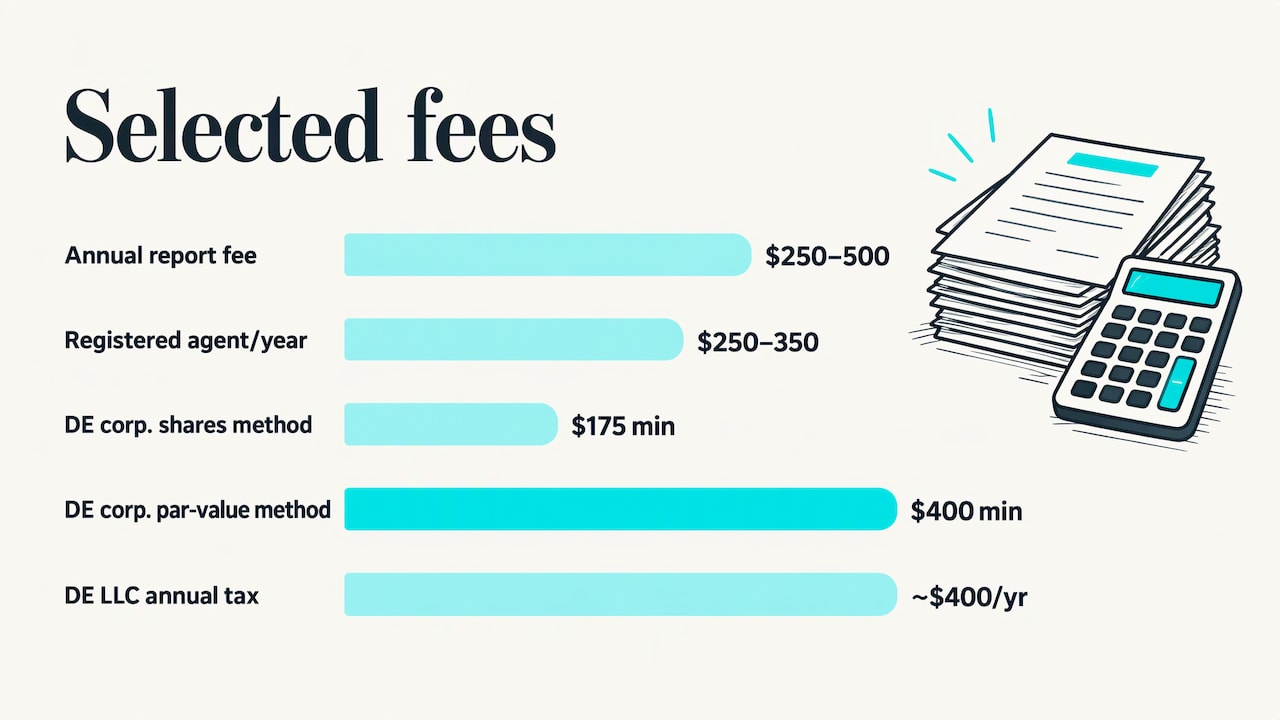
- Annual report fees: generally $250 to $500.
- Registered agent: $250 to $350 per year.
- Foreign qualification in each additional state: usually a few hundred dollars a year.
The same chapter says an entity can often be formed in a few days, sometimes the same day. Plan on one to two weeks in practice, because the bank account and EIN usually take longer than the state filing.
Delaware adds franchise tax. According to Hiro Law, a Delaware corporation owes a minimum of $175 under the Authorized Shares Method or $400 under the Assumed Par Value Capital Method, and a Delaware LLC generally owes around $400 a year. A small startup with few authorized shares can end up on the lower end, but pick the method with an accountant, since a large authorized share count can push the number up sharply.
Legal, accounting and bank costs come on top, and they vary by provider, so get written quotes.
Ongoing compliance: where the real work sits
A subsidiary that is formed and then ignored loses its good standing and its liability protection. Holland & Knight’s 2026 guide lays out the recurring duties:
- Federal tax. A US corporation pays 21% federal corporate income tax, files annual returns and makes estimated payments.
- Related-party reporting. A corporation that is 25% or more foreign-owned must report related-party transactions to the IRS, using Form 5472, with a $25,000 penalty per missed year. Intercompany prices must meet the arm’s-length standard, meaning they must look like what unrelated parties would agree.
- Withholding on payments to the parent. Dividends, interest and royalties paid to foreign persons face 30% withholding, reducible by treaty. Repatriated profits can face up to 44.7% combined.
- State filings. In Delaware, a corporation files its annual report by March 1, and an LLC pays its annual tax by June 1, with the amounts published by the state.
- State and local tax. These apply wherever there is business nexus, meaning a sufficient connection such as employees or sales.
SelectUSA’s investor guide adds three more checks. Review intercompany transactions for withholding and transfer pricing, check whether the parent already had a US permanent establishment that created back taxes, and prepare for employment taxes once you hire. If you will have a Californian entity or foreign registration there, state-specific annual filings such as California’s Statement of Information are part of the routine.
Two practical points for security founders. First, the intercompany agreement matters: if the parent owns the product IP and the subsidiary sells it, the license fee must be set and documented. Second, your own house must be in order. If you are building a US office, an IT and security checklist for opening an office abroad is a useful way to plan devices, access and monitoring from day one.
Tax law keeps moving
Law changes affect the numbers above. The BDO roadmap to doing business in the US notes that the One Big Beautiful Bill Act of July 2025 made the 20% pass-through deduction permanent. It also flags the 15% corporate alternative minimum tax, which reaches US subsidiaries of foreign groups only with at least $100 million in domestic financial statement income, far above startup scale. Before any filing, have a US tax adviser confirm the rates for your parent’s country, since treaties change the withholding picture.
When to form, and in what order
A sensible sequence for a foreign cyber or AI startup:
- Validate demand first: design partners, a pilot or a letter of intent from a US buyer.
- Decide the entity’s job: contracting, hiring, fundraising or all three.
- Form the C-corp, get the EIN, open the bank account.
- Sign the intercompany IP license and services agreements.
- Calendar every annual deadline, federal and state.
Founders from Europe will find country-specific detail in our German and UK entry guides. US companies heading the other way can start with how to expand from the US into Europe and Brazil.
Where Cybertech comes in
We run a cybersecurity-only accelerator for solo and early-team cyber founders. The November to March program brings exited founders, CISOs, MSSPs and a court-appointed digital forensics expert around the decisions you carry alone: co-founder, first hires, pricing and US market entry. The program fee is US$ 3,000 with no equity, and it closes with an in-person Texas Mission during SXSW.
Our Soft Landing offer covers structured market entry, compliance and local setup for founders building for the US, so the entity question is part of a wider plan rather than a standalone form. Country pages exist for Portuguese, UK, German and Israeli cyber startups. You can see the full program and Soft Landing at Cybertech Acceleration.
Since 2025, our founders have generated €600K+ in investment and new revenue, and the Texas Mission puts them in front of US buyers in person.
Our perspective
Most founders ask us how to form a US company. The better question is what the company has to prove. A US buyer in security wants to know who signs, who is liable and what happens when something goes wrong. The entity is the first answer to those questions.
We see the subsidiary as a commercial tool, not paperwork. Form it when a pilot, a hire or an investor needs it, keep it clean, and document the intercompany arrangements from the first day. Solo founders are tempted to postpone this because there is nobody to share the decision with. That is exactly where a room of exited founders and CISOs helps: they have made these calls, and they say so plainly.
Our founders work outside the usual hubs in Brazil, Portugal and Europe, building for the US. For them we also add something most formation guides skip: evidence-grade proof built into the product, designed to hold up with US buyers and in court. A well-structured entity and a credible product together are what move a US deal forward.
Thiago Vieira
FAQ
Do I need a US subsidiary to sell to US customers?
Not legally, in every case. But a branch or direct sale leaves the parent exposed to US liabilities and taxes, and many US buyers prefer a US contracting entity. If you plan to hire, sign contracts or raise US money, a subsidiary is the standard route.
Is Delaware the best state for a foreign-owned subsidiary?
It is the most common choice for venture-backed companies, and Holland & Knight data shows how many large and newly public companies use it. It is not the cheapest state, so the case rests on its predictable law. If operations sit in one other state, you will register there as well.
Can I form the subsidiary without visiting the US?
Formation is a state filing, and a registered agent supplies the in-state address. The EIN and bank account usually take longer and may need extra documents from the foreign parent. Plan the timeline around those two items, not the state filing.
How long does setup take?
A state can form an entity in a few days, sometimes the same day, according to SelectUSA. Allow one to two weeks overall once the EIN and bank account are included.
What happens if I miss the annual filings?
The entity can lose good standing, and a missed Form 5472 carries a $25,000 penalty per year, per the Holland & Knight guide above. Put every state and federal deadline in a calendar when you form the company, and have a US tax adviser confirm the filings.
Sources
- Foothold America describes
- Mintz checklist for foreign companies
- SelectUSA Taxes chapter
- LawMay P.C. explains
- SelectUSA Investor Guide
- Holland & Knight reports
- Delaware is not the cheapest option
- SelectUSA Business Structure chapter
- BDO roadmap to doing business in the US