Cybersecurity Sales Cycle: Stages, Length and How to Shorten It

The cybersecurity sales cycle typically runs from a few months to well over a year, because the buyer is betting their infrastructure, data and career on a vendor they have just met. You cannot make a buyer move faster than their risk review allows. What you can do is arrive with the proof that review asks for, and plan your runway around the real timeline. For a founder selling into the US, that proof is what separates a six-month deal from a twelve-month one.
TL;DR
- Published benchmarks put cybersecurity deals at roughly 30 to 90 days for small-ticket SMB sales and 12 to 18+ months for large enterprise, with six or more decision makers in most deals.
- The extra time comes from gates most software never faces: security questionnaires, proofs of concept, CISO approval, legal review of data terms and procurement.
- Evidence of delivery for similar customers and fast responses are the two things buyers say they cannot forgive missing.
- Your runway must be longer than your buyer’s timeline, or the cycle becomes a survival problem rather than a sales problem.
- Proof built into the product, such as forensic-grade evidence, shortens the technical and legal gates.
Table of Contents
- What the cybersecurity sales cycle actually is
- How long it takes: the numbers founders plan around
- Who sits at the table
- Where deals stall: the gates and their cost
- Do the runway math before you chase the deal
- Shorten the cycle with proof, not pressure
- Selling across the Atlantic: what changes
- FAQ
- Sources
What the cybersecurity sales cycle actually is
A sales cycle is the time from first contact with a prospect to a signed contract. In cybersecurity it usually runs through prospecting, qualification, technical evaluation, executive buy-in, procurement review and close, followed by a handoff into the buyer’s security onboarding. Each stage sounds familiar from any B2B sale. The difference is the set of gates inside them: security questionnaires, a proof of concept in a live environment, CISO approval, legal review of data-processing terms and, on bigger deals, board sign-off.
The reason is structural. A wrong choice of project-management software is an annoyance. A wrong choice of security vendor can mean a breach, a regulatory fine or an incident that reaches the board. So buyers move slowly, add stakeholders and ask for more validation than in almost any other software category. Each new stakeholder layer can reset part of the evaluation, and the delays compound.
There is also the matter of how the purchase starts. Founder-focused writing describes security purchases as fear-driven rather than aspiration-driven: triggered by an incident, an audit finding or board pressure, funded from risk and compliance budgets, and judged by whether nothing bad happens. A buyer in that position is not shopping for innovation. They are shopping for certainty.
If you want a model of the funnel itself, our guide to the B2B cybersecurity sales funnel for startups walks through it from the founder’s side. For a wider view of the mechanics, a practical guide to how SaaS sales cycles work is a good companion read.
How long it takes: the numbers founders plan around
No single figure fits every deal, and the published numbers come from different samples. Read them as a range, then place yourself in it by deal size.
By annual contract value (ACV), one 2026 benchmark gives:
| Deal size (ACV) | Typical cycle | Decision makers |
|---|---|---|
| Under $25K (SMB) | 30 to 90 days | 1 to 3 |
| $25K to $100K (mid-market) | 90 to 180 days | 4 to 6 |
| $100K to $500K (enterprise) | 6 to 12 months | 6 to 9 |
| Above $500K (large enterprise) | 12 to 18+ months | 9 to 13+ |
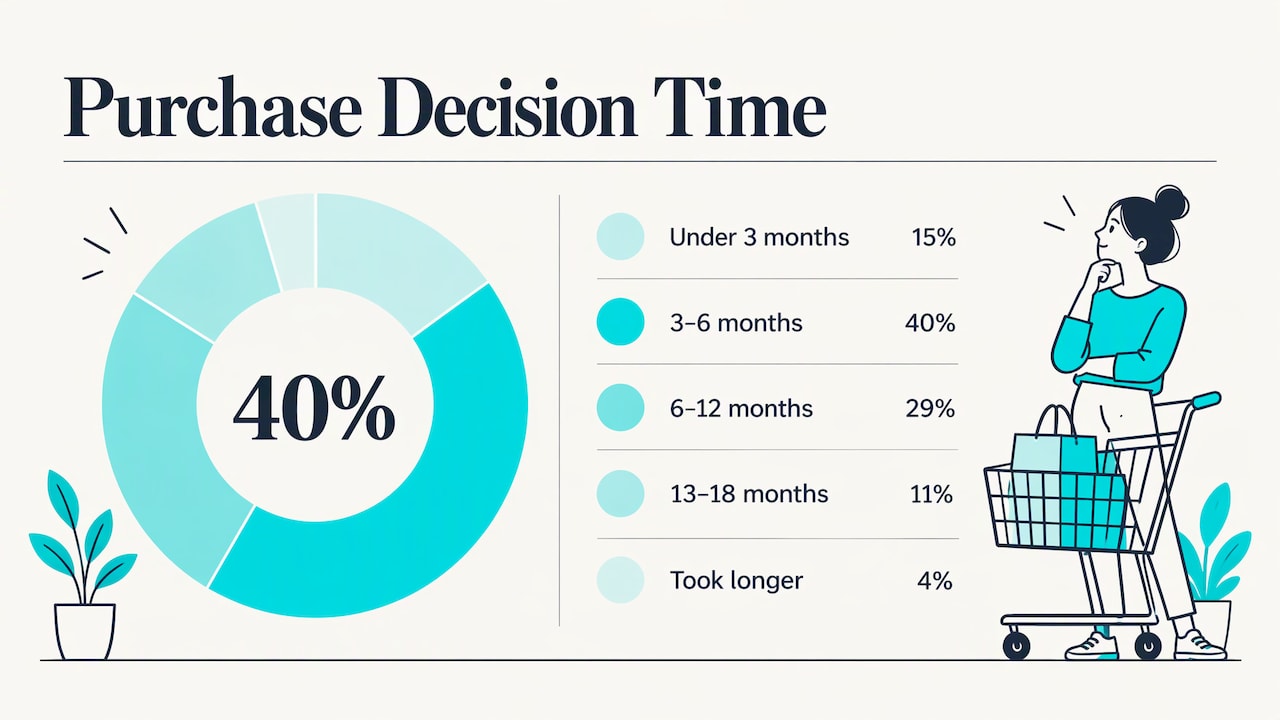
The buyer side tells a similar story. An April 2026 survey of 500 senior cybersecurity decision makers in the US, UK, France and Germany found that purchases took an average of seven months from identifying a need to selecting a vendor. Fifteen percent decided in under three months, 40% took three to six months, 29% took six to twelve, 11% took 13 to 18 and 4% took longer.
An earlier survey of 327 US senior security decision makers found that 55% start budgeting six to twelve months ahead, and that closing in under three months is unlikely unless an urgent incident set the conversation off. Another analysis found that 86% of organizations follow annual budget cycles, which is why a deal that misses the budget window can slip by months.
Two patterns are worth knowing:
- Urgency compresses the cycle. Deals that follow a breach can close in 30 to 60 days, against four to nine months for a typical enterprise deal that includes a proof of concept, architecture review, procurement and legal. You cannot manufacture a breach, but you can be the vendor the buyer already trusts when one happens.
- Brand does not erase the timeline. One account of early security companies reports that even with a brand and references, a typical enterprise security cycle is six to nine months, sometimes twelve once procurement is involved.
Who sits at the table
The buying committee is the main reason cycles stretch. One benchmark finds that 73% of cybersecurity deals involve six or more decision makers: the CISO or head of security, an IT director or engineer, a compliance or risk officer, finance, legal and procurement. Enterprise deals can add a CTO, a board risk committee and an external auditor.
Each person asks a different question:
- CISO: Will this make my program stronger, and will it make me look good if it goes wrong or right?
- IT and engineering: Will it break anything, and how hard is it to deploy?
- Compliance and risk: Does it map to the frameworks we are audited against?
- Finance: What does it cost, and where does the budget come from?
- Legal: Who is liable, where does data live, and what do the data-processing terms say?
- Procurement: Is this vendor stable, insured and comparable to alternatives?
The CISO usually leads. In one 2026 survey of vendors, the CISO was named a decision maker in 52% of cases, ahead of the CIO, IT manager and CTO. Among 156 buyers in the same report, reliability was the top evaluation criterion at 63%, ahead of cost at 50% and integration at 49%. Buyers also ran several test methods at once, including proofs of concept, pilots and trials.
Winning the CISO is its own craft. We cover it in two guides: how to sell to CISOs from the buyer’s side and how cyber founders win the deal. One principle from founders who have done it: a CISO who champions a young vendor is betting their own career on it, so your job is to make that person look good.
Where deals stall: the gates and their cost
One published breakdown lists six gates, each with a typical delay:
| Gate | Typical added time |
|---|---|
| Security questionnaire | 2 to 8 weeks (longer for regulated healthcare or finance) |
| Proof of concept | 4 to 12 weeks |
| CISO buy-in | 2 to 6 weeks |
| Legal and data-processing review | 2 to 6 weeks |
| Procurement and budget approval | 3 to 8 weeks |
| Board approval, deals above $250K | 4 to 12 weeks |
Those ranges come from one 2026 guide to the cybersecurity sales cycle. Treat them as planning ranges, not promises.
The security questionnaire is where early-stage vendors lose the most time. It typically arrives after technical evaluation and before legal sign-off. Common blockers are no SOC 2 report, undocumented incident response, missing audit logs and unlisted subprocessors, and remediation requests can stretch a deal by four to eight weeks. A vendor with current documents can clear a straightforward review in about two weeks, while a complex or regulated deal with missing paperwork can take six weeks or more.
The delay is not small at scale either. A 2025 McKinsey study, as cited in a security guide, found that 67% of enterprise deals over $100K are delayed at least 30 days by vendor security review. And in most companies, legal will not open the contract until security signs off, a point made in a 2026 review of procurement data. Security review is the gate that holds all the others shut.
If you are preparing for that review, a vendor security assessment playbook shows how buyers score vendors, which helps you answer the way they grade.
Do the runway math before you chase the deal
A long cycle is a financial problem before it is a sales problem. The Illumio CEO put it bluntly in a founder interview: if your buyer takes 12 months to sign and your runway is 14, you have an existential problem, not a sales problem. The same source reports that Illumio spent about two years meeting large banks before the first sale.
A simple way to apply it:
- Pick the deal size you are targeting and read the cycle off the table above.
- Add four to eight weeks if your champion lacks budget authority, the buyer needs compliance mapping, or you need new-vendor onboarding. That adjustment comes from the same benchmark.
- Add the time you need to build a pipeline in the first place.
- Compare the total with your cash. If cash runs out first, change the segment: smaller deals close faster and build the references that bigger deals demand.
That last point matters. Landing smaller mid-market or SMB customers first, building compliance habits from the start and offering sandbox proofs of concept with synthetic data, is a route to references before you attempt a six-figure enterprise deal. Our guide to building your first cybersecurity sales team covers who to hire for that early motion, and the one on the closer in cybersecurity deals covers the final stretch.
Shorten the cycle with proof, not pressure
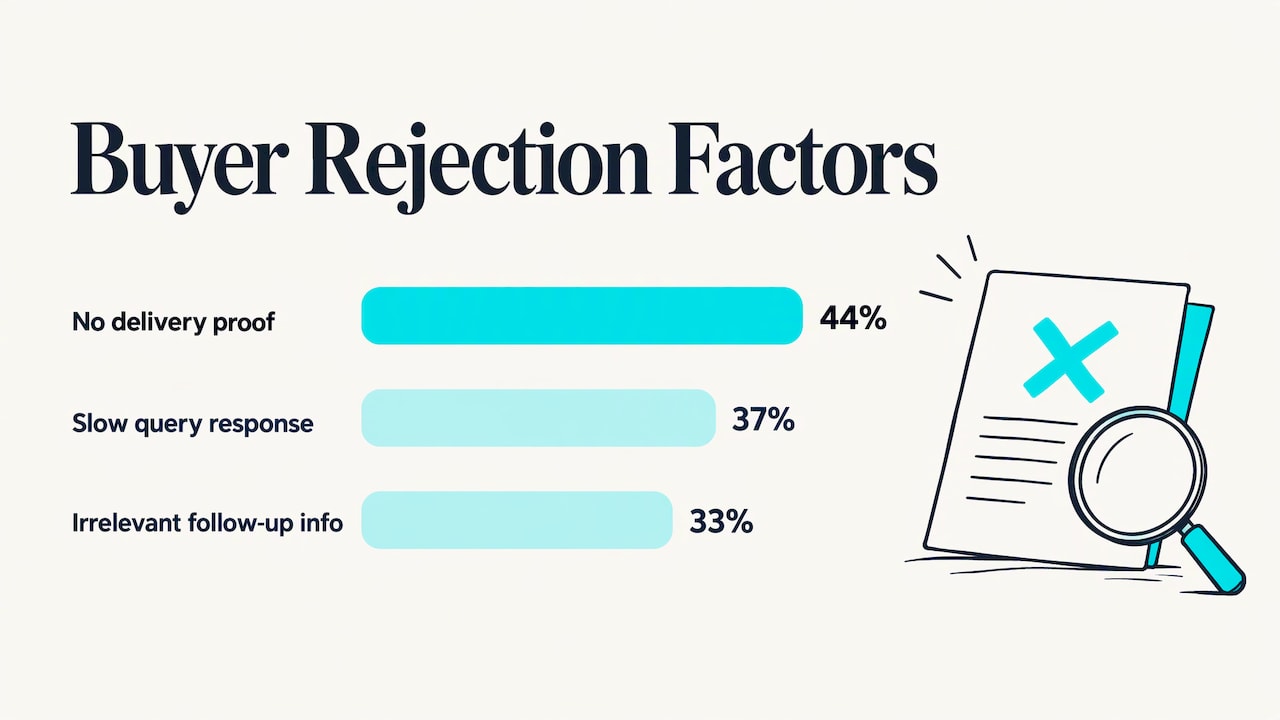
Buyers tell us what they reject. In the April 2026 survey, the top rejection factors were lack of evidence of delivery for similar businesses (44%), slow response to queries (37%) and a lack of relevant information after contact (33%). The survey’s authors summarize the two fatal flaws as no proof of delivery and slow response. Everything else, buyers can live with.
That gives a founder a short list to work on.
Make trust visible before the first call
The buyer is often researching before you know they exist. In the same survey, 65% of buyers engage vendors before the shortlisting stage. A global study of nearly 4,000 buyers found that the winning vendor is already on the Day One shortlist 95% of the time. So public documentation, architecture detail, original research and a clear mapping to frameworks such as MITRE ATT&CK or CIS Controls do real work, as one 2026 go-to-market playbook describes. Peers matter too: buyers name direct peers (35%), analysts (32%) and industry events (28%) as their first sources of awareness. For outbound, see our guide to LinkedIn lead generation for cybersecurity founders.
Arrive with a ready security package
Before a first enterprise deal, a typical checklist includes SOC 2 Type I with Type II in progress, a retested penetration test with an attestation letter, single sign-on and multi-factor authentication, a software bill of materials, and a trust package: questionnaire answers, an incident response plan, business continuity and disaster recovery targets, a data-processing agreement and cyber insurance. Type I can open the door, but many enterprise contracts require Type II, which needs a three-to-twelve-month observation period. Time that audit to your pipeline rather than starting it blind.
If you are comparing audit and assessment help, our note on what cybersecurity compliance services cover explains the options by type.
Write the proof of value down
Run proofs of value with written success criteria: which detections, which environments, how long, who evaluates and what happens if you pass. A proof of concept can add four to twelve weeks. Without a written definition of success, it can also run on indefinitely.
Build evidence into the product
This is where the cycle shortens most for a vendor whose output can be challenged by a buyer’s legal team, an auditor or a court. If your product produces findings, logs or reports, the question every stakeholder eventually asks is whether they would stand up under scrutiny. Evidence that is traceable and defensible answers the CISO, compliance and legal together, instead of one gate at a time. We explain why in why forensic-grade proof sells cybersecurity in the US.
Selling across the Atlantic: what changes
For an international startup, geography adds its own friction. European buyers often require ISO 27001 specifically, while North American buyers lean toward SOC 2, and dual certification reduces friction in either market. Data residency controls and subprocessor management also come up often in international enterprise deals.
Cycle lengths differ too. In 6sense’s 2025 study, the European average buying cycle rose from 9.0 to 9.8 months, while the global average fell from 11.3 to 10.1 months. These are all-B2B figures, not cybersecurity-only, but they show that a European company with a US pipeline, or a US company entering Europe, should not assume one timeline carries across.
In the Coleman Parkes survey, German buyers were the most likely to connect with vendors early, at 71%, so a US company entering Germany needs credibility in place before it starts selling. For a European founder entering the US, our US market entry playbook for cyber startups lays out the steps in order.
Our view: the cycle is a trust problem, and trust can be built into the product
We work with solo and early-team cyber founders who carry the big decisions alone: co-founder, first hires, pricing, US entry. The sales cycle punishes exactly that position. Every gate in it, from the questionnaire to the legal review, is a buyer asking whether they can rely on you.
Our answer is to treat proof as a product feature rather than a sales asset. In our program, exited founders, CISOs, MSSPs and a court-appointed digital forensics expert help founders build evidence-grade proof into what they ship, so it holds up with US buyers and in court. A founder who can show that kind of proof has a short answer for the CISO, the compliance lead and the lawyer.
The second part is access. Cycles shorten when a trusted peer vouches for you. That is why we make introductions inside a network of portfolio companies, alumni and 350+ cyber founders, and why we work with founders outside the usual hubs who are building for the US.
Run your runway math honestly, build proof early, and do not walk into a twelve-month cycle alone.
Thiago Vieira
FAQ
How long is the average cybersecurity sales cycle?
It depends on deal size. Published benchmarks run from 30 to 90 days for small SMB deals to 12 to 18+ months for large enterprise deals. A 2026 buyer survey in four countries found an average of seven months from identifying a need to choosing a vendor.
What are the stages of the cybersecurity sales cycle?
The common path is prospecting, qualification, technical evaluation, executive buy-in, procurement and legal review, and close. Some overviews describe seven steps: prospecting, warm-up, qualifying, presenting, overcoming objections, closing and follow-up. Security questionnaires and proofs of concept sit inside the evaluation and review stages.
Why is selling cybersecurity slower than selling other software?
The product touches infrastructure and data the buyer is responsible for, so a wrong decision can mean a breach or a fine. That brings more stakeholders and more validation. One comparison puts B2B cybersecurity at 6 to 18 months with 6 to 10 stakeholders, against 2 to 6 weeks for SMB SaaS.
What speeds up a cybersecurity deal?
Urgency from an incident or audit can compress a deal to 30 to 60 days. Without that, the controllable levers are current security documents, quick answers to questions, written proof-of-value criteria and references from similar customers.
Sources
- security purchases as fear-driven rather than aspiration-driven
- practical guide to how SaaS sales cycles work
- purchases took an average of seven months from identifying a need to selecting a vendor
- 55% start budgeting six to twelve months ahead
- 86% of organizations follow annual budget cycles
- 30 to 60 days
- the CISO was named a decision maker in 52% of cases
- clear a straightforward review in about two weeks
- the winning vendor is already on the Day One shortlist 95% of the time
- one 2026 go-to-market playbook
- typical checklist
- what cybersecurity compliance services cover
- seven steps
- 6 to 18 months with 6 to 10 stakeholders