Data Residency Strategy: Where to Store Customer Data
A data residency strategy is a documented decision about where each type of customer data is stored, processed, accessed and backed up, and which legal rule or customer promise drives each choice. It is not one region on a cloud console. It is a map of data, laws and controls that you can show to a buyer, an auditor or a regulator without scrambling.
This guide is for founders selling software into more than one country, especially security and AI startups whose customers ask hard questions about where data lives. It covers the vocabulary, what the GDPR does and does not require, how localization laws differ, a step-by-step method, and the backup and access gaps that most plans miss.
TL;DR
- Residency is where data sits, localization is a legal duty to keep it in a country, and sovereignty is which country’s laws reach it. Treat them as three separate questions.
- The GDPR does not say personal data must stay in the EU. It governs how data is handled and, when data goes to a third country, requires a transfer mechanism.
- No single global rule exists. Start by classifying data, then check each market’s rules and sector rules, then pick regions and controls.
- Backups, disaster recovery, support access and subprocessors are where residency plans usually leak.
- Evidence beats promises: automated controls and audit trails are what close enterprise deals.
Table of Contents
- Residency, localization and sovereignty: three different questions
- Does the GDPR require data to stay in the EU?
- What localization looks like around the world
- Building the strategy, step by step
- Cover more than production: access, backups and disaster recovery
- Proving compliance, not just claiming it
- Data residency for SaaS and security startups
- Our perspective
- How Cybertech helps founders decide and execute
- FAQ
- Sources
Residency, localization and sovereignty: three different questions
The top-ranking explainers mostly agree on the definitions, and so should your internal documents. IBM’s explainer frames data residency as where data is held, data localization as a legal requirement to keep specified data where it was created, and data sovereignty as the laws that govern the data. A Scale Computing guide puts the same idea this way: sovereignty is the extent to which data is subject to a country’s laws regardless of where it is stored.
In practice, each term answers a different question you will hear from customers:
| Concept | The question it answers | Who decides | Example of a founder decision |
|---|---|---|---|
| Data residency | Where is the data physically stored and processed? | Often you, sometimes the customer’s contract | Hosting a European customer’s tenant in an EU region |
| Data localization | Is the data legally required to stay in a country? | A government | Keeping certain payment data in the country that demands it |
| Data sovereignty | Whose laws can reach the data? | Jurisdiction, not geography | Asking whether a provider’s parent company can be compelled by a foreign court |
The difference matters because fixing one does not fix the others. You can store a file in the right country and still have it reachable by a foreign legal order through the provider that holds it. You can also have no localization law at all and still lose a deal because a buyer’s procurement policy demands local hosting.
A useful habit from AWS’s digital sovereignty guidance: separate the legal requirement (a transfer restriction or a local-storage mandate) from the technical control you choose to enforce it. Write the requirement first. Pick the control second. Teams that do it backwards end up with expensive infrastructure that answers no actual obligation.
Does the GDPR require data to stay in the EU?
No, and this is the most common misreading among startups. The GDPR is about who is covered and how data moves, not a blanket ban on storing data elsewhere.
Your Europe explains that the regulation applies to organizations established in the EU wherever they process data, and to organizations outside the EU that offer goods or services to people in the EU or monitor their behavior. So a US SaaS company with European customers is likely in scope even with every server in Virginia.
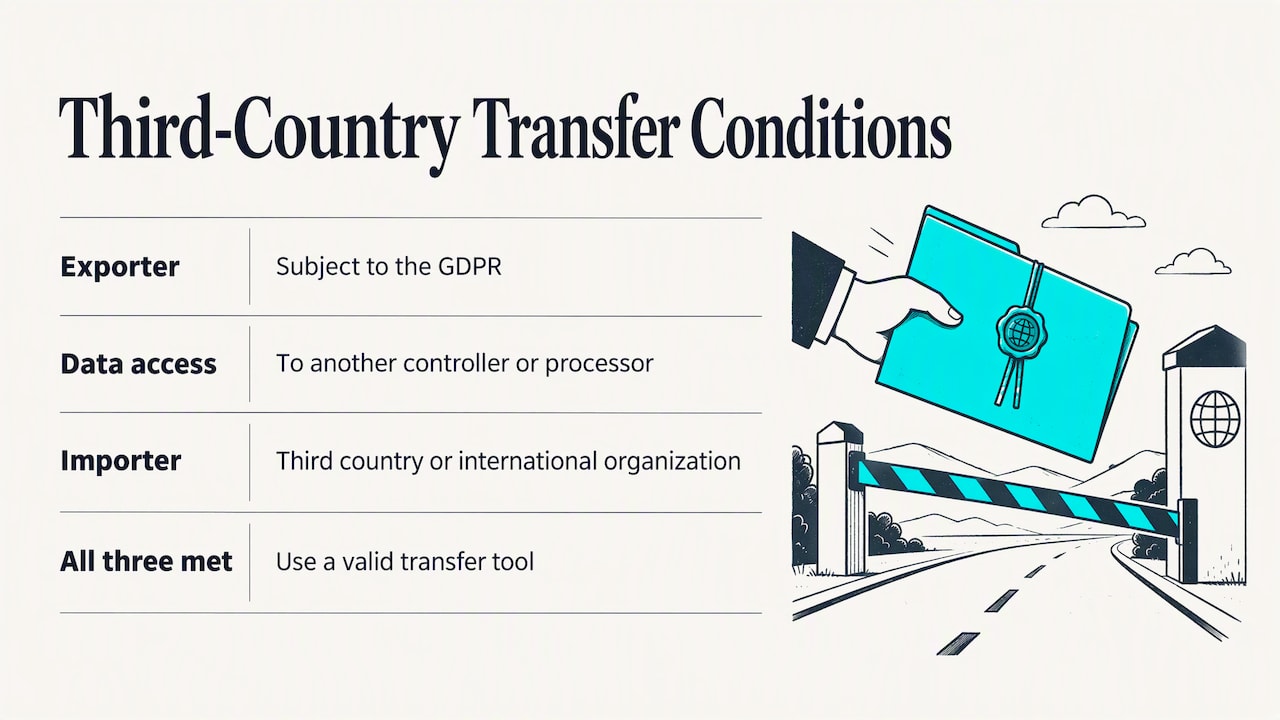
What changes when data leaves the EU is the transfer regime. The European Data Protection Board’s Guidelines 05/2021 describe a third-country transfer through three cumulative conditions: the exporter is subject to the GDPR, it discloses or makes data available to another controller or processor, and the importer is in a third country or an international organization. If all three are met, you need a valid transfer tool. The European Commission says its standard contractual clauses can provide appropriate safeguards for transfers from the EU to third countries.
The same EDPB document adds a point founders skip: even processing that is not technically a transfer stays under GDPR accountability, and may call for a risk assessment where conflicting laws or disproportionate government access are a concern. In other words, “no transfer” is not the same as “no work.”
If your buyers are asking for EU hosting, they are usually asking for risk reduction and simpler paperwork, not citing a legal ban. That distinction changes how you price and sell it. For a deeper look at the compliance questions that sit beyond server location, this piece on EU data residency compliance questions is a good companion, and our own walkthroughs on cross-border data transfers and GDPR for SaaS startups go through the contract and process side.
Non-personal data inside the EU
Not everything you store is personal data. Telemetry, aggregated analytics and some security signals may fall outside personal-data rules. Your Europe states that non-personal data can generally be stored and processed anywhere in the EU, subject to exceptional restrictions based on public security. The same page says EU cloud customers must be able to switch providers or restore data to their own systems, and that switching and egress charges are scheduled to be eliminated from January 2027. That helps your exit story: you can tell customers they are not locked in.
Be careful with the classification. Logs that contain IP addresses, device identifiers or user names often count as personal data. Security vendors in particular collect a lot of it.
What localization looks like around the world
There is no universal localization rule. Thomson Reuters’ Practical Law toolkit notes that some laws broadly require in-country storage of most personal data, others target sensitive categories such as healthcare or financial information, and others focus on infrastructure such as internet and telecom services.
Two examples show how different they can be:
- Russia. A Morgan Lewis country guide explains that Federal Law 152-FZ, Article 18(5), requires operators collecting Russian citizens’ personal data to record, store, update and extract it using Russian databases. The same guide reports administrative fines of RUB1,000,000 to RUB6,000,000 for a first offense and RUB6,000,000 to RUB18,000,000 for repeat offenses, based on the provisions it cites in 2021. Check current law before relying on those figures.
- India, payments. AWS’s sovereignty lens contrasts the GDPR’s transfer-based approach with an Indian Reserve Bank requirement that payment-related data reside locally. One is a gate on movement. The other is a location rule for a single sector.
The lesson is that residency analysis has to be done by jurisdiction and by sector. A single global policy that says “we host in the US and EU” will not hold when a fintech buyer in one country, a hospital in another and a government agency in a third each ask their own question.
Building the strategy, step by step
AWS’s guidance supports a jurisdiction-by-jurisdiction assessment: classify the data and workload, identify the applicable residency, transfer, sovereignty and sector rules, then choose regions and controls that enforce them. Here is that method turned into a working sequence for a startup.
- Inventory your data. List what you collect, where it is stored, where it moves and who touches it: customer content, account data, logs, analytics, support tickets, billing, model training data. Visibility is the starting point of every credible plan.
- Classify each category. Personal or not, sensitive or not, regulated by sector or not. A customer’s uploaded files and your own product metrics deserve different treatment.
- List your markets and the rules in each. For every country you sell in or plan to, note any localization law, any transfer restriction and any sector rule. Add the contractual requirements buyers have actually put in writing.
- Separate must-do from choose-to-do. Some placements are legal obligations. Others are commercial choices to win trust. Label them differently, because only the first kind is non-negotiable.
- Choose regions and architecture. Options run from one global region with strong transfer paperwork, to regional tenants per market, to fully separate stacks for markets with strict localization. Pick the lightest option that satisfies the rules you listed.
- Decide who can access what. Residency of storage means little if engineers or support staff in another country can read the data freely.
- Write it down and test it. One page per market, owned by a named person, reviewed when you add a country, a subprocessor or a major feature.
The City of Toronto’s cloud residency guideline is a public-sector example of the same logic: assess where data is stored and processed, identify the foreign and domestic laws that apply, and evaluate provider arrangements against your information-management obligations. Your enterprise buyers may run a similar assessment on you, so it helps to have answers ready.
A worked example
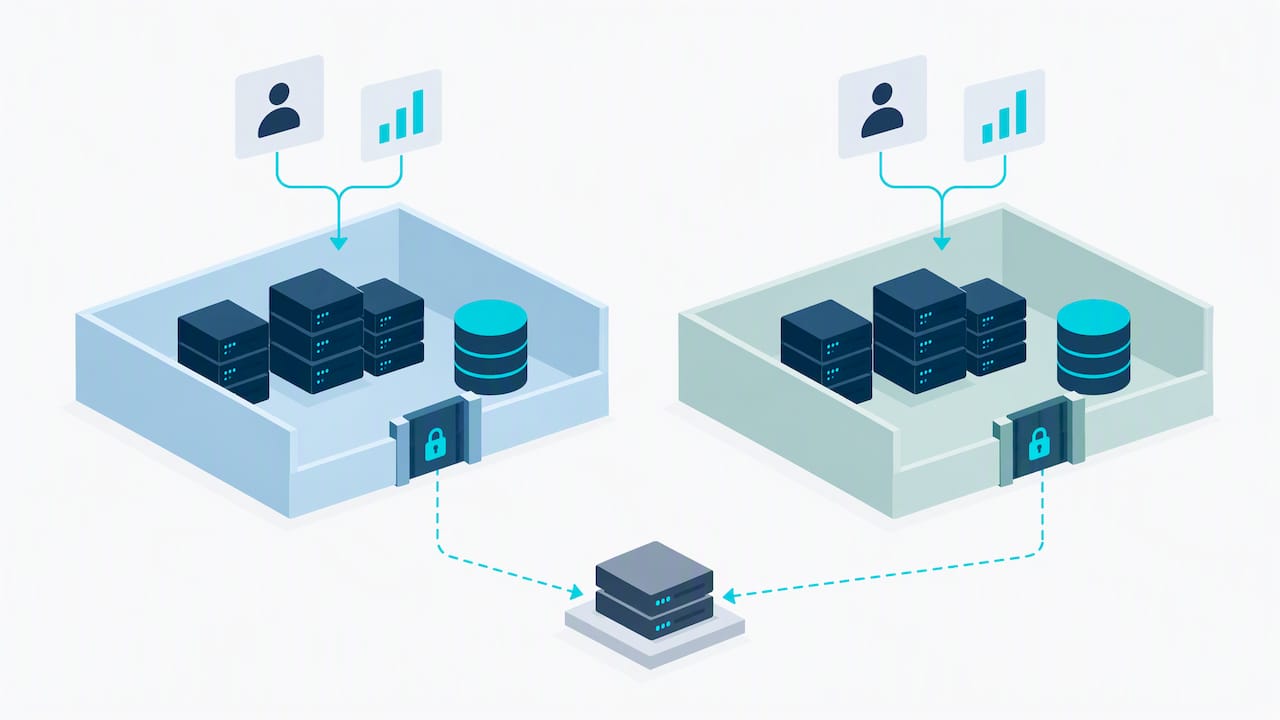
Imagine a US endpoint-security startup with a small German customer and a US bank pilot. Its inventory shows account data, alert telemetry containing hostnames and IP addresses, and uploaded forensic artifacts. The German customer is covered by GDPR, so the telemetry is personal data and the company needs a transfer tool or EU processing. The bank wants US-only storage in its contract. The sensible design is two regional tenants, one in the EU and one in the US, with support access gated per tenant and a clear statement of which subprocessors touch each. That is cheaper than a stack per country and answers both buyers.
Cover more than production: access, backups and disaster recovery
The pages that rank for this topic keep returning to the same blind spot. Data stays in the right region in production, then gets copied somewhere else by a backup job, a replication setting or a support tool.
The Bank of Mauritius’ cloud guideline is written for financial institutions, but its checklist is a good template for any serious plan. It expects coverage of production storage and processing, administrator and support access, subprocessors, replication, backups, disaster recovery, recovery time and point objectives, incident communications, testing, retention, deletion, portability and exit. It also says exit plans for material cloud services should cover deletion of customer data, independent assurance that production and backup data become irrecoverable, transfer to another provider, and continuity during the transition.
On backups specifically, France’s ANSSI publishes IT backup guidance recommending the 3-2-1 rule: three copies including production, two backups on distinct media and one offline. It also calls for regular restoration tests, least-privilege control over backup administration, defined retention periods, logging of restores, isolation of backup infrastructure during incidents, and attention to malware in restored backups.
Here is where residency and resilience can pull against each other. A second copy in a distant region is good for disaster recovery and bad for a localization rule. Decide it in advance:
- Keep primary and backup copies within the same legal boundary when a rule requires it, and use separate availability zones or providers inside that boundary.
- If the offline copy must live elsewhere, make sure it is encrypted with keys you control and that the transfer is covered by a valid mechanism.
- Record the recovery time and recovery point you promise per region, and test them.
And do not forget people. If a support engineer on another continent can open a customer’s records during a ticket, you have created cross-border access, whatever your storage setting says.
Proving compliance, not just claiming it
Enterprise buyers have heard “we host in the EU” many times. What moves a deal is evidence. AWS says automated preventive and detective controls, region and access restrictions, continuous configuration evaluation and audit trails can give verifiable, auditable assurance beyond contractual commitments. Translated for a startup:
- Prevent. Use policy controls that block resource creation outside approved regions, so a mistake cannot become a violation.
- Detect. Continuously check configuration and alert when something drifts, such as a new storage bucket in the wrong place.
- Record. Keep audit logs of access and of restores, and retain them according to your policy.
- Report. Be able to produce, per customer, the region, the subprocessors and the access paths on request.
For teams expanding into the UK, the Information Commissioner’s Office publishes a guide to international transfers for organizations and data protection officers, explaining when the transfer rules apply and what steps follow. It is a practical checklist for a market that many US startups treat as an afterthought.
Data residency for SaaS and security startups
Security and AI vendors face sharper scrutiny than most SaaS companies. Your product ingests logs, endpoint data, forensic artifacts and sometimes model inputs, all of which can contain personal data and customer secrets. Three habits help:
- Offer region choice at onboarding rather than as a custom enterprise project. It becomes a selling point and cuts procurement cycles.
- Keep evidence handling separate. Where your product handles material that might be used in an investigation or legal proceeding, chain of custody and location records matter as much as storage region. Our note on geofence warrant compliance for companies storing data shows how location and legal process can intersect.
- Plan market by market. What you need for a European buyer differs from a US federal buyer. See our US compliance checklist for foreign cybersecurity startups if you are a non-US company, or our guide on US cybersecurity companies expanding to Brazil and LatAm if you are going the other way.
Our perspective
We work with cybersecurity and AI founders who cross the Atlantic in both directions, and the pattern is consistent: residency gets treated as an infrastructure ticket when it is really a credibility question. A buyer who asks where the data lives is asking whether your claims will hold up under scrutiny. The founders who win are the ones who can answer in the buyer’s own terms, with a clear map, a named owner and evidence they can hand over.
Our view is shaped by our focus on digital forensics. In forensics, the value of data depends on whether you can show where it came from, who handled it and that it was not altered. The same discipline applies to residency. A statement that data stayed in a region is only as strong as the logs behind it. We encourage founders to build that judicial-grade habit early, because it turns a compliance cost into something a buyer can verify and a competitor cannot easily copy.
We also tell founders to resist over-building. Do not stand up five regional stacks to answer one buyer’s questionnaire. Start with the markets you are actually selling in, write down the rule behind each choice, and expand the architecture when revenue asks for it.
— Thiago Vieira
How Cybertech helps founders decide and execute
Cybertech Acceleration is the first US accelerator dedicated exclusively to digital forensics for cybersecurity and AI startups. We help founders turn technical capabilities such as evidence handling and data placement into commercial narratives that buyers and investors understand, and we support structured market entry, compliance and local setup, and introductions in both directions between the US and international markets.
If you are a European, UK or other international company planning US expansion, our Soft Landing program is built for that move, and you can see how it works for specific countries, such as German cyber startups or UK cyber startups. For a view on the legal and technical side of the move, read our US market entry guide for cybersecurity startups.
FAQ
What is the difference between data residency and data sovereignty?
Data residency is the physical or geographic location where data is stored and processed. Data sovereignty is about which country’s laws govern that data, which can reach beyond where it sits. A file can be stored in one country and still be subject to another country’s legal reach through the provider that holds it.
Does the GDPR require data to be stored in the EU?
No. The GDPR applies to EU-established organizations wherever they process data, and to outside organizations that offer services to people in the EU or monitor their behavior. Moving personal data to a third country requires a valid transfer mechanism, such as standard contractual clauses, but storage in the EU is not mandated by the regulation itself.
How do I decide where to store customer data?
Classify your data, list the rules in each market you sell into, and separate legal requirements from commercial preferences. Then choose the lightest architecture that satisfies the legal ones, such as regional tenants, and document the reason for each choice. Revisit it when you add a market or a subprocessor.
Do backups have to follow the same residency rules?
Yes, in most cases. Backups and replicas are copies of the same data, so a backup in another country can create the cross-border issue you were trying to avoid. Decide backup and disaster recovery locations at the same time as production, and test restores.
Sources
- IBM’s explainer
- Scale Computing guide
- digital sovereignty guidance
- Your Europe
- Guidelines 05/2021
- standard contractual clauses
- Your Europe
- Practical Law toolkit
- country guide
- cloud residency guideline
- cloud guideline
- IT backup guidance
- a guide to international transfers