Cybersecurity Case Study Examples: 9 Real Incidents and Lessons
The most useful cybersecurity case studies are the ones backed by an official review or an academic analysis, because they give you verified facts about what failed, what it cost and what recovery took. Below are nine real incidents, from a national health service to a global shipping giant, each with the numbers that were reported and the lesson a security team or startup can apply.
TL;DR
- Missed alerts, weak authentication and untested backups show up again and again. The HSE, Ascension and Canadian government cases all trace back to them.
- Recovery speed matters as much as prevention. HSE needed four months to recover fully, while Co-op’s fast detection kept its 2025 incident far smaller than M&S’s.
- Supply-chain attacks (Kaseya/Coop, NotPetya) hit companies that did nothing wrong in their own networks.
- Evidence is part of the response. Logs and forensic records decide how fast you can scope, report and defend an incident.
- For cyber and AI startups, the same cases are a buyer’s checklist: enterprise customers want proof that you survive an incident, not only that you prevent one.
Table of Contents
- How to read a cybersecurity case study
- Case 1: HSE Ireland (2021), ransomware and ignored alerts
- Case 2: Microsoft Exchange Online (2023), a preventable intrusion
- Case 3: Change Healthcare (2024), one vendor, a whole sector
- Case 4: Maersk and NotPetya (2017), collateral damage at global scale
- Case 5: Coop and Kaseya (2021), the supply chain as entry point
- Case 6: M&S versus Co-op (2025), minutes against days
- Case 7: Canada’s CRA and ESDC (2020), credential stuffing
- Case 8: HWL Ebsworth (2023), a law firm’s data in the open
- Case 9: Ascension (2024), weak passwords and patient care
- The nine cases side by side
- What the cases have in common
- Writing your own case study: what buyers look for
- Perspective
- FAQ
- Sources
How to read a cybersecurity case study
A good case study answers five questions: how the attacker got in, how long they stayed, what was affected, how the organization responded, and what changed afterward. Most vendor case studies skip the first two and lead with the success story. Government reviews and academic write-ups usually include the uncomfortable details, so we lean on them here.
Figures also age and differ by source. Where a number comes from a company’s own account, we say so.
Case 1: HSE Ireland (2021), ransomware and ignored alerts
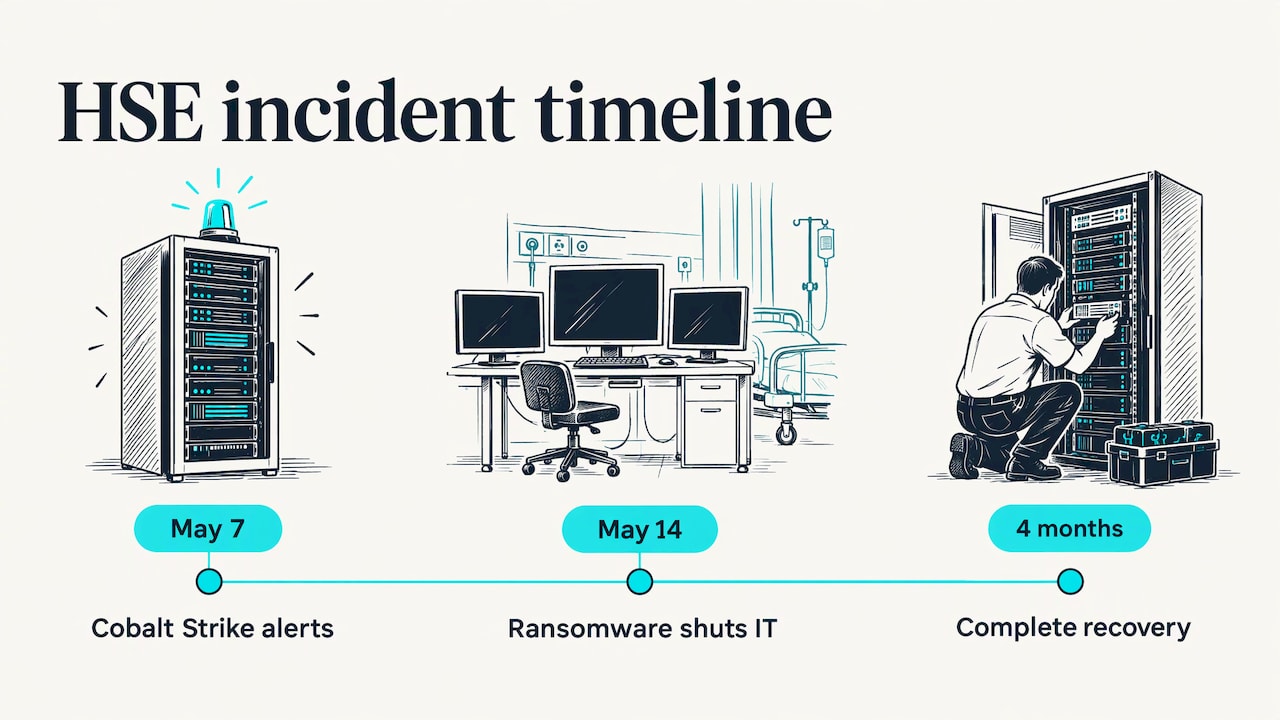
On May 14, 2021, ransomware attributed to Conti shut down all IT systems of Ireland’s health service nationwide. HSE management reported that 80% of its IT environment was encrypted.
The warning signs came a week earlier. HSE’s antivirus identified Cobalt Strike, a tool attackers use for remote control, on six servers on May 7, and on more servers in the following days. According to the same review, those alerts were not appropriately actioned, and the attack was not identified or contained before the ransomware ran.
The cost was long. Complete recovery took four months, with impacts on healthcare delivery throughout. The review also found that time was lost early on because the organization had not planned for a high-impact technology event, so it relied on third parties in the first weeks.
Lesson: an alert nobody owns is the same as no alert. If your team is small, the fix is to define who acts on a high-severity detection and how fast. Practical ideas for improving security operations after missed alerts start with clear ownership and tested procedures.
Case 2: Microsoft Exchange Online (2023), a preventable intrusion
In May and June 2023, a threat actor compromised the Exchange Online mailboxes of 22 organizations. The U.S. Cyber Safety Review Board concluded that the intrusion was preventable and should never have occurred, citing avoidable errors, an inadequate security culture and a failure to detect the cryptographic key compromise itself.
The review states that the actor, Storm-0558, had access to cloud mailboxes for at least six weeks and downloaded approximately 60,000 emails from the State Department. Microsoft began notifying potentially affected organizations on or about June 19 and individuals on or about July 4, 2023.
Lesson: even the largest vendors fail at basics such as key management and detection of their own signing infrastructure. If you sell software into enterprises, expect buyers to ask how you protect secrets and how fast you can tell a customer what happened.
Case 3: Change Healthcare (2024), one vendor, a whole sector
Change Healthcare discovered a ransomware attack on February 21, 2024 and went offline to limit the damage. That shut down medical claims clearing for a substantial portion of the U.S. medical sector. The attack was by the ALPHV/Black Cat group, and hundreds of thousands of physician practices, hospitals and pharmacies could not submit claims or receive payments during weeks of paralysis.
The numbers show how far one dependency reaches. An American Hospital Association survey cited by the Office of Financial Research found that 94% of affected hospitals reported a financial impact, and more than half called it significant or serious. As of August 30, 2024, Change Healthcare said it was still working to restore some services.
The same brief notes that backups were affected because they were not properly isolated from the compromised network, and that organizations need business continuity plans that are well prepared and practiced.
Lesson: concentration risk is a security risk. Map which single supplier would stop your operations, and keep backups in a place the attacker cannot reach from the main network.
Case 4: Maersk and NotPetya (2017), collateral damage at global scale
NotPetya started in Ukraine and spread worldwide. A Columbia University case study reports a White House assessment of total damages at $10 billion. Maersk’s CEO estimated that the company’s quick response limited lost shipping volume to 20%.
The same study lists reported company losses: FedEx (through TNT Express) reported $400 million in remediation and related expenses, Mondelēz lost nearly $190 million, and Merck incurred $870 million in losses.
The study also records a bright spot: two organizations successfully acted on detections of the attacker and prevented ransomware deployment within their estates. Its academic lesson, attributed to Greg Rattray of Columbia University, is that in disruptive attacks recovery speed is as important as the fact that an organization was knocked down.
Lesson: you can be a target by accident. Plan for destructive malware, not only for theft.
Case 5: Coop and Kaseya (2021), the supply chain as entry point
In the Coop case, described by incident response firm Truesec, a known threat actor exploited a previously unknown vulnerability in Kaseya’s products. Coop’s systems were infected through solutions used by its payment systems supplier, Visma Esscom. Tills and self-service checkouts stopped working, and Coop closed around 700 of its 800 stores. According to Truesec’s own account, all stores reopened within six days after it got involved.
Keep in mind that this is a company’s description of its own work. The part that holds up independently is the pattern: Coop’s networks were not the weak point. A supplier’s management tooling was.
Lesson: your vendors’ tools run with high privileges inside your environment. Inventory them, and know how you would operate if they went dark.
Case 6: M&S versus Co-op (2025), minutes against days
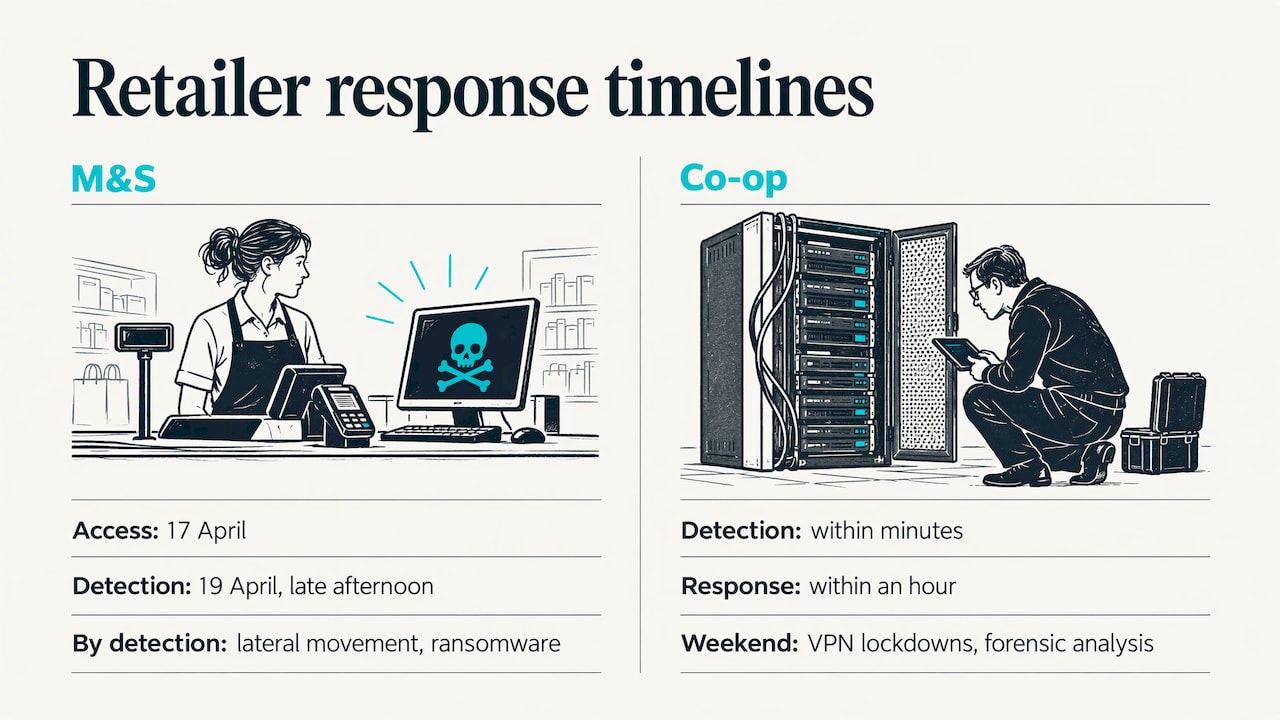
Two UK retailers faced cyberattacks in 2025, and a comparison by the security firm MTI shows how detection time shapes the outcome. It reports that attackers gained access to M&S on 17 April, but M&S leadership did not detect the breach until the late afternoon of 19 April. By then the attackers had moved laterally and deployed ransomware. The article estimates M&S endured a £300 million loss in profit, plus operational shutdown, long-term disruption to online business and reputational damage.
Co-op, by contrast, is reported to have detected its breach within minutes and launched response measures within the hour. Containment actions, including VPN lockdowns and forensic analysis, were already underway that weekend.
Treat the £300 million as an estimate from a secondary source rather than an audited figure. The contrast in detection time is still the instructive part.
Lesson: the first hours decide the scale. Pre-agreed containment steps, such as who can cut off VPN access, are what turn minutes into a smaller incident.
Case 7: Canada’s CRA and ESDC (2020), credential stuffing
The Office of the Privacy Commissioner of Canada investigated attacks in which criminals used credential stuffing against the CRA sign-in portal and the GC Key authentication service. They accessed, modified or created accounts to fraudulently redirect benefit payments. The ESDC attack began around July 23, 2020, through its Enterprise Cyber Authentication Solution and the Canada Student Loan systems.
Credential stuffing uses bots and passwords stolen in earlier breaches, and it works because people reuse usernames and passwords. The OPC found inadequate authentication and monitoring at both agencies.
Lesson: a login page is an attack surface. Multi-factor authentication, rate limits and monitoring for automated login patterns are the baseline, particularly for any product that holds payments or personal data.
Case 8: HWL Ebsworth (2023), a law firm’s data in the open
HWL Ebsworth, an Australian law firm, became aware of its incident on 28 April 2023. The government’s lessons-learned report describes reported exfiltration of about four terabytes of data, roughly 2.2 million files, exposing sensitive legal advice, personal information, and government and corporate material.
The report also makes a point about coordination: central coordination and consequence management functions reduce the burden on impacted entities during a coordinated response. The firm’s clients were the ones left to work out what the leak meant for them.
Lesson: if you hold customer data, your breach is your customers’ incident too. Being able to tell them quickly which of their records were touched is a forensic capability, not only a communications task.
Case 9: Ascension (2024), weak passwords and patient care
As reported by Ars Technica, ransomware at the Ascension health system locked medical staff out of electronic health records and the systems used to coordinate medications, surgeries and tests. The article says records of 5.6 million patients were stolen and disruption lasted weeks.
Lesson: for healthcare, security failures become clinical failures. Outside healthcare, the same logic applies to any product customers rely on to run their day.
The nine cases side by side
| Case | Year | Root pattern | Reported impact |
|---|---|---|---|
| HSE Ireland | 2021 | Alerts not actioned | 80% of IT encrypted, four months to recover |
| Microsoft Exchange Online | 2023 | Key compromise, weak detection | 22 organizations, about 60,000 State Department emails |
| Change Healthcare | 2024 | Single point of dependency | Claims clearing halted, 94% of surveyed hospitals hit financially |
| Maersk/NotPetya | 2017 | Collateral destructive malware | $10 billion total damages (White House assessment) |
| Coop/Kaseya | 2021 | Supplier tooling | About 700 of 800 stores closed |
| M&S vs Co-op | 2025 | Detection speed | M&S estimated £300 million profit loss |
| CRA/ESDC | 2020 | Credential stuffing | Benefit payments fraudulently redirected |
| HWL Ebsworth | 2023 | Data exfiltration | About four terabytes, 2.2 million files |
| Ascension | 2024 | Weak passwords | 5.6 million patient records |
What the cases have in common
Detection beats cleanup. HSE saw the tool and did not act. M&S found out two days late. Co-op found out in minutes. The cheapest security spend in these stories is a response path for the alert you already have.
Backups must be isolated and tested. Change Healthcare’s backups were affected because they sat too close to the compromised network. The BBC’s analysis of recovery times notes that long recoveries often reflect rebuild complexity, backup integrity and decryption-key delays. It also cites Statista data showing an average ransomware downtime in the U.S. of 24 days from 2020 to mid-2022.
Identity is the front door. Credential stuffing, weak passwords and key compromise appear in four of the nine cases.
Plans matter before the incident. HHS’s reading of the HSE review lists governance and leadership, understanding technology dependencies, ransomware-specific assessment, effective monitoring and response, simulated-attack testing, incident and crisis plans, continuity and disaster recovery planning, and retained incident support. It is a usable checklist for a company of any size.
If you are building a first version of that plan, our guides on forensic readiness for cyber startups and incident response forensic readiness walk through the logging and evidence-handling steps. For the exposure side, see our piece on vulnerability management best practices.
Writing your own case study: what buyers look for
If you run a security or AI startup, you will eventually write a case study of your own. The nine above show what a credible one contains:
- A timeline with dates. When access happened, when it was detected, when it was contained.
- Named systems and data. What was touched, in plain terms.
- Verified figures with their source. Say which numbers are yours and which come from a regulator or a customer.
- What changed afterward. Controls added, processes rewritten, drills run.
- Evidence you can stand behind. Logs and records that would hold up if a customer, insurer or court asked.
The fifth point is where most young companies are thin, and where an enterprise buyer’s questions get sharp.
Perspective
Reading these cases as founders, we see one gap that sits under almost all of them: the organizations could not quickly prove what happened. Scoping a breach, telling customers which records were touched, and answering a regulator all depend on evidence that was collected before the incident, not reconstructed after it.
That is why we built Cybertech Acceleration around digital forensics. We believe a cyber or AI product that produces judicial-grade evidence is easier for an enterprise to trust and to buy. Credibility is the real bottleneck in cybersecurity sales, and forensic capability is a way to show it rather than claim it.
We also see founders struggle to translate technical strength into a story a CISO, a general counsel or an investor will act on. Our work is to help turn “we detect more” into “you recover faster, and you can prove it.”
Thiago Vieira
FAQ
What makes a good cybersecurity case study?
A good one has a dated timeline, the systems and data affected, figures tied to a named source, and the changes made afterward. Official reviews, such as those from government agencies, tend to be the most complete because they cover what went wrong as well as what went right.
Which cybersecurity incidents are most often used as case studies?
NotPetya and Maersk, the HSE ransomware attack, the Change Healthcare attack, and the Microsoft Exchange Online intrusion are widely studied. Each has an official or academic review with detailed findings, which makes them reliable teaching material.
What is the most common lesson across these cases?
Detection and response speed. Missed alerts at HSE, a two-day detection gap at M&S and quick action at Co-op show that time to detect and contain drives the size of the loss. Isolated, tested backups and strong authentication come next.
How can a startup use case studies to improve its security?
Pick the case closest to your product, then ask which failure it describes could happen to you. Write down who acts on a high-severity alert, where your backups live, which supplier you cannot operate without, and what logs you would hand an investigator.
Sources
- ransomware attributed to Conti shut down all IT systems of Ireland’s health service
- was preventable and should never have occurred
- shut down medical claims clearing for a substantial portion of the U.S. medical sector
- hundreds of thousands of physician practices, hospitals and pharmacies
- total damages at $10 billion
- Coop closed around 700 of its 800 stores
- comparison by the security firm MTI
- credential stuffing against the CRA sign-in portal and the GC Key authentication service
- reported exfiltration of about four terabytes of data, roughly 2.2 million files
- reported by Ars Technica
- long recoveries often reflect rebuild complexity, backup integrity and decryption-key delays