FedRAMP for Startups: Is It Worth It, and How Do You Start?

FedRAMP is the U.S. government’s standard for authorizing cloud services, and a startup needs it when a federal agency wants to buy its cloud product and the use case falls inside FedRAMP’s scope. It is not a badge to collect early. It is a costly, months-long project that pays off when a real agency buyer is waiting. This guide covers how to decide, what it costs, what a readiness assessment checks, how the newer FedRAMP 20x path changes the picture, and how FedRAMP differs from StateRAMP.
TL;DR
- FedRAMP is required for cloud services used by federal agencies, but only an agency can confirm that your use case is in scope.
- Published estimates run roughly 5 to 9 months and $100K to $250K for a low-impact SaaS path, and 12 to 18 months and $400K to $900K for Moderate.
- A readiness assessment by a third-party assessor is optional but highly recommended, because it surfaces gaps before the formal audit.
- FedRAMP 20x is a newer, automation-based path with Class A, B and C certifications, built to shorten the old multi-year waits.
- StateRAMP is now GovRAMP and covers state, local and education buyers. FedRAMP covers federal agencies.
Table of Contents
- What FedRAMP is and why startups run into it
- Do you actually need FedRAMP?
- What it costs and how long it takes
- Choosing a path: agency, JAB or 20x
- Your first step: a readiness assessment
- After authorization: continuous monitoring
- FedRAMP vs StateRAMP (now GovRAMP)
- Our perspective
- A practical sequence for the first 90 days
- FAQ
- Sources
What FedRAMP is and why startups run into it
FedRAMP, the Federal Risk and Authorization Management Program, gives federal agencies one shared way to assess, authorize and continuously monitor cloud services. Instead of every agency auditing every vendor from scratch, an authorization can be reused.
For a startup, the practical effect is simple: you reach a federal deal, procurement asks for your FedRAMP status, and the conversation stalls. FedRAMP itself has said that its past requirements pushed providers to build separate government-specific versions of their services, and that its current work aims to avoid splitting government and commercial offerings. That matters for a lean team: one product, one security program, a government-ready posture.
The same page says the modernization effort aims to remove historical backlogs and open more agile paths, because providers in earlier fiscal years faced waits of two to three years.
Do you actually need FedRAMP?
Not every startup that sells to government does. The decision rests on three questions.
Is your product a cloud service that handles federal information? If agencies would store, process or transmit their data in your SaaS, PaaS or IaaS offering, FedRAMP is likely in play. If you sell on-premises software or a consulting service, it usually is not.
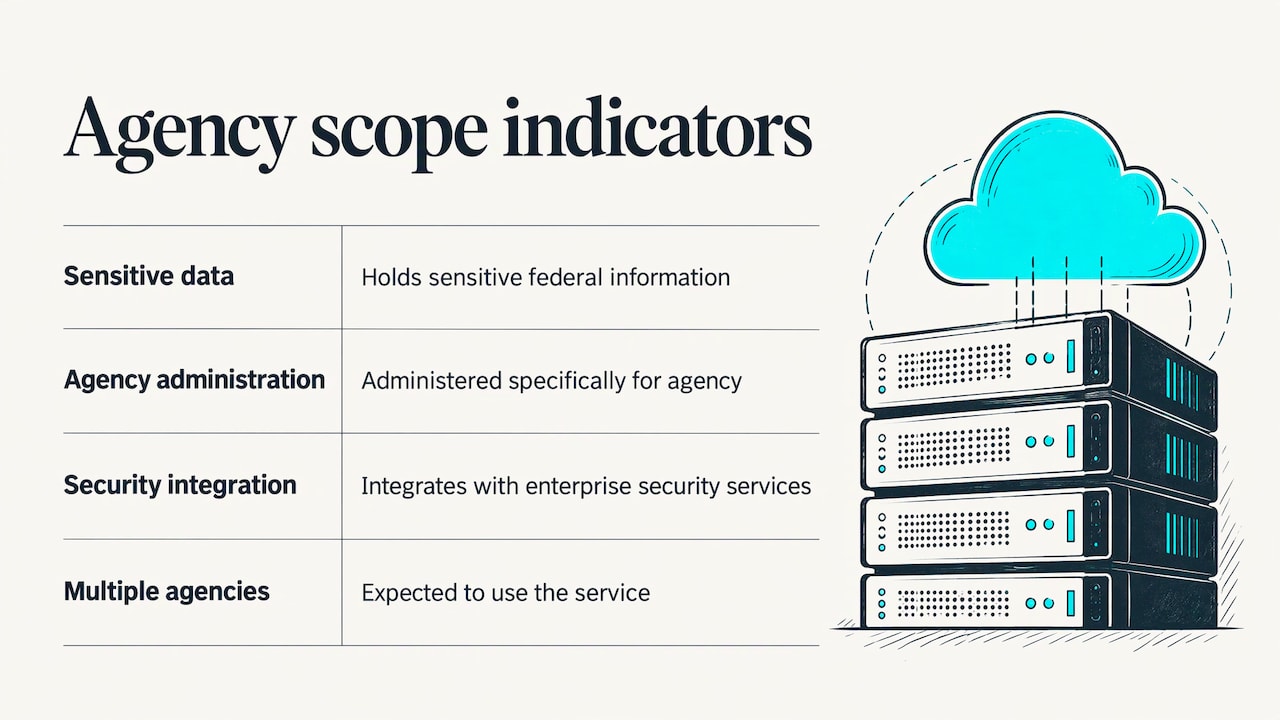
Does the agency consider it in scope? Only a federal agency can determine whether a cloud-service use case falls within FedRAMP. The agency looks at indicators such as whether the service holds sensitive federal information, whether it is administered specifically for the agency, whether it integrates with enterprise security services, and whether multiple agencies are expected to use it. You cannot settle this by reading the rules alone. Ask your buyer.
Is there a buyer? FedRAMP advises providers to have an executive team committed to the process and to be clear about whether the service is operational or still under development, according to its authorization playbook. A sponsoring agency, a signed letter of intent or a funded pilot is the strongest signal that the spend is justified.
A useful rule of thumb: if you cannot name an agency, a program office and a contract vehicle, you are not ready to start. Build your commercial security foundation first. Many founders get further, faster, with a lean ISO 27001 program, which also shortens the road to FedRAMP controls later.
What it costs and how long it takes
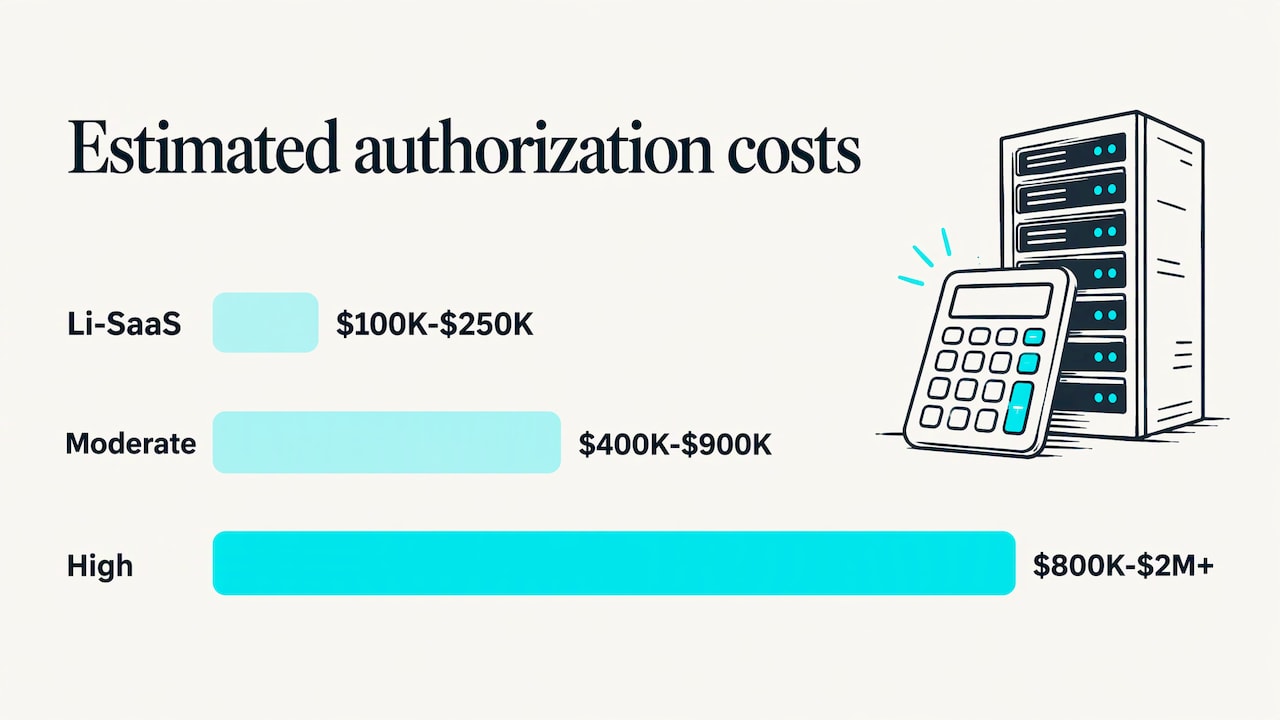
Nobody publishes a single official price, because the work depends on your architecture, your impact level and how much engineering you must do internally. One practitioner estimate for 2026 puts a low-impact SaaS path at 5 to 9 months, and a Moderate authorization at 12 to 18 months. The same source estimates costs at:
| Impact level | Typical timeline | Estimated cost (assessor fees plus internal engineering) |
|---|---|---|
| Li-SaaS (Low impact SaaS) | 5 to 9 months | $100K to $250K |
| Moderate | 12 to 18 months | $400K to $900K |
| High | Longer, case by case | $800K to $2M+ |
Treat these as planning ranges from a vendor-side estimate, not a quote. Your own numbers will move with scope and staffing.
Costs do not stop at authorization. An industry pricing guide estimates that annual continuous monitoring adds roughly 15 to 25 percent of the initial authorization cost each year. Put that line in your model before you commit.
Where startups lose time
The common delays are not mysterious: unclear system boundaries, missing logging and encryption evidence, undocumented policies, and surprises found late in the formal audit. Which brings us to readiness.
Choosing a path: agency, JAB or 20x
The traditional options were a provisional authorization through the Joint Authorization Board or an authorization through a sponsoring agency, as the FedRAMP playbook describes for earlier program versions. For a startup, the agency route has long been the realistic one, because it starts with a buyer who wants your product.
FedRAMP 20x is the newer approach. Per the program’s 20x page, it began as pilots and is now in wide-scale adoption, with Class A (pilot), Class B (Low) and Class C (Moderate) certifications. Class A is aimed at cloud services with mature security and compliance programs that are entering the federal market, and it asks for a small amount of information up front. The official path guide also notes that Class D is planned for 2027.
What this means in practice:
- Check which class matches your data and your buyer’s needs.
- Ask your agency contact which path they will accept. Agency preference still shapes the decision.
- Confirm the current rules on the official FedRAMP site before you budget, because the program is changing quickly.
Your first step: a readiness assessment
A FedRAMP readiness assessment tests whether your service can meet federal security requirements and shows where the gaps are before you start the full process. FedRAMP’s Rev5 agency authorization page describes it as optional but highly recommended, performed by a FedRAMP-recognized third-party assessment organization (3PAO). The current authorization playbook likewise says it can identify security gaps ahead of authorization.
What to prepare before the assessor arrives:
- A clear authorization boundary: which components, data flows and third-party services are in scope.
- A current inventory of assets, interconnections and data types.
- Written policies and procedures that match what your team really does.
- Evidence of access control, encryption, logging, vulnerability scanning and incident response.
- Named owners for each control family.
It is also worth testing one capability that founders overlook: whether you can reconstruct what happened during an incident. Logs that are complete, time-stamped and preserved make audits easier and make your story credible to a federal buyer. Our guide to forensic readiness walks through that groundwork.
After authorization: continuous monitoring
Authorization is the start of a recurring workload. After approval, a provider sends monthly continuous-monitoring deliverables, including an updated plan of action and milestones (POA&M) and vulnerability scan files and reports, and it also submits an annual assessment package, per the playbook.
FedRAMP’s Vulnerability Detection and Response standard also reshapes expectations, with a focus on recurring detection and timely fixes for high-risk weaknesses. Plan for a named owner, a scanning cadence, and a remediation process that engineers will follow without a fire drill.
FedRAMP vs StateRAMP (now GovRAMP)
The short answer: FedRAMP serves federal agencies, while StateRAMP serves state and local buyers. StateRAMP has since been renamed. According to a comparison from a compliance platform, the program rebranded as GovRAMP in February 2025, and it provides security baselines for providers working with state and local governments, tribal governments and educational institutions.
When does a startup need one or both?
- Federal agency buyers only: FedRAMP.
- State, city, county or university buyers only: GovRAMP, if the buyer requires it. Not every state does, so ask.
- Both: sequence them by where your first signed deal comes from, and ask each program how it treats an existing authorization from the other. Check the official GovRAMP and FedRAMP pages for the current reciprocity rules rather than assuming.
The security work overlaps heavily, since both build on NIST-style controls, so evidence you gather for one is rarely wasted on the other.
Our perspective
Most FedRAMP advice treats compliance as a paperwork exercise. In our experience with cybersecurity and AI founders, the harder problem is credibility: a federal buyer must believe your security claims, and your own team must be able to prove them.
That is why we work from digital forensics. Cybertech Acceleration is designed as the only U.S. accelerator dedicated exclusively to digital forensics, and we help founders build judicial-grade evidence capabilities into their products and then explain them in terms a procurement officer or investor understands. Logs, chain of custody and incident reconstruction are not extras. They are the proof layer under every control you will be asked about.
Our advice is to sequence the work. Get a buyer. Get the commercial foundation right. Then spend on FedRAMP with a clear boundary and a clear sponsor. If you are a non-U.S. company, the U.S. market adds a second layer of local setup, introductions and positioning, and we built our soft landing work around that.
Thiago Vieira
A practical sequence for the first 90 days
If you have decided FedRAMP is on your roadmap, this order avoids most wasted spend:
- Weeks 1 to 2: talk to your target agency about scope, impact level and which authorization path it will sponsor.
- Weeks 2 to 4: define the authorization boundary and list every service inside it. Cut what does not need to be there.
- Weeks 4 to 8: map your current controls, find gaps, and fix the cheap ones first: logging, multi-factor authentication, encryption, asset inventory.
- Weeks 8 to 12: book a readiness assessment with a recognized 3PAO and budget for remediation afterward.
- Ongoing: set up monthly scanning and POA&M tracking now, so continuous monitoring is a habit rather than a scramble.
One warning on shortcuts. A company-published estimate says that skipping a formal gap assessment can delay authorization by 6 to 12 months because of remediation found during the audit, and while that figure comes from a vendor, the logic is sound: problems found early cost less than problems found by the auditor.
FAQ
Can a startup get FedRAMP authorized without a federal sponsor?
The agency route has traditionally depended on a sponsoring agency, which is why a named buyer matters so much. Newer 20x classes change how authorization is structured, so check the official FedRAMP site for current requirements and ask your target agency which path it will accept.
How much does FedRAMP cost a startup?
Published practitioner estimates range from about $100K to $250K for a low-impact SaaS path to $400K to $900K for Moderate, including assessor fees and internal engineering. Add roughly 15 to 25 percent of the initial cost each year for continuous monitoring, based on one industry pricing guide.
Is a FedRAMP readiness assessment mandatory?
No. FedRAMP describes it as optional but highly recommended. A recognized 3PAO checks your readiness against federal requirements and identifies security gaps before the full assessment, which usually saves time and rework.
Is StateRAMP the same as FedRAMP?
No. StateRAMP, now called GovRAMP, covers state, local, tribal and education buyers, while FedRAMP covers federal agencies. The controls overlap, but the programs are separate and each has its own process.
Sources
- avoid splitting government and commercial offerings
- multiple agencies are expected to use it
- authorization playbook
- low-impact SaaS path
- annual continuous monitoring
- 20x page
- path guide
- Rev5 agency authorization page
- current authorization playbook
- comparison from a compliance platform