Transfer Impact Assessment: A Founder’s Guide to Doing One

A transfer impact assessment (TIA) is a written check, done before you send personal data from the European Economic Area (EEA) to a country without an EU adequacy decision, that the recipient can really honor the safeguards you signed. If you sell cybersecurity or AI products across the Atlantic, you will meet one in almost every EU enterprise security review. Below: when you need one, the six steps to run it, what to write down, and how the EU-US Data Privacy Framework changes the work.
TL;DR
- A TIA is required when personal data leaves the EEA under an Article 46 tool such as Standard Contractual Clauses (SCCs) or binding corporate rules. It is not required for adequacy-decision countries or Article 49 derogations, according to the French regulator CNIL.
- The assessment is specific to your transfer: the importer, the data, the purpose and the technical setup, not a verdict on a whole country.
- Follow six steps: know the transfer, identify the tool, assess the destination’s laws, add supplementary measures, implement, and reassess.
- Contracts alone rarely suffice. Technical measures such as encryption carry the weight, and if nothing works, the transfer stops.
- A US importer certified under the EU-US Data Privacy Framework (DPF) usually needs no TIA for that transfer, but the framework is being watched, so keep a fallback.
Table of Contents
- What a transfer impact assessment is
- When you need one, and when you do not
- How the EU-US Data Privacy Framework changes the work
- The six steps of a transfer impact assessment
- What to document
- What if the assessment comes out negative
- TIA versus DPIA
- Why this matters for cyber and AI founders
- Our perspective
- FAQ
- Sources
What a transfer impact assessment is
The GDPR restricts moving personal data out of the EEA. Chapter V lets you do it only if the destination is covered by an adequacy decision (the European Commission has formally found the country’s protection essentially equivalent) or if you use a safeguard such as SCCs. In 2020 the Court of Justice’s Schrems II ruling (case C-311/18, 16 July 2020) added a duty: the exporter must check whether the destination country’s laws and practices undermine the safeguard, and suspend the transfer or end the contract if the importer cannot comply.
That check is the TIA. The CNIL’s practical guide defines it as an assessment, documented by the exporter before transfer, of whether the importer can meet its obligations under the chosen tool given local legislation and the practices of public authorities. The term itself is not in the GDPR text. The duty comes from the safeguards requirement, the ruling, EDPB guidance and Clause 14 of the 2021 SCCs.
Two terms to keep straight:
- Exporter: the organization subject to the GDPR that sends the data out. If you are a US SaaS vendor with EU customers, you are usually the importer, and your customer is the exporter.
- Importer: the recipient outside the EEA, which has to supply information so the exporter can finish the assessment.
That second point is why founders care. Your EU customer cannot sign off without your help, and a vendor that hands over a clear, evidence-backed answer clears procurement faster.
When you need one, and when you do not
The rule depends on the transfer tool.
| Situation | TIA needed? |
|---|---|
| Transfer to a country with an adequacy decision, within its scope | No, but monitor that the decision stays valid |
| Transfer under SCCs or binding corporate rules (Article 46) | Yes, before the transfer |
| Occasional, non-repetitive transfer under an Article 49 derogation | No |
| Transfer to a US company certified under the DPF | Generally no extra tool or measures for that transfer |
The CNIL guide confirms a TIA is not needed for adequacy destinations or Article 49 derogations, and warns that adequacy decisions can have limited scope, so you should check the transfer falls inside it. The EDPB’s Recommendations 01/2020 add that Article 49 derogations are only for occasional, non-repetitive transfers, so a product that sends data every day needs a real tool.
The SCCs themselves build the TIA in. Clause 14 requires the parties, before concluding the clauses, to assess whether third-country laws and practices could prevent the importer from complying. The Commission’s SCC Q&A says the assessment must look at the specific circumstances: data categories, type of recipient, sector and length of the processing chain. The EDPB’s SME guide likewise says the SCCs include a requirement to document the transfer, the destination laws and the extra safeguards.
For how this fits the wider picture, our guide to cross-border data transfers for founders covers the transfer tools themselves, and the GDPR plan for SaaS startups covers the surrounding compliance work.
How the EU-US Data Privacy Framework changes the work
The Commission adopted the EU-US DPF adequacy decision in July 2023, after US Executive Order 14086 and an Attorney General regulation. Personal data can flow freely from the EU to US companies that participate in the framework. The Commission also states that the new US national-security safeguards apply to all GDPR transfers to US companies, whatever the mechanism, which helps with SCC-based transfers.
Germany’s federal data protection authority takes the practical view: companies transferring to DPF participants can rely on the adequacy decision without additional Article 46 tools or supplementary measures, while transfers to non-participating US entities still need another Chapter V tool. It adds that the Commission’s assessment of US safeguards can be used inside your own TIA. In practice, that shortens the US-law section of a TIA considerably. For a deeper look at how adequacy shapes data handling, this guide to data privacy for IT decision-makers is a helpful companion.
There is a watch item. On 31 July 2026 the EDPB asked the Commission to assess whether a US Supreme Court ruling on the removal of FTC commissioners affects the framework’s validity, because the FTC’s independence was part of the 2023 assessment. Reporting on the letter stresses that the DPF remains fully in force and that the Commission can monitor, and if needed suspend, amend or repeal the decision. Earlier frameworks, Safe Harbor and Privacy Shield, were struck down by the Court of Justice, so a sensible architecture has an answer ready to the question “what if the DPF falls?” That answer is, in effect, a TIA you have already done.
The six steps of a transfer impact assessment
The CNIL’s January 2025 guide organizes the work in six steps. Here is each one, with where it tends to go wrong.
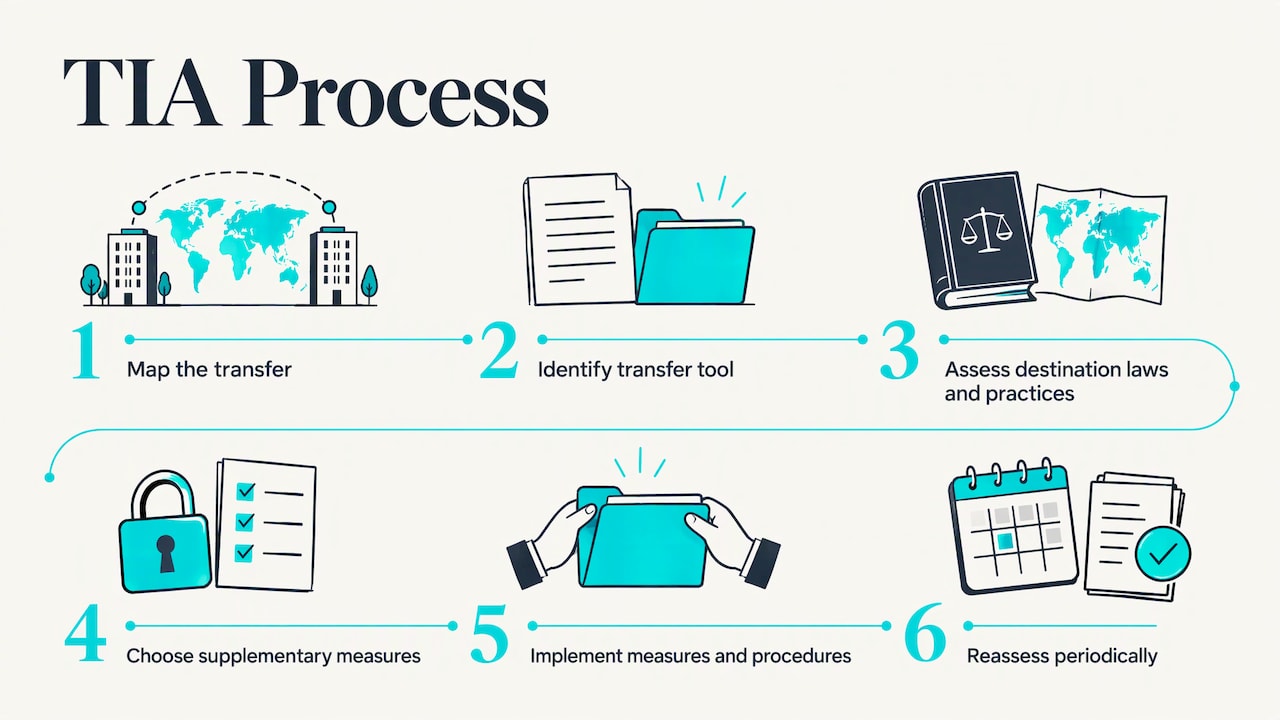
Step 1: Know your transfer
Map every flow: which personal data categories, which data subjects, which systems, which recipients, and every sub-processor in the chain. For a security product this includes telemetry, logs, support tickets, incident data and anything an analyst can view remotely. The common failure is missing remote access: data stored in Frankfurt but viewable by a support engineer in Austin is still a transfer.
Write one line per flow: data, purpose, location, who can read it in clear text, and how long it is kept.
Step 2: Identify the transfer tool
Name the Chapter V basis for each flow: adequacy decision, SCCs, binding corporate rules or a derogation. Only Article 46 tools trigger the assessment. If a US vendor is DPF-certified and the flow is within the certification’s scope, record that and the date you checked.
Step 3: Evaluate the destination’s laws and practices
This is the core. The EDPB wants you to focus on legislation relevant to your transfer and tool, particularly laws on public-authority access for surveillance, tested against the European Essential Guarantees. Where the law is ambiguous or unpublished, rely on objective factors rather than guesses about how likely an access request is, and document everything, because you will be held accountable for the decision.
The importer’s help is essential here. The CNIL says the exporter should ask the importer for an analysis of its legislation on authority access, or at least a list of applicable laws. It also says to use sources that are relevant, objective, reliable, verifiable and public, such as country analyses commissioned by the EDPB and reports from international organizations.
A TIA is not a verdict on a country. It judges this importer, sector, data set and purpose together.
Step 4: Identify and adopt supplementary measures
If the law in Step 3 could stop the importer from honoring the tool, add measures. The Commission’s Q&A names end-to-end encryption as an example of a safeguard that can make a transfer under SCCs compliant after a negative assessment. The CNIL notes that in most cases contractual and organizational measures alone are not enough and must be complemented by properly implemented technical measures.
Practical technical options include:
- Encryption with keys held by the EU customer and not accessible to the provider.
- Pseudonymization where the importer cannot re-identify individuals.
- Splitting processing so no single recipient sees intelligible data.
- Keeping the data in the EEA and limiting remote access to what is truly necessary.
Be careful with cloud and support use cases where the importer needs data in clear text. In the EDPB’s use cases for a cloud provider needing intelligible data and for remote access for shared business purposes, it did not find an effective technical measure that blocks the problematic access while still giving the importer access in the clear. For those flows, consider data residency changes; our data residency strategy guide walks through where to store customer data.
Step 5: Implement the measures and any procedural steps
A measure on paper is not a measure. Turn the decision into configuration: key management set up, access roles restricted, contract clauses signed, a process for handling government access requests (notify the exporter, challenge unlawful requests). The EDPB’s SME guide lists these access-request obligations as part of the SCCs. Keep evidence that each control is live: screenshots, configuration exports, access logs.
Step 6: Reassess at appropriate intervals
The CNIL recommends periodic review, with intervals set case by case by destination and risk, and earlier review when third-country law or practice changes, the importer cannot comply, or the Commission’s assessment changes. Put a calendar trigger on your DPF status, on any CJEU developments and on each new sub-processor.
For practical help structuring the checks in this step, this walkthrough on running a supplier risk assessment shows how to turn findings into a repeatable review.
What to document
The EDPB’s line is that exporters are accountable for the decision they take, so the file matters as much as the conclusion. A defensible TIA record holds:
- The transfer map from Step 1.
- The tool and, for DPF flows, the certification check and date.
- The destination-law analysis with its sources.
- The supplementary measures chosen and why.
- Evidence of implementation.
- The conclusion: proceed, proceed with measures, or stop.
- Opinions from your data protection officer, legal and technical advisers, annexed to the file as the CNIL advises.
- The next review date and the events that trigger an early one.
If you are the importer, keep a short, reusable answer pack: your sub-processor list, encryption design, access-request policy and DPF status. Customers will ask for it again and again.
What if the assessment comes out negative
The Commission’s Q&A is clear. If the Clause 14 assessment is negative, the parties may transfer under SCCs only with supplementary safeguards that ensure compliance. The exporter must suspend the transfer if it considers no appropriate safeguards can be ensured, or if the supervisory authority instructs it to. The same applies if it later learns the importer can no longer comply, including after a change in third-country law. The CNIL puts the end point plainly: where no measure ensures essentially equivalent protection, waive the transfer.
For a product team, that means the TIA can change engineering priorities. It is far cheaper to design customer-held keys or an EU processing region before a large EU deal than to retrofit under a suspension notice.
TIA versus DPIA
A data protection impact assessment (DPIA) looks at the risks a processing activity creates for people, wherever the data goes. A TIA looks at whether Chapter V safeguards survive the move to a specific importer. The same product feature can need both: a DPIA for a high-risk monitoring feature, and a TIA because the vendor’s support team sits in the US. Run the TIA after you know what data the feature really processes, so the two documents agree.
Why this matters for cyber and AI founders
Security and AI products handle exactly the data that makes regulators and buyers nervous: logs, endpoint data, identities, prompts and outputs. A European buyer will ask where it goes and who can read it. A US buyer entering Europe, or a European startup entering the US, will see the question from both sides. If you also compare regimes, our GDPR vs CCPA guide shows how obligations differ.
Our perspective
Most founders treat a transfer impact assessment as a legal form to survive a questionnaire. We see it as product evidence. A buyer who asks where data goes and who can read it is asking whether your design can be trusted, and the strongest answer is one you can prove.
That is the same discipline we push in our program: build proof into the product, not into a slide. Customer-held keys, clear access logs and a documented decision trail are the kind of evidence that holds with US buyers and in court, and they make the TIA a short, factual exercise.
Founders outside the usual hubs often carry these decisions alone. Our small cohorts put them next to exited founders, CISOs and a court-appointed forensic expert, inside a network of 350+ cyber founders, so the question “what do we do if the framework changes?” gets answered once, early, with people who have shipped through it.
Thiago Vieira
FAQ
Is a transfer impact assessment a legal requirement?
The words “transfer impact assessment” are not in the GDPR, but the duty is real. It follows from the safeguards requirement, the Schrems II ruling and Clause 14 of the 2021 SCCs. If you transfer under an Article 46 tool, the CNIL says the assessment must be done before the transfer.
Do I need a TIA if my US vendor is in the Data Privacy Framework?
Generally not for that transfer. The German federal authority says DPF participants can receive data on the adequacy decision without additional tools or supplementary measures. Confirm the certification covers your data type and keep a note of the check date and a fallback plan.
How often should a TIA be updated?
There is no fixed number. The CNIL says intervals depend on the destination country and risk level, and an earlier review should follow a change in law, an importer’s inability to comply or a change in the Commission’s assessment.
Is a TIA the same as a DPIA?
No. A DPIA assesses risks from the processing itself. A TIA assesses whether transfer safeguards hold up in the destination country. One feature can require both.
Sources
- according to the French regulator CNIL
- Article 49 derogations are only for occasional, non-repetitive transfers
- the specific circumstances: data categories, type of recipient, sector and length of the processing chain
- a requirement to document the transfer, the destination laws and the extra safeguards
- can flow freely from the EU to US companies that participate in the framework
- without additional Article 46 tools or supplementary measures
- guide to data privacy for IT decision-makers
- the DPF remains fully in force
- third-country law or practice changes, the importer cannot comply, or the Commission’s assessment changes