Digital Forensics for Startups: Build Evidence Buyers Trust

For a startup, digital forensics is two things at once. It is the discipline you rely on when something goes wrong inside your company, and it is a product quality that US buyers increasingly test: can your tool produce evidence that survives scrutiny, even in court? If you build cybersecurity or AI products and want to sell in the US, the second meaning is where differentiation lives. This guide covers both, in the order a founder meets them. At Cybertech Acceleration, a cybersecurity-only accelerator, we build our program around that second meaning.
TL;DR
- Digital forensics establishes what happened from digital evidence while preserving its integrity and chain of custody. Incident response contains and recovers. You need both, and they must not trample each other.
- Startups usually meet forensics through a departing employee, business email compromise, a breach, or a dispute over who sent or changed what.
- What you do in the first hours (preserve, hash, log who touched what) decides whether the evidence is usable later.
- US courts now audit the reliability of an expert’s method before a jury hears it, so evidence-grade design in your product is a sales argument.
- Our program runs November to March for a $3,000 fee and no equity, and ends with a Texas Mission during SXSW.
Table of Contents
- What digital forensics is, and how it differs from incident response
- When a startup needs digital forensics
- Preserving evidence without a forensics team
- Tools, expertise and the in-house question
- The founder’s second question: can your product produce proof?
- Selling forensic-grade products across borders
- A worked example: the departing engineer
- How our program fits
- Our perspective
- FAQ
- Sources
What digital forensics is, and how it differs from incident response
NIST’s 2022 framework document defines digital forensics as applying science to identify, collect, examine and analyze data while preserving its integrity and maintaining chain of custody. Chain of custody is simply the written record of who held the evidence, when, and what they did with it.
Incident response is the operational side: stopping an attack, containing the damage and restoring normal operations. NIST notes that incident response can include a forensic investigation. The practical difference is the question each asks. Responders ask “how do we stop this?” Forensic investigators ask “what exactly happened, and can we prove it?”
The two collide in small companies. A founder who wipes and reimages a compromised laptop to get back to work has just destroyed the memory and logs an investigator would need. IBM’s DFIR guidance makes the same point: when the two run separately, responders can alter evidence while removing a threat, and investigators can delay resolution. Running them as one coordinated effort lets collection happen alongside containment.
If you have no written plan for this yet, a short incident response steps for small teams outline is a good baseline, and our own guide to incident response forensic readiness covers the legal and technical side.
When a startup needs digital forensics
You do not need a forensics lab. You need to recognize the moments when ordinary IT cleanup becomes an evidence problem. Practitioner write-ups consistently list the same situations:
- A departing employee takes data. Forensics can show USB copies, personal cloud syncs and emails to personal addresses, as one US firm’s scenario list describes.
- Business email compromise. The question is how the attacker got in, what mailbox rules were set, and what timeline you can hand to your bank, insurer or law enforcement.
- Ransomware or a breach. You need to know which systems and records were reached, because that drives state-law notification and insurance claims.
- A dispute over what was sent or changed. Verified extraction of messages and files holds up far better than editable screenshots.
- Suspected fraud, IP theft or deletion of records. A UK investigations firm adds that evidence can show who accessed an account, when, and whether files were created, changed, copied or deleted. It also notes that conclusions are limited by the condition of the evidence, retention periods and anything done before preservation.
That last caveat is the founder’s lesson. The quality of an investigation is capped by what you did in the first hour.
Preserving evidence without a forensics team
The Chartered Institute of Investigators’ general principles for digital evidence are a solid, professional-body standard. Translated into a startup routine:
- Identify and preserve promptly. List the sources that may matter: laptops, phones, cloud accounts, mailboxes, chat tools, logs. Touch them as little as possible.
- Document everything. Record the collection method and every person who handled the evidence.
- Hash at collection. A hash is a fixed-length fingerprint of a file. Compute it the moment you collect, and store it securely.
- Keep a chronological custody record. Each entry names the item, its source, who collected or received it, the date and time, and the method.
- Work on copies. Examine duplicates and secure the originals.
- Write a useful report. It should document what was done, explain the conclusions and include recommendations.
Two refinements matter for technical founders. First, volatile data such as memory disappears on reboot, so collect memory and fast-overwriting logs before or during containment. Second, a hash only proves integrity from the moment it was recorded. As one investigation guide stresses, it does not prove the content is true, who wrote it, or that collection was complete. A good report separates account activity from attribution to a person, and says plainly what could not be answered.
For a deeper technical walk-through, see our chain of custody guide for digital evidence. If you are preparing before anything happens, our forensic readiness guide for cyber startups turns the list above into a checklist you can adopt now.
If you also need to show auditors that your controls produce records, automated evidence collection is worth understanding: it keeps compliance evidence flowing without manual screenshots.
Tools, expertise and the in-house question
The toolset is well known. Commercial suites include EnCase, FTK, Magnet AXIOM, X-Ways and Cellebrite; open-source options include Autopsy, The Sleuth Kit, Volatility, Wireshark and the SANS SIFT Workstation, according to Bitdefender’s cyber forensics overview. It adds that tools should be tested on known datasets and that organizations that rarely do this work commonly use managed services.
The cost logic is the same one law enforcement faces. A 2024 Major Cities Chiefs Association white paper observes that in-house forensics takes significant time and money, and that outsourcing can save cost on infrequent tasks and speed resolution. It also warns that an outside party’s chain-of-custody records may not match local standards. For a startup, the lesson is to agree on how evidence is handled before you need it, so an outside examiner’s records and yours line up.
A hybrid works for most early teams: your own people handle first-hour preservation, and a specialist handles the deep analysis and any testimony.
The founder’s second question: can your product produce proof?
If you build security or AI software, forensics is also a feature. Your customers will face incidents, audits and disputes, and they will ask whether your tool’s logs, detections and AI outputs can be trusted as evidence.
The US legal standard makes that question sharper. According to Law & Forensics, Federal Rule of Evidence 702 was amended on December 1, 2023: the party offering expert testimony must show it is more likely than not that the rule’s requirements are met, including that the opinion reflects a reliable application of methods to the facts. In practice, a court examines the specific opinion about the specific evidence before the jury hears it. The same source advises experts to avoid claims of absolute certainty and be ready to discuss error rates.
For product design, that translates into concrete requirements:
- Reproducible collection: another examiner can repeat your method and get the same result.
- Integrity controls: hashing and tamper-evident logging from the point of capture.
- Documented error rates and limits, especially for AI-assisted findings.
- Exportable records that fit a custody log.
There is also a procedural shortcut worth knowing. The 2017 additions to the Federal Rules of Evidence, Rules 902(13) and 902(14), allow a certification from a qualified person to authenticate machine-generated records and hash-verified copies without live testimony. A product that produces records in that shape saves its customers real legal effort.
Our view is that this is one of the clearest ways for a young company to stand apart in a crowded security market. Most competitors claim detection speed. Few can say their output holds up under cross-examination.
Selling forensic-grade products across borders
If you are a European or international founder aiming at the US, or a US company looking at Europe, rules diverge by region, and each region shapes what buyers ask for.
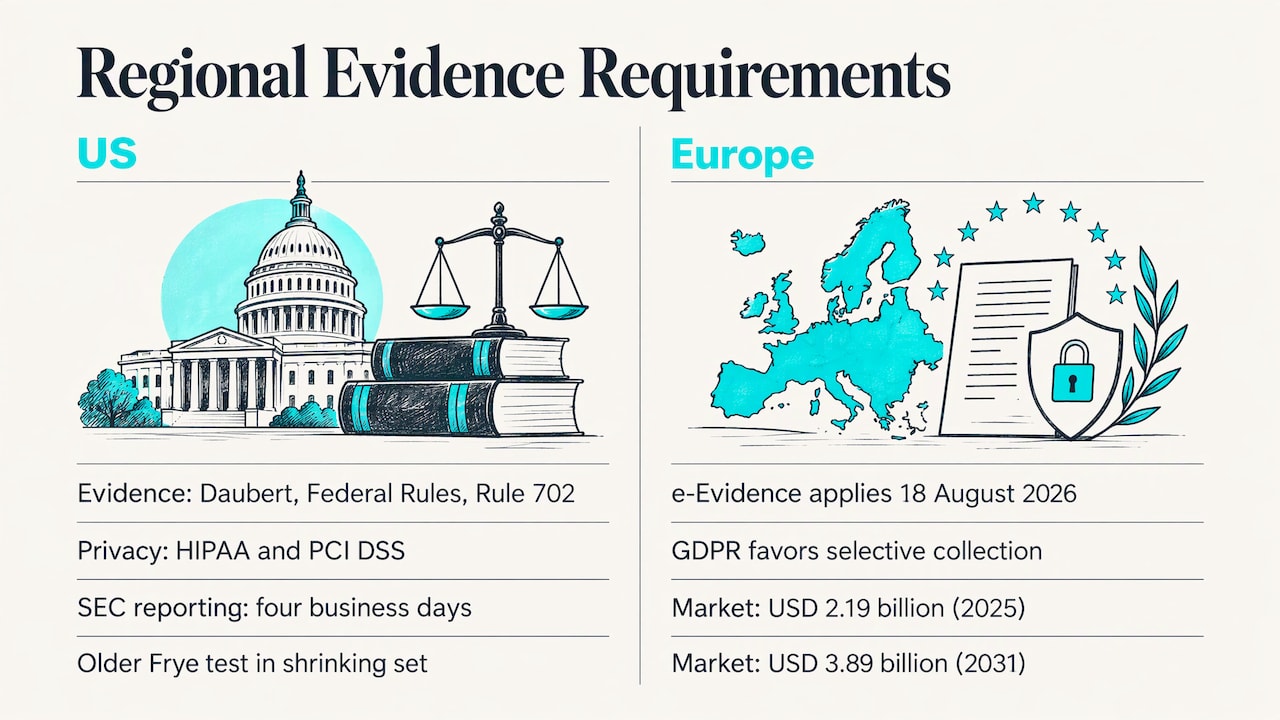
In the US, the Daubert standard and the Federal Rules of Evidence require scientifically sound methods and a solid chain of custody, and privacy and security regimes such as HIPAA and PCI DSS affect how sensitive data is handled, per Bitdefender. Federal courts apply Rule 702 as read through Daubert, while a shrinking set of states still use the older Frye “general acceptance” test, according to Legal Cyber Academy. Reporting clocks add pressure: the SEC’s 2024 cyber-disclosure rule requires material-incident reporting within four business days, which pushes buyers toward tools that reconstruct timelines quickly.
In Europe, the EU e-Evidence package is the big change. Mordor Intelligence reports that Regulation (EU) 2023/1543 applies from 18 August 2026 and that in-scope providers must designate an EU establishment or appoint a legal representative. It sees procurement needs for preservation workflows, provider-response tooling and audit-ready chain of custody. The same report values the European digital forensics market at USD 2.19 billion in 2025, growing to USD 3.89 billion by 2031, with the top five vendors holding about 48% of revenue. It also notes that GDPR limits are pushing demand toward selective-collection software that flags personal data instead of copying whole disks.
Admissibility across borders is still worked out case by case. Eurojust’s monitor records an Estonian Supreme Court ruling of 16 January 2025 that presumes evidence collected abroad was lawfully obtained, while courts must still assess reliability, and may ask for more verification the easier the content is to influence.
The takeaway for a founder: build one evidence model rigorous enough for the stricter reading in each market, then adapt the legal wrapper. For the distinction between collecting data for litigation and examining it forensically, our note on eDiscovery versus digital forensics helps, and if your team is based in Israel, our US go-to-market guide for Israeli cybersecurity startups covers entry.
A worked example: the departing engineer
Imagine a six-person security startup. Your lead engineer resigns on a Friday, and on Monday you notice a large export from the code repository the previous week.
The tempting move is to wipe the laptop, hand it to a new hire and start reading logs on the live system. Do the opposite. Leave the laptop powered as found if memory might matter, and note the time. Suspend the engineer’s accounts without deleting them. Export repository and cloud audit logs, hash each export and record the hashes with the date, time and your name. Write the custody entry before anything else is touched.
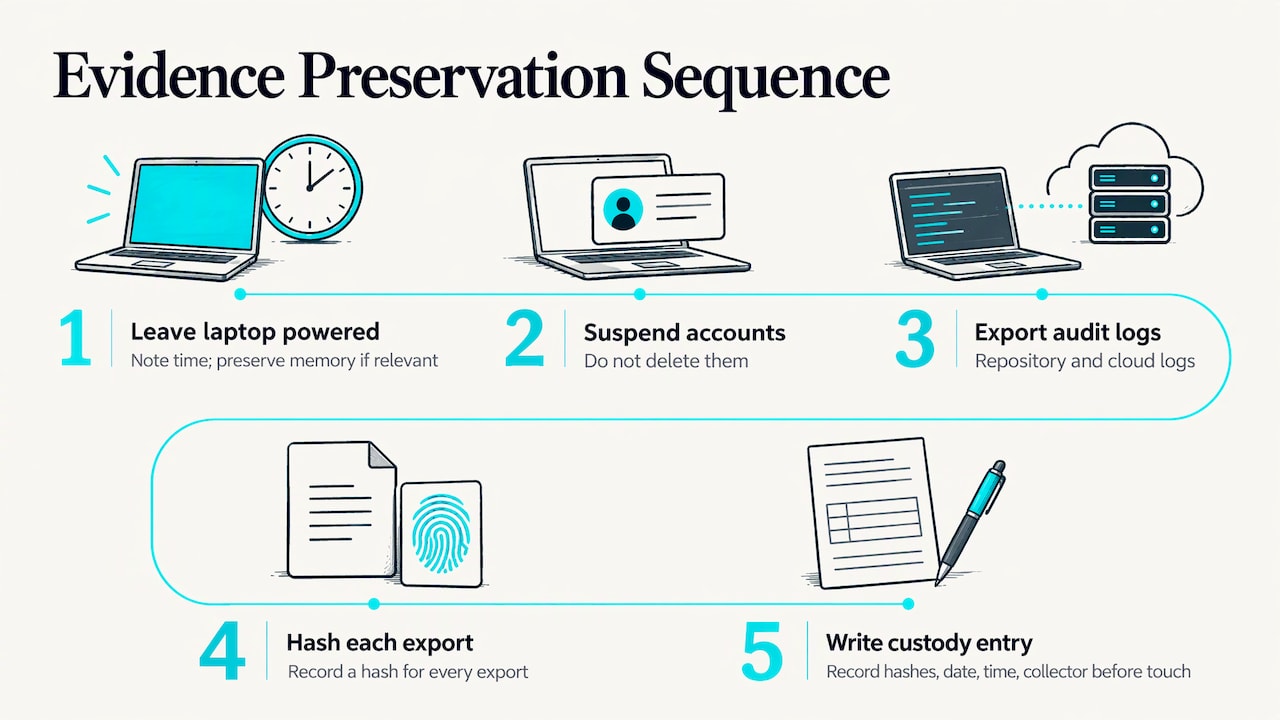
A specialist can then examine copies and answer the questions that matter: what was copied, to which destination, and when. The report should say what the logs show and what they cannot show, such as intent. If a dispute follows, you have a record in the shape a court expects. If none does, you have lost an afternoon. The asymmetry is the argument for doing it right the first time.
How our program fits
We run Cybertech Acceleration as a cybersecurity-only program for solo and early-team founders. From November to March, exited founders, CISOs, MSSPs and a court-appointed digital forensics expert help founders decide on co-founder, first hires, pricing and US market entry, and build evidence-grade proof into their products that holds up with US buyers and in court. Introductions run through a network of portfolio companies, alumni and 350+ cyber founders. Since 2025, our founders have generated €600K+ in investment and new revenue.
The fee is $3,000, with no equity.
The program closes with an in-person Cybertech Texas Mission during SXSW. If you are building for the US from outside it, our soft landing support covers structured entry, and we have market-specific pages for Portuguese, UK, German and Israeli cyber startups.
Our perspective
Most founders we meet treat forensics as something you buy after a breach. We think that is backwards for a security company. The founders who win US buyers are the ones whose product already speaks the language of evidence: capture that is reproducible, integrity that can be shown, and honest statements about what the data does and does not prove.
That is hard to do alone. A solo founder is deciding on a co-founder, a first hire, pricing and a market, and evidence design tends to slip to the bottom of the list. Our program puts a court-appointed digital forensics expert in the same room as exited founders and CISOs, so those decisions are made together and the proof is built in from the start.
The US legal bar has moved toward scrutinizing method before a jury hears anything. A product designed for that bar is easier to sell, easier to defend and harder to copy. That is the differentiation we help founders build.
Thiago Vieira
FAQ
Does a small startup really need digital forensics?
You need the habits, not a lab. Preserve before you clean up, hash what you collect, and keep a custody record. Bring in a specialist when the matter involves a breach, suspected theft or a potential dispute.
What is the difference between digital forensics and incident response?
Incident response contains an attack and restores operations. Digital forensics establishes what happened from preserved evidence. NIST notes that incident response can include a forensic investigation, so the two should be planned together.
What is the first thing to do after a suspected incident?
Stop changes to the affected systems where you safely can, and record what you see with times. Collect volatile data such as memory and logs before rebooting or reimaging, and hash everything you collect. If customer data or legal exposure is involved, talk to your attorney early.
Why does forensic-grade evidence help a security startup sell in the US?
US courts examine the reliability of an expert’s method before admitting testimony, following the 2023 amendment to Rule 702. Buyers who may one day rely on your product’s output want it to be reproducible and well documented.
Sources
- applying science to identify, collect, examine and analyze data while preserving its integrity and maintaining chain of custody
- IBM’s DFIR guidance
- one US firm’s scenario list
- A UK investigations firm
- professional-body standard
- collect memory and fast-overwriting logs before or during containment
- one investigation guide
- Bitdefender’s cyber forensics overview
- 2024 Major Cities Chiefs Association white paper
- Law & Forensics
- 2017 additions to the Federal Rules of Evidence
- SEC’s 2024 cyber-disclosure rule
- Mordor Intelligence
- Estonian Supreme Court ruling of 16 January 2025