Austin Cybersecurity Ecosystem: A Founder’s Guide for 2026
Austin’s cybersecurity ecosystem is a dense mix of venture-backed startups, University of Texas research labs, a handful of security-focused investors and a state government that is building its own cyber capacity. For a founder, the value is in how these pieces connect: you can find talent, early capital and buyers within a few miles, but you still have to earn trust with US buyers one reference at a time. That is where a cybersecurity-only accelerator such as Cybertech Acceleration helps: it brings exited founders, CISOs and MSSPs around your product decisions and ends with an in-person Texas Mission during SXSW.
TL;DR
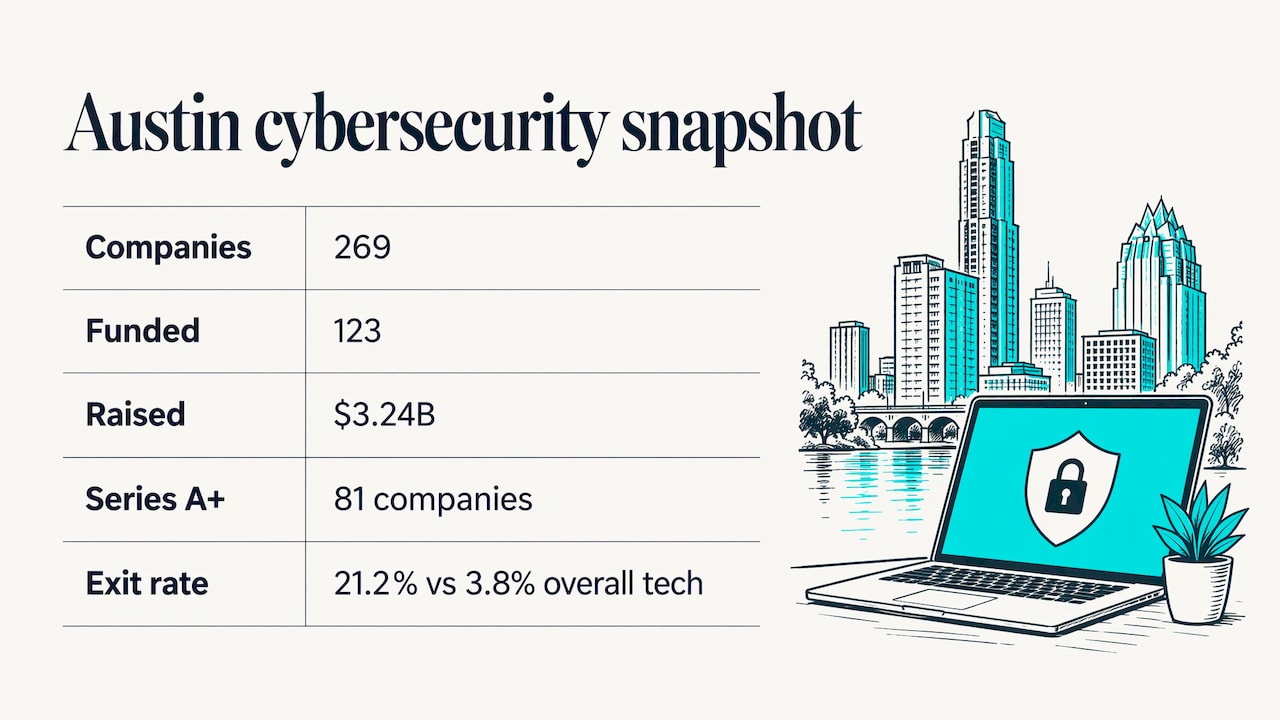
- Austin counted 269 cybersecurity companies in Tracxn’s November 2026 report, 123 of them funded, with $3.24B raised in total.
- Strengths cluster around AI security, identity and privacy, and government-facing platforms, backed by UT Austin research.
- Funding is lumpy: a few large rounds dominate, so a founder should read the market as a network of people, not a headline total.
- International founders should decide what Austin must prove for them (buyers, partners, credibility) before they move anything.
- Our program runs November to March for a $3,000 fee with no equity, and closes with the Texas Mission during SXSW.
Table of Contents
- What the Austin cybersecurity ecosystem is made of
- Who is building what: AI security, identity and government platforms
- Reading the numbers without overreading them
- What to settle before you build a position in Austin
- Using Austin as a route into the US market
- If you are a US company looking at Europe
- Promo: a cybersecurity-only program ending in Texas
- Perspective
- FAQ
- Sources
What the Austin cybersecurity ecosystem is made of
Think of it in four layers: companies, research, capital and public-sector demand. Each feeds the others.
Companies. Tracxn’s November 1, 2026 report lists 269 Austin cybersecurity companies. Of these, 123 have raised money (a combined $3.24B in venture capital and private equity), 81 are at Series A or later, and the sector has seen 55 acquisitions and 2 IPOs. Tracxn puts the exit rate at 21.2%, against 3.8% for tech overall. For a founder, that exit rate means there are people in town who have built and sold security companies, and that is the kind of experience that shortens your learning curve.
Research. The University of Texas at Austin supplies much of the intellectual base. The Center for Identity leads interdisciplinary work on identity security and privacy, including projects that map identity assets and predict identity threats. The Spark Research Lab in electrical and computer engineering works on secure systems from architecture to compilers, and has published recent work on threats to compound AI systems and retrieval-augmented language models.
Capital. A small group of local investors is focused on security. The Austin Infosec Founders directory names Runtime Ventures, Silverton Partners, LiveOak Ventures and S3 Ventures among them. If your seed round is on the horizon, these are worth researching before you arrive.
Public-sector demand. Texas is investing in cyber as a state function. The Texas Cyber Command’s 2026 Cybersecurity Report says responsibility for the Regional Security Operations Center program moved to the Command in 2025. Centers at UT Austin, Angelo State and UT Rio Grande Valley give up to 150 students each semester hands-on experience, and as of September 25, 2026 the network’s preventive services had reached at least 1,975 public entities across 248 counties. That is a signal of how much attention state and local government pays to security, and of a talent pipeline forming around it.
Who is building what: AI security, identity and government platforms
The most visible theme is AI security. HiddenLayer, based in Austin, raised a $100M Series B in September 2026 led by Delta-v Capital. Its CEO said annual recurring revenue grew more than 10x over the past year, with over 90% of the growth from new customers, and that the company plans to expand into Europe and EMEA. The same report cites Gartner’s estimate that companies will spend $2.83B in 2026 on products that secure AI tools, rising to nearly $4.78B in 2027.
Other Austin names in the AI-security space, per the local founders directory, include Eve Security (a runtime firewall for AI agents), DryRun Security (AI-code security review), Perpetual Systems (AI SOC triage) and Riscosity (a data firewall for AI flows).
Government-facing platforms are the second theme. Wraithwatch, founded in 2023 and listed in Overmatch’s 2026 Austin Deep Tech 50, builds an AI-driven cybersecurity control plane for government and critical industry. The list says it was selected in February 2026 for a $30M federal contract to deploy across multiple US agencies. A seed-stage company winning at that scale shows a path for newcomers: a sharp wedge, a credible team and a buyer who needs proof.
The third theme is identity and privacy, anchored by the UT research above. If your product touches identity, trust scoring or privacy, you are building next to people who study these questions for a living.
Reading the numbers without overreading them
Founders often cite one funding figure and move on. Look at several, and look at their dates.
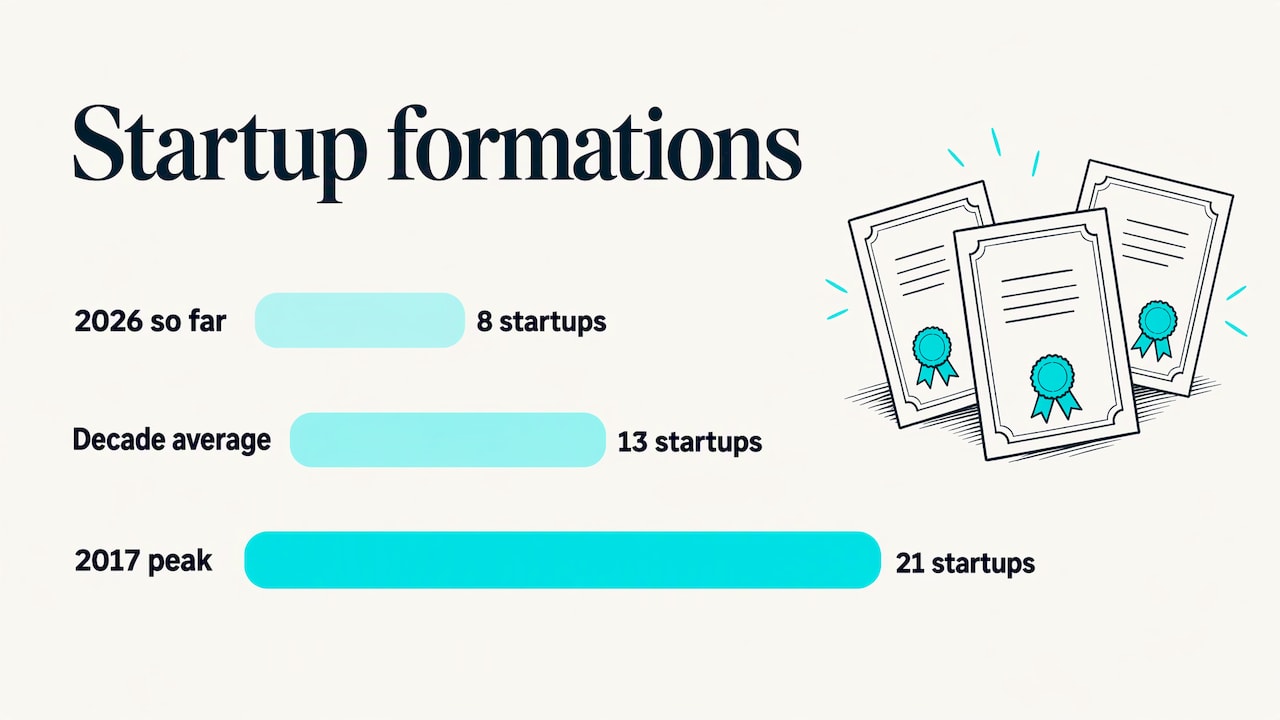
- Tracxn’s November 2026 data shows 8 new Austin cybersecurity startups founded so far in 2026, against an average of 13 a year over the past decade, with 2017 the peak at 21.
- The same report shows $132M in equity funding across 6 rounds through September 2026, versus $387M across 12 rounds through September 2025, a drop of 65.82%.
- Ten-year funding exceeded $2.61B, peaking above $864M in 2021.
These figures are published for specific periods and are revised as the database updates, so check the live report when you read this. The pattern matters more than any single number: capital concentrates in a few large rounds, and fewer new companies are forming. For an early founder, that suggests the investors who remain active are selective, and that a clear position and real proof carry more weight than a good story.
The local labor market adds context. The Dallas Fed’s December 2025 report on the Austin metro says more than half of adults 25 and older hold at least an undergraduate degree, against 34% in Texas, and that employment in professional, scientific and technical services grew 35.5% from December 2019 to December 2024. A UT study by Elsie Echeverri attributes Austin’s high-tech growth to continuous migration of skilled workers, with California consistently the top out-of-state source since 1990. In practice, hiring here means competing for people who often arrive from elsewhere, which also means many of them know how to join an early-stage team.
What to settle before you build a position in Austin
A local ecosystem helps only if you know what you are asking of it. Three questions do most of the work.
Who is the buyer, and who holds the budget?
American Cybersecurity Founders’ analysis of product-market fit describes buyer-product fit as solving a problem the practitioner cares about in a way the budget holder approves. Many technically strong products fail because they persuade one and not the other. Write down both people, and what each needs to see.
What do customers say when you are not in the room?
Positioning begins with evidence: your three to five happiest customers, the alternative they would use without you (often a spreadsheet or a manual process) and the outcomes they name in their own words. Signals that you are on track include customers pulling your roadmap, renewing, referring peers and describing your value back to you. If you have no customers yet, your first task is twenty conversations with people who already spend money or time on the problem.
What proof will a US buyer accept?
US buyers, and the lawyers behind them, ask whether your product’s output can be trusted and defended. This is where we spend much of our time with founders: building evidence-grade proof into the product so it holds up with US buyers and in court. In Austin’s government-facing and regulated segments, that kind of credibility is a differentiator that a feature list rarely matches.
Using Austin as a route into the US market
For a founder outside the US, Austin is attractive because the ecosystem is concentrated and reachable. You can meet investors, buyers and fellow founders in one trip, and SXSW each March draws the wider tech community to the city. But the move itself needs structure. Before you commit, assess:
- Entry goal. Are you looking for pilots, a channel partner, a seed round, or all three? Each points to different people in the ecosystem.
- Funding stage. Know what investors expect at your stage. A guide to the stages of startup funding helps you match your story to the round you are raising.
- Legal and compliance setup. Entity, contracts, data handling and US-specific buyer requirements should be planned before the first pilot, not after.
- Proof. Reference customers and evidence-grade results travel better than slides.
- Team. Decide who among the founders is the face of the US effort, and whether your first hire is local.
We have written country-specific guides for founders who come from where our community is strongest: French cybersecurity companies, UK startups and Brazilian startups. Our US market entry playbook covers the general sequence.
If you are a US company looking at Europe
The flow runs both ways. HiddenLayer’s stated plan to expand into Europe and EMEA shows that Austin companies see Europe as the next step after US traction. If that is you, the questions mirror those above: which country first, which partners (MSSPs and integrators) can validate demand, and how your product fits into a customer stack that already contains many tools. Start with one market and a few partners rather than a continent. Our network includes founders and MSSPs across Europe, and we can introduce you to people who have made the crossing from the other side.
Promo: a cybersecurity-only program ending in Texas
Cybertech Acceleration is built for solo and early-team cyber founders who carry big decisions alone, or who have a co-founder and still feel alone. Between November and March, exited founders, CISOs, MSSPs and a court-appointed digital forensics expert help you decide on a co-founder, first hires, pricing and US market entry. You get introductions inside a network of portfolio companies, alumni and 350+ cyber founders. The fee is $3,000, with no equity. Since 2025, our founders have generated €600K+ in investment and new revenue.
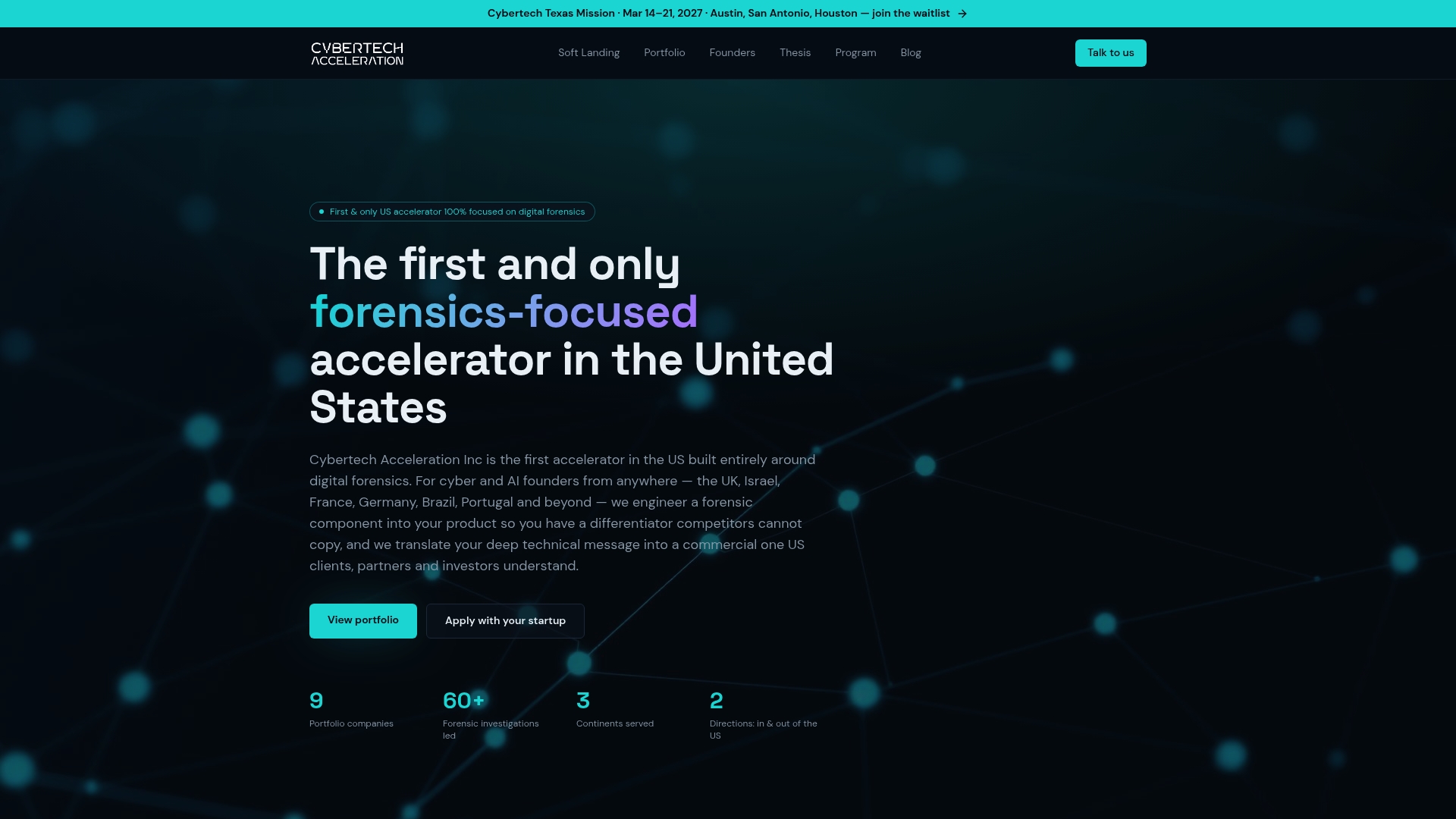
The program closes with the in-person Cybertech Texas Mission during SXSW, where Austin’s ecosystem stops being a list and becomes people you meet. You can see how the program works and how to apply on our site.
Perspective
Most founders who look at Austin ask where the money is. We think the better question is who will vouch for you. A buyer in the US wants to know that your product’s results will stand up when something goes wrong, and that someone credible has seen you work.
That is why our program pairs founders with exited founders, CISOs, MSSPs and a court-appointed digital forensics expert, and why we put evidence-grade proof into the product itself. Pricing, first hires and the co-founder question are decisions a solo founder should not make in isolation. A small cohort and a cybersecurity-only focus mean those conversations are specific to your product.
The Texas Mission during SXSW exists so that the ecosystem described in this article becomes a set of introductions. We built it for founders from outside the usual hubs, in Brazil, Portugal and across Europe, who are building for the US.
Thiago Vieira
FAQ
Is Austin a good city for a cybersecurity startup?
It offers a large pool of cybersecurity companies, UT Austin research, security-focused investors and a state government investing in cyber. Tracxn’s November 2026 data counts 269 companies, with 55 acquisitions recorded. Whether it fits you depends on your buyer and your stage.
Which Austin cybersecurity startups are worth watching?
HiddenLayer (AI security), Wraithwatch (a control plane for government and critical industry), Eve Security, DryRun Security, Perpetual Systems and Riscosity are named in the sources above. Check the live databases for current stage and funding, since these change often.
Do I need to relocate to Austin to sell in the US?
Not necessarily at the start. Many founders begin with a structured entry plan, targeted introductions and a short, focused trip. Our Texas Mission during SXSW is designed as that first in-person step.
What does Cybertech Acceleration cost?
The program fee is $3,000, with no equity. It runs from November to March and ends with the Texas Mission.
Is the program only for founders in the US?
No. It is built for solo and early-team cyber founders, including those outside the usual hubs, such as in Brazil, Portugal and Europe, who are building for the US market. US companies looking at Europe can also draw on our network.
Sources
- 269 cybersecurity companies in Tracxn’s November 2026 report
- Center for Identity
- Spark Research Lab
- Austin Infosec Founders directory
- 2026 Cybersecurity Report
- $100M Series B in September 2026
- Overmatch’s 2026 Austin Deep Tech 50
- December 2025 report on the Austin metro
- UT study by Elsie Echeverri
- guide to the stages of startup funding