Selling to CISOs: How Cyber Founders Win the Deal
A CISO (chief information security officer, the executive who runs a company’s security program) does not buy your product. They buy a closed gap: less risk, time back and a decision they can defend to a board or an auditor. If you are a founder selling into the US, your job is to show that outcome with proof a skeptical buyer can verify, and to do it for a whole buying committee, not one person. This guide covers what CISOs prioritize in 2026, how a purchase actually moves, and what earns trust in a first meeting.
TL;DR
- CISOs buy outcomes, not features. Frame your product as a risk reduced, in dollars and probability where you can.
- Buying is slow and crowded: a seven-month average cycle, vendors contacted before the shortlist, and several sign-offs behind the CISO.
- Evidence of delivery for similar businesses is the strongest lever. Lack of it is the top reason vendors are rejected.
- Verifiable artifacts (assessments, certifications, advisories) build more trust than claims.
- Outreach works through warm peers and useful insight, not volume.
Table of Contents
- What a CISO is actually buying
- What CISOs are prioritizing in 2026
- How the purchase really moves
- The CISO is not the only buyer
- Proof beats promises
- Speak in dollars and probability
- Outreach that earns a reply
- Selling from outside the US hubs
- FAQ
- Sources
What a CISO is actually buying
A CISO develops and leads the information security program: protecting systems and data, building processes to prevent, detect and recover from attacks, and continuously assessing risk. That is the job description. The working reality is more commercial.
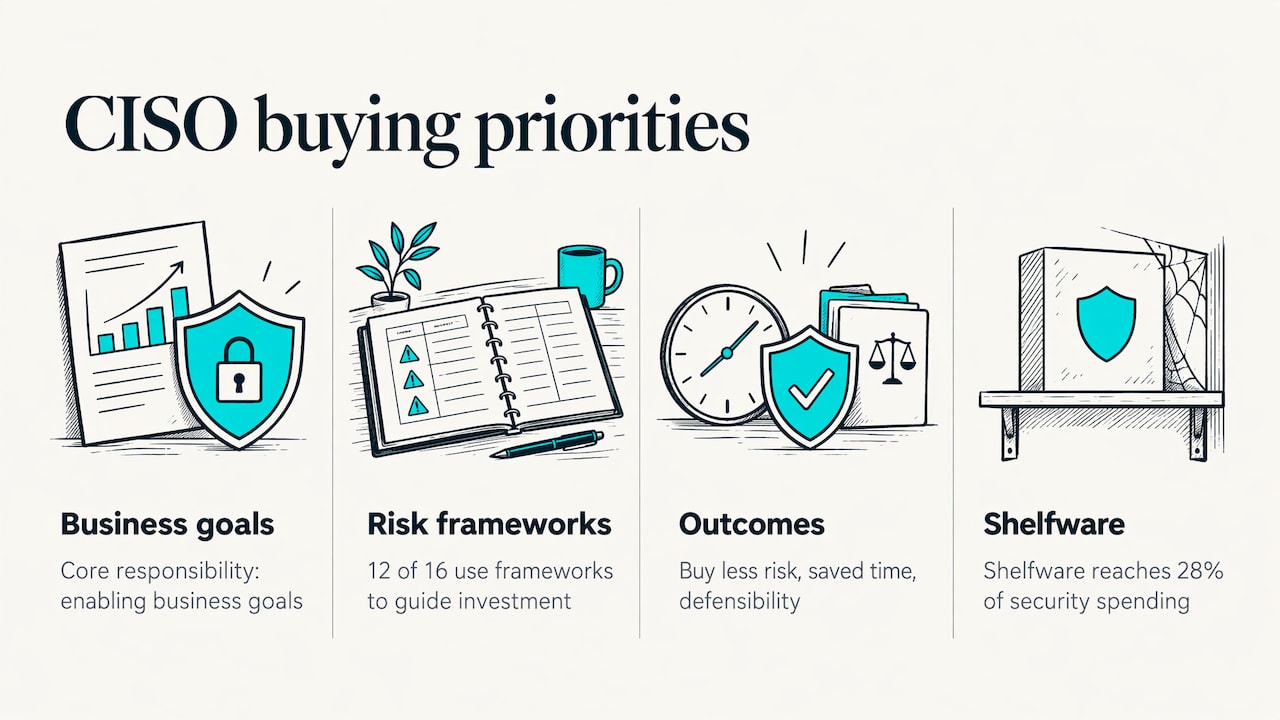
A 2025 peer-reviewed study of 16 CISOs published at the ACM CHI conference found that their core responsibility is enabling business goals rather than maximum security. Twelve of the 16 used risk assessment frameworks such as risk registers to decide where to invest, and because security is usually a cost center, they have to build business cases for senior leadership. Some lead with the compliance requirement when asking for funding, because nobody argues with it.
For you, that means the CISO is already translating security into business language before you walk in. If your pitch makes them do the translation, it loses to one that does it for them.
Senior CISOs interviewed by Expert Insights put it bluntly: they buy outcomes, not products, meaning less risk, time saved and defensibility. The same piece cites Osterman Research data putting shelfware at up to 28% of security spending, which is why a CISO is wary of anything that needs heavy effort to deploy and then sits unused.
What CISOs are prioritizing in 2026
Priorities decide which conversations get a calendar slot. Several 2026 surveys point in similar directions, though they measure different things:
- Foundry’s Security Priorities Survey, reported by CSO Online in January 2026, found that strengthening data protection was the top priority for 48% of security chiefs. Cloud data security, simplifying security infrastructure, threat intelligence, compliance and privacy, and reducing spending also made its top ten.
- Evanta’s 2026 survey of more than 1,600 CISOs found that enabling and protecting AI is the top initiative, followed by assessing and managing cyber risk and optimizing security tools and services. Respondents align to NIST and to regulations such as NIS2 and the Cyber Resilience Act.
- In an April 2026 survey of 500 senior cybersecurity decision-makers in the US, UK, France and Germany, the top technology needs were cloud environments (51%), endpoint security (45%) and identity and access management (42%), with AI systems and governance at 38%.
- Proofpoint’s 2026 Voice of the CISO reports that 78% of CISOs see GenAI as a security risk and 79% name human risk as their biggest vulnerability.
Two things follow. First, “simplify” and “reduce spending” sit next to “protect AI” on the same list, so a product that adds capability without adding operational weight is easier to place. Second, if you sell to AI-driven or AI-adjacent problems, you are in the most active budget conversation of the year. These figures are survey results for their stated periods, and they shift with each new release, so check the latest edition before you quote one in a deck.
How the purchase really moves
Founders often picture a CISO meeting followed by a decision. The data says otherwise. The April 2026 survey above found an average of seven months from need identification to vendor selection: 15% decided in under three months, 40% in three to six, 29% in six to twelve, and 15% took more than a year.
Two more findings shape your plan:
- 65% of buyers contact vendors before the shortlist stage: 25% at discovery, 40% at longlisting, 27% at shortlisting and only 9% at purchase. Being present early matters more than pushing late.
- Top information sources for both awareness and selection are direct peers, industry analysts and industry events. Cold outreach is not on that list.
So the early job is to be findable and credible where peers talk, and to stay responsive. Slow answers to queries were a rejection reason for 37% of buyers in the same survey.
For the mechanics of building pipeline across that long cycle, our guide to the B2B cybersecurity sales funnel for startups walks through the stages, and LinkedIn lead generation for cybersecurity founders covers the peer-visible channel.
The CISO is not the only buyer
Behind most CISOs sit several people who can say no. GatherHQ’s 2026 technology buying report found multiple sign-offs are common, from 73% of security leaders to 81% of technical evaluators. Sophos and Vanson Bourne found that only 1% of organizations say the board or senior leadership play no role in cybersecurity purchasing, in a survey of 5,000 IT and security decision-makers across 17 countries.
Gartner’s 2026 guidance goes further for AI: it says CISO-only sales approaches will stall under cross-functional AI risk, and that vendors need multithreaded plays that address both the CISO’s operational reality and the shared responsibility of the wider executive team.
In practice, prepare three versions of the same story:
- For the CISO: the risk closed, the effort to run it, the integration cost.
- For the engineers who test it: architecture, data handling, failure modes.
- For legal, finance and the board: liability, compliance evidence, cost against the loss avoided.
The CISO’s engineers often shape the verdict before you reach the executive, so treat them as first-class buyers. If your product touches AI governance, a role-by-role view of AI governance shows how different stakeholders see compliance, audit and access needs, which helps you write each version.
Proof beats promises
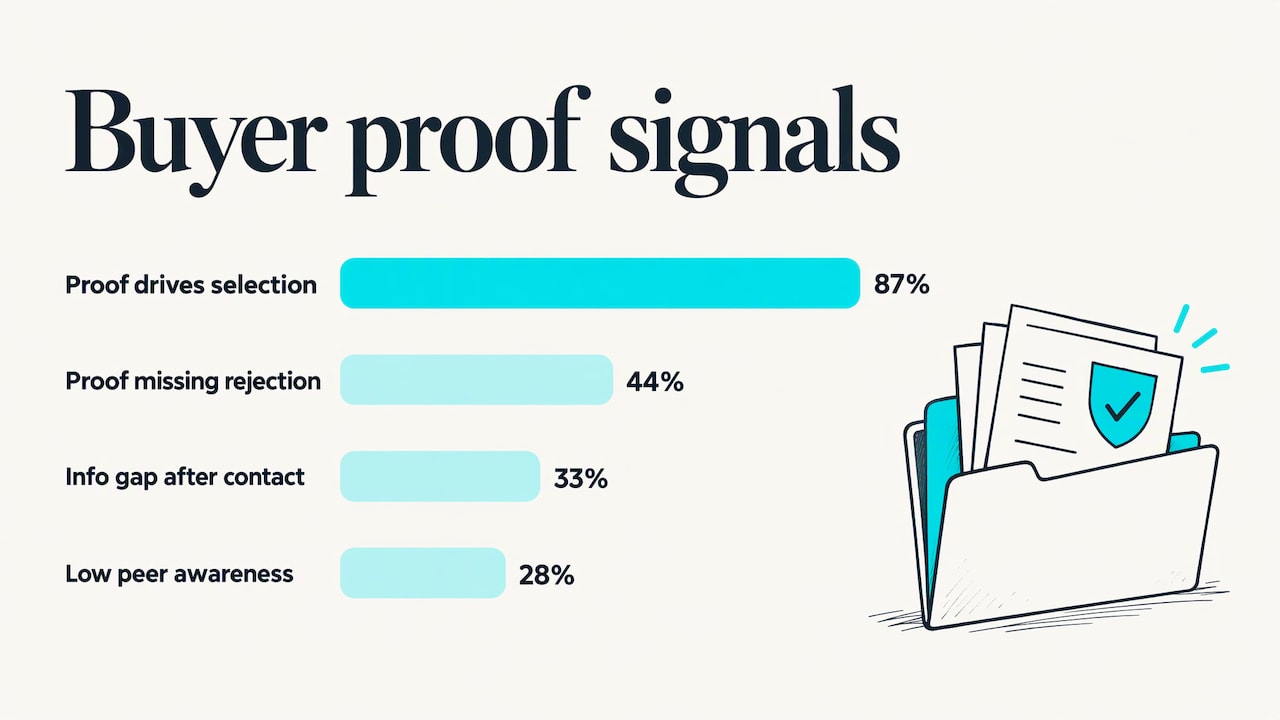
The most useful number in the 2026 data is the one about evidence. In the April 2026 survey, evidence of delivery for similar businesses was cited as a selection attribute by 87% of buyers, and lack of that proof was the leading rejection reason, at 44%. Lack of relevant information after first contact (33%) and low peer awareness (28%) followed.
GatherHQ found that security or compliance assessments are the most-weighted evidence for security leaders (45%), well above the share for IT leaders, and that trials rank at 32 to 35% across roles.
Trust is the underlying problem. In the Sophos study, only 5% of IT leaders said they have full trust in their cybersecurity vendors, and 79% find it hard to assess a new vendor’s trustworthiness. What ranked highest as a trust driver for both leadership and IT teams was verifiable artifacts of cybersecurity maturity: bug bounty programs, public trust centers, advisories with remediation details, third-party assessments and certifications.
For a young company with few logos, this is the opening. You may lack a customer list, but you can build artifacts a buyer can inspect. That is where forensic-grade evidence matters: a product that produces records which hold up under scrutiny gives a CISO something concrete to show an auditor, or a court. We explain the idea in why forensic-grade proof sells cybersecurity in the US.
A proof checklist to have ready before the first serious call:
- Two or three reference stories from similar-sized buyers in the same industry, with a measured result.
- Third-party assessment or certification status, stated plainly.
- A short security review of your own company: how you handle customer data, how you disclose vulnerabilities.
- Sample outputs a skeptical engineer can open and test.
Speak in dollars and probability
The CISO has to win budget from people who do not read threat reports. Fractional CISO founder Rob Black advises expressing risk the way a board hears it, for example a 10% chance of a $5 million loss rather than “high risk”.
A worked example for a detection startup: instead of “we reduce dwell time”, write “if an intruder stays undetected for weeks in a mid-size customer, the exposure is X; in your trial, our median detection time was Y; the difference is the loss you avoid.” The numbers must be your own measured ones. A CISO who can lift your sentence straight into a board slide has a reason to champion you.
Metrics matter after the sale too. The 2026 NASCIO-Deloitte study of US state technology leaders notes that without metrics it is hard to show the benefits of security investments and recommends tracking operational, compliance and risk-based indicators such as incident response time. Build those reports into your product, and the renewal conversation is half won.
Outreach that earns a reply
CISOs are flooded, and the ranking pages on this topic agree on little except that volume fails. What works is narrower:
- Start with a warm path. Peers are the top information source, so an introduction from someone the CISO trusts outperforms any sequence.
- Lead with something they can use. A finding about a threat pattern in their sector, a short benchmark, or a clear point of view on a regulation they face.
- Time it to a trigger. Breaches, audits, board directives and new budgets start buying cycles.
- Do not exploit fear. Rushing out with a pitch right after a public breach reads as ambulance chasing. If you need to prepare your own messaging for such moments, a cyber crisis playbook for leaders is a useful frame for how organizations communicate under pressure.
- Be honest about limits. Vanson Bourne’s 2026 research observes that building confidence and reducing uncertainty is becoming as important as product capability, because security decisions face closer inspection than almost any other business area.
If you are a solo founder carrying sales yourself, see how to sell to CISOs from the buyer’s side and, when you are ready to add people, building your first cybersecurity sales team.
Selling from outside the US hubs
The pattern above is harder when your team sits in Lisbon, São Paulo, Tel Aviv or Berlin and your buyer sits in Dallas or New York. Peer references, events and analyst awareness are all local to the buyer, and a seven-month cycle is long to carry on a small runway. Foreign founders need US-recognizable proof, a US presence in time zones and paperwork, and introductions that substitute for a reputation built over years. The same applies in reverse for US companies entering Europe, where NIS2 and the Cyber Resilience Act now frame what European CISOs ask for.
FAQ
How long does it take to sell to a CISO?
Expect months, not weeks. An April 2026 survey of 500 decision-makers in the US, UK, France and Germany found an average of seven months from identifying a need to selecting a vendor. Plan your runway and your pipeline around that, and keep responding quickly through the whole period.
Do CISOs take cold calls and cold emails?
Rarely with success. Peers, analysts and industry events are the top sources buyers use to learn about and choose vendors, so introductions and visible credibility do more than cold volume. If you do reach out, lead with an insight about their sector and a one-sentence reason the conversation matters to them.
What are CISOs prioritizing in 2026?
Surveys point to data protection, AI protection and governance, cyber risk management, cloud security and simplifying security tools. Foundry’s survey reported by CSO Online put data protection first for 48% of security chiefs, while Evanta’s survey put enabling and protecting AI at the top. Check each survey’s latest edition, since figures update with every release.
What makes a CISO reject a vendor?
In the April 2026 survey, the top rejection reasons were no evidence of delivery for similar businesses (44%) and slow responses to queries (37%), followed by a lack of relevant information after first contact (33%). All three are fixable before the first call with reference stories, a response routine and a ready information pack.
Who else do I need to convince besides the CISO?
Engineers who test the product, plus legal, finance and often the board. Sign-offs from several roles are common, so prepare a version of your case for each one, with evidence the others in the chain can understand.
Sources
- develops and leads the information security program
- enabling business goals rather than maximum security
- buy outcomes, not products
- strengthening data protection was the top priority for 48% of security chiefs
- enabling and protecting AI is the top initiative
- cloud environments (51%), endpoint security (45%) and identity and access management (42%)
- 78% of CISOs see GenAI as a security risk
- multiple sign-offs are common, from 73% of security leaders to 81% of technical evaluators
- survey of 5,000 IT and security decision-makers across 17 countries
- CISO-only sales approaches will stall
- role-by-role view of AI governance
- without metrics it is hard to show the benefits of security investments
- building confidence and reducing uncertainty is becoming as important as product capability